Cr18MoV is a high-carbon Chinese stainless steel that delivers 440C-level performance at a noticeably lower cost. With roughly 0.9% carbon and 18% chromium, it holds a keen edge, resists rust well, and sharpens easily—three reasons it has become the default mid-range steel for brands like Civivi, Kizer, and Artisan.
For OEM knife manufacturers and private label buyers, 9Cr18MoV sits in a sweet spot: a clear upgrade over 8Cr13MoV without the price jump to VG-10 or premium powder steels. In this guide, we break down its composition, performance data, best applications, and sourcing considerations.
What is 9Cr18MoV steel?

9Cr18MoV is a high-carbon martensitic stainless steel produced to Chinese GB standards. The name decodes directly from its chemistry: “9” stands for roughly 0.9% carbon, “Cr18” for 18% chromium, and “MoV” for the molybdenum and vanadium additions. It is widely regarded as the Chinese counterpart to 440C, with a nearly identical composition and performance profile.
The steel hardened its reputation in the 2010s as Chinese knife brands moved upmarket. Civivi built much of its early lineup on 9Cr18MoV, and Kizer, Artisan, and CJRB followed. One insider detail worth knowing: Artisan’s proprietary AR-RPM9 steel is, per Knife Steel Nerds’ analysis, a spray-formed version of 9Cr18MoV with a trace of cobalt. Production blades typically run 58–60 HRC, with the best heat treatments reaching 60–61 HRC.
Today the steel anchors a large share of China’s mid-range knife output. Along with 3Cr13 and 1.4116, the Cr-series stainless grades account for the vast majority of Chinese kitchen knife production, which means 9Cr18MoV benefits from mature mills, stable strip supply, and heat-treatment know-how built over millions of blades. For buyers, that maturity shows up as consistent lead times and predictable quality.
Chemical composition of 9Cr18MoV
| Element | % | Role |
|---|---|---|
| Carbon (C) | 0.85–0.95% | High carbon for hardness and edge retention |
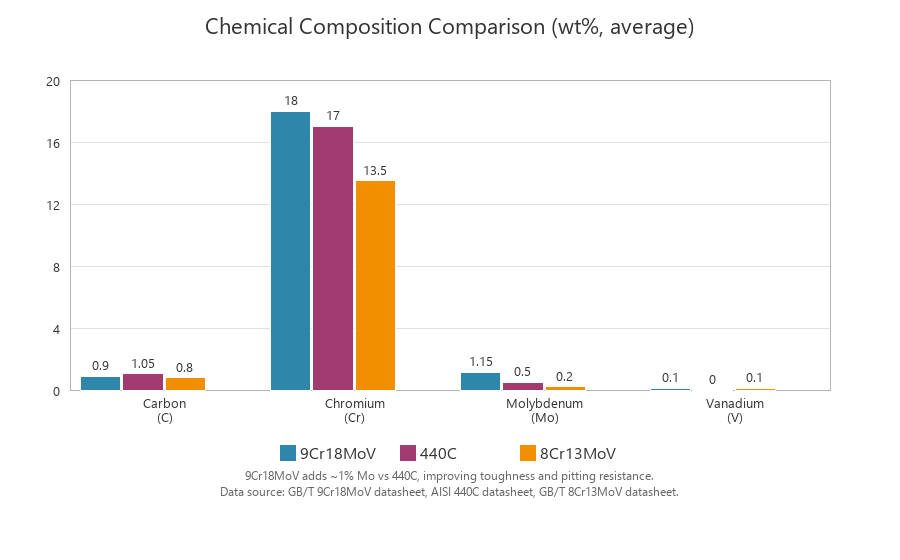
| Chromium (Cr) | 17.00–19.00% | Well above the stainless threshold; core rust protection |
| Molybdenum (Mo) | 1.00–1.30% | Improves toughness, strength, and pitting resistance |
| Vanadium (V) | 0.07–0.12% | Forms hard carbides for wear resistance |
| Manganese (Mn) | ≤0.80% | Hardenability and deoxidation |
| Silicon (Si) | ≤0.80% | Deoxidation and strength |
| Nickel (Ni) | ≤0.60% | Slight toughness boost |
| Phosphorus (P) | ≤0.035% | Controlled impurity |
| Sulfur (S) | ≤0.03% | Controlled impurity |
Data source: GB/T 9Cr18MoV technical datasheet
The formula tells a simple story: near-440C chemistry, tuned for mass production. The 17–19% chromium comfortably clears the stainless threshold, and even after chromium carbides form, enough free chromium remains to protect the blade in daily use. The molybdenum addition—about 1%—is what separates 9Cr18MoV from cheaper 9Cr18 variants, improving both toughness and resistance to pitting corrosion.
A 2026 metallurgical study measured 9Cr18MoV at roughly 20.8% carbide volume, versus just 2.7% in 3Cr13. That carbide density explains both its solid edge retention and its limits: those chromium carbides are what wear slowly, but they also cap the steel’s toughness.
Performance Analysis of 9Cr18MoV Steel
Performance Overview
| Performance Indicator | Score | Notes |
|---|---|---|
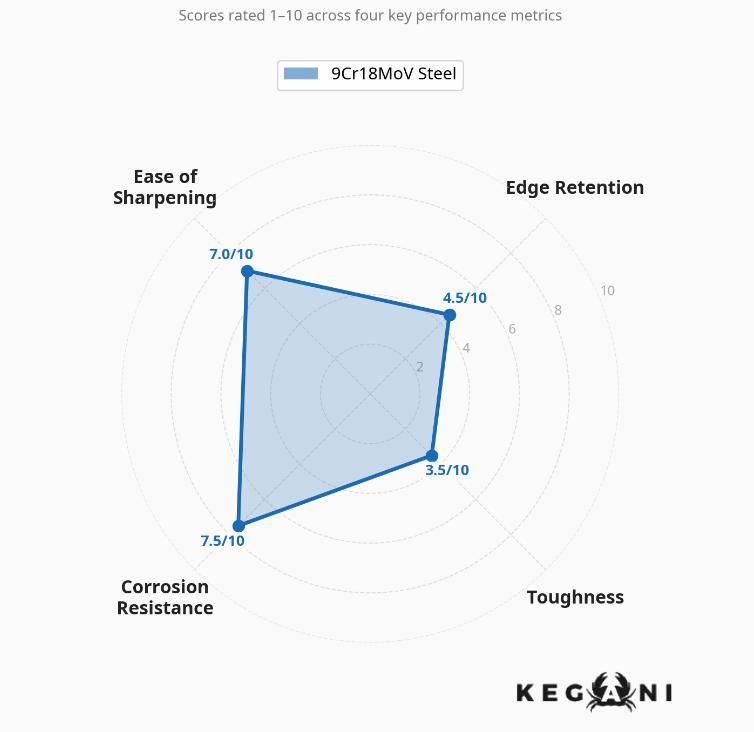
| Toughness | 3.5/10 ★★★☆☆ | Adequate for slicing; not for impact work |
| Edge Retention | 4.5/10 ★★★★☆ | Strong for the price; beats 8Cr13MoV clearly |
| Corrosion Resistance | 7.5/10 ★★★★☆ | True stainless; handles kitchens and humidity |
| Ease of Sharpening | 7.0/10 ★★★★☆ | Easy on standard stones; no diamonds needed |
| Hardness (HRC) | 58–60 | Best balance at 59–60 HRC |
Data source: Knife Steel Nerds steel ratings and production heat-treatment data
Toughness
Toughness is 9Cr18MoV’s weakest metric. At 3.5/10, it matches 440C and D2 but falls well behind 8Cr13MoV (6.0/10) and tough stainless steels like 14C28N (9.0/10). Knife Steel Nerds testing puts this family of steels at around 6 ft-lbs of impact energy at 59 HRC—fine for cutting, risky for prying or batoning.
For product designers, the practical takeaway is geometry: keep blades at moderate edge angles (around 18–20 degrees inclusive performs best per recent cutting research) and avoid marketing this steel for chopper-style hard use.
Corrosion Resistance
With 17–19% chromium, corrosion resistance is a genuine strength. The 7.5/10 score means 9Cr18MoV shrugs off sweat, humidity, food acids, and wet outdoor conditions with basic care. It clearly outperforms semi-stainless D2 (4.5/10) and edges past 8Cr13MoV (7.0/10).
For kitchen knife lines and EDC folders sold into humid climates, this level of rust protection translates directly into fewer customer complaints and returns.
Edge Retention
Edge retention is where 9Cr18MoV earns its price premium over budget steels. Its 4.5/10 score matches 440C and VG-10, and sits a full 1.5 points above 8Cr13MoV (3.0/10). In practical terms, a 9Cr18MoV blade stays working-sharp noticeably longer when cutting cardboard, rope, or food.
In CATRA-style abrasive testing, it performs on par with 440C and VG-10, as the identical scores suggest.
It still trails true wear-resistance steels like D2 (5.0/10) and premium options like MagnaCut (5.0/10) or S30V. But in the sub-$80 knife segment, 4.5/10 edge retention combined with easy sharpening is a compelling package.
Start Working with a Professional Now
Ease of Sharpening
Despite its carbide content, 9Cr18MoV scores 7.0/10 for ease of sharpening. Standard water stones, ceramic rods, and guided systems all work well, and most users can restore a keen edge in a few minutes. It is noticeably easier to sharpen than 154CM (5.0/10) or S90V, though not quite as effortless as 8Cr13MoV (8.0/10).
This matters for after-sales experience: end users who can maintain their own edges rate knives higher and return them less.
Hardness Range
| Application | Recommended HRC | Reasoning |
|---|---|---|
| Kitchen knives | 59–60 HRC | Edge stability plus stain resistance |
| EDC folders | 58–60 HRC | Balance of retention and toughness |
| Outdoor/hunting knives | 58–59 HRC | Slightly softer for impact margin |
| Scissors and grooming tools | 56–58 HRC | Toughness over peak hardness |
The steel heat-treats predictably at scale—typically austenitized around 1050–1060°C, air or oil quenched, and tempered near 200°C. That forgiving window is one reason large factories can hold tight HRC tolerances across big batches, which is exactly what OEM buyers need.
9Cr18MoV vs Other Steels
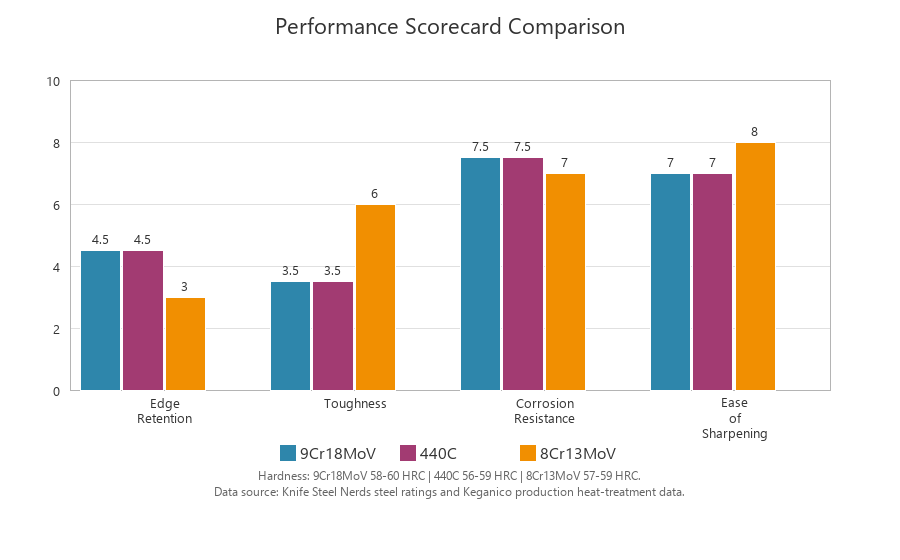
9Cr18MoV rarely wins any single category outright. Its value is the combination: 440C-level edge retention and corrosion resistance, at Chinese supply-chain pricing. Here is how it stacks up.
| Steel | Toughness | Edge Retention | Corrosion | Ease of Sharpening | Best For |
|---|---|---|---|---|---|
| 9Cr18MoV | 3.5/10 | 4.5/10 | 7.5/10 | 7.0/10 | Mid-range stainless all-rounder |
| 440C | 3.5/10 | 4.5/10 | 7.5/10 | 7.0/10 | Equivalent American classic |
| 8Cr13MoV | 6.0/10 | 3.0/10 | 7.0/10 | 8.0/10 | Budget entry-level knives |
| D2 | 3.5/10 | 5.0/10 | 4.5/10 | 6.0/10 | Wear resistance on a budget |
| VG-10 | 4.0/10 | 4.5/10 | 7.5/10 | 7.0/10 | Japanese kitchen knives |
| 14C28N | 9.0/10 | 3.0/10 | 8.5/10 | 9.0/10 | Tough, rust-proof kitchen blades |
Data source: Knife Steel Nerds steel ratings and Keganico production data
9Cr18MoV vs 440C
These two are functionally twins. Composition, hardness, and all four performance scores are effectively identical, and most users could not tell them apart in a blind test. The real differences are supply chain and cost: 9Cr18MoV comes from Chinese mills at a lower price point, while 440C carries an American steel name some customers recognize. For a deeper look, see our 440C steel guide and the 8Cr13MoV vs 440C breakdown.
9Cr18MoV vs 8Cr13MoV
This is the comparison that defines most OEM product ladders. 9Cr18MoV trades a step of toughness (3.5 vs 6.0) for a big jump in edge retention (4.5 vs 3.0) and slightly better corrosion resistance. Think of 8Cr13MoV as the entry tier and 9Cr18MoV as the $10–$20 retail step-up. See our full 8Cr13MoV steel review for the budget baseline.
9Cr18MoV vs D2
D2 wins on edge retention (5.0 vs 4.5) but loses badly on corrosion resistance (4.5 vs 7.5) and sharpening ease. Choose 9Cr18MoV for kitchen, EDC, and humid-market products; choose D2 only when maximum wear resistance justifies the extra maintenance. Our 8Cr13MoV vs D2 guide covers the same trade-off logic.
9Cr18MoV vs VG-10
VG-10 is marginally tougher and carries Japanese-steel marketing cachet, but the performance gap is small (4.0 vs 3.5 toughness; identical 4.5 edge retention and 7.5 corrosion scores). VG-10 costs more and usually runs 59–61 HRC. For premium kitchen lines the VG-10 story may justify the premium; for value-driven EDC, 9Cr18MoV wins on cost.
9Cr18MoV vs 14C28N
14C28N is the opposite philosophy: extreme toughness (9.0/10) and corrosion resistance (8.5/10) with modest edge retention (3.0/10). For thin-ground kitchen knives that see daily abuse, 14C28N is arguably better. For users who sharpen infrequently, 9Cr18MoV’s higher wear resistance wins.
Best Uses & Limitations
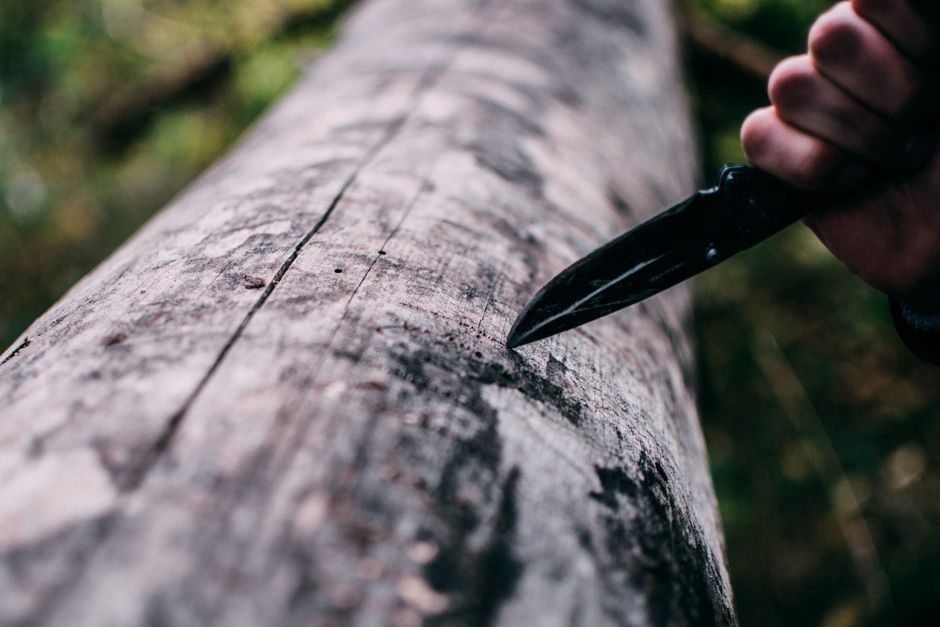
1. Kitchen Knives
9Cr18MoV is a workhorse kitchen steel. It takes a keen edge, resists food acids and repeated washing, and holds that edge through weeks of home cooking. Together with 3Cr13 and 1.4116, it accounts for a large share of China’s kitchen knife output—which means mature supply and competitive pricing for kitchen knife programs.
2. EDC Folding Knives
This is the steel’s home turf. Civivi’s best-selling folders proved that 9Cr18MoV delivers a “premium feel” at a $40–$70 retail price: good slicing, easy maintenance, and no rust anxiety. For EDC knife lines, it is the default mid-tier choice.
3. Hunting and Outdoor Knives
For fixed blade knives used for skinning, food prep, and camp tasks, 9Cr18MoV performs well—its corrosion resistance handles blood and wet conditions better than carbon steels. Keep designs slicing-focused; it is not the right steel for chopper-style blades.
4. Scissors and Precision Cutting Tools
Beyond knives, the steel is widely used in scissors, grooming shears, and surgical-style instruments, where its hardness, wear resistance, and stain resistance all matter. Barbershop shears and kitchen scissors are natural line extensions: brands expanding beyond knives into multi-tool or grooming categories can standardize on the same steel supply and the same heat-treatment program.
Limitations
- Hard-use and chopping: The 3.5/10 toughness score rules out batoning, prying, and survival-style abuse. Choose 80CrV2, 5160, or CPM-3V class steels instead.
- Maximum edge retention: For premium lines promising long sharpening intervals, step up to D2, S30V, or MagnaCut.
- Ultra-thin Japanese-style edges: The coarse-ish chromium carbides limit how fine an edge stays stable; 14C28N or VG-10 behave better at highly acute angles.
- Premium brand storytelling: Knowledgeable buyers know it is a 440C equivalent; it supports “great value” positioning, not luxury pricing.
Cost Analysis & Market Positioning
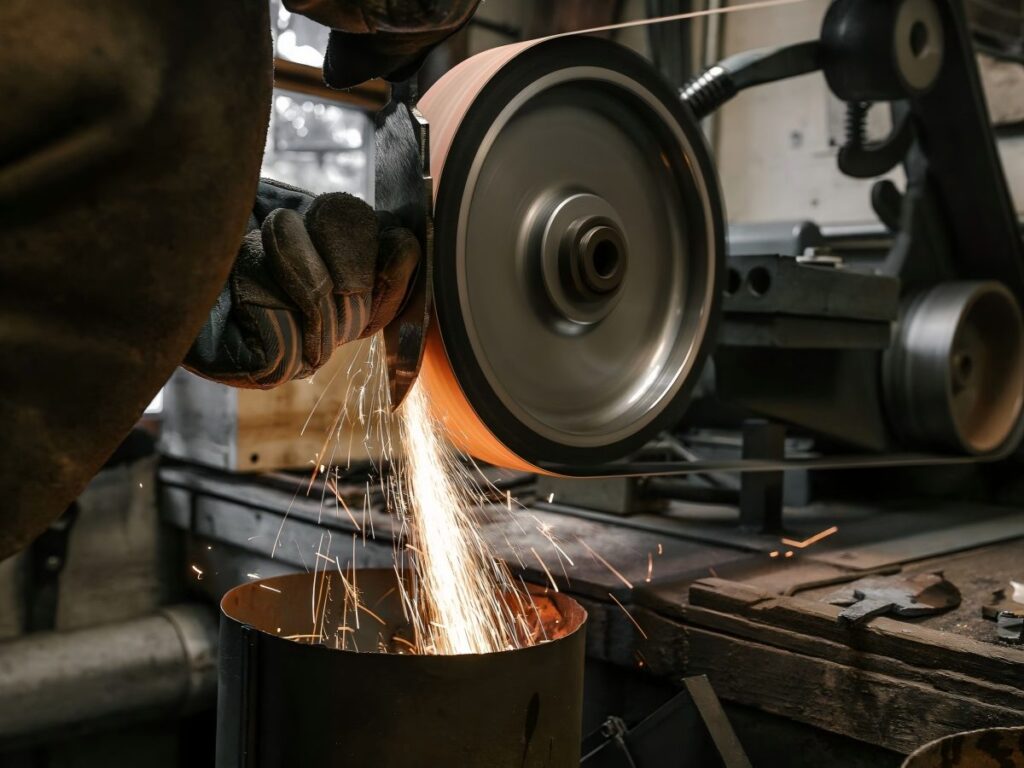
For OEM programs, the steel typically adds only a modest material premium over 8Cr13MoV, while supporting a meaningful retail price step. It enables knives that retail credibly in the $40–$90 segment—the fastest-moving band for online knife sales—where 8Cr13MoV products cap out lower and VG-10 or powder steels push costs up.
Supply is another advantage. Major Chinese mills such as TISCO produce it at scale, and the heat-treatment window is forgiving, so batch-to-batch HRC consistency is achievable even on large orders. One caution for private label buyers: because proprietary variants like AR-RPM9 are built on the same base steel with a spray-form process, spec sheets should state the exact GB grade to keep marketing claims clean.
Three sourcing habits protect your margin. First, specify the full GB/T grade on purchase orders rather than the shorthand “9Cr,” which suppliers sometimes interpret loosely. Second, lock the HRC target—58–60 for most products—into the QC plan and require batch certification. Third, for kitchen SKUs, request a basic corrosion check such as a water-boil or salt-spray test. These steps cost little but prevent the most common disputes in mid-range knife programs.
Maintenance and Care
This steel is low-maintenance by knife standards, but a few habits keep it at its best.
Cleaning: Hand-wash with mild soap and warm water, then dry immediately. It is stainless, not rust-proof—dishwashers and prolonged wet storage will eventually spot the blade.
Sharpening: Touch up on a 1000-grit water stone or ceramic rod at 15–20 degrees per side, then strop. The steel responds quickly; most edges come back in under five minutes.
Honing: A few passes on a ceramic rod or leather strop between sharpenings keeps the edge aligned and can double the time between full sharpening sessions.
Storage: Store dry. For fixed blades, avoid long-term leather sheath storage, which traps moisture. A light coat of mineral oil protects blades before extended storage or sea freight.
What to avoid: Don’t pry or twist the tip, don’t cut on glass or stone, and don’t leave acidic food residue on the blade overnight.
Start Working with a Professional Now
Final Verdict
9Cr18MoV is one of the most rational steel choices in the mid-range market. It delivers 440C-equivalent performance—solid edge retention, real stainless behavior, easy sharpening—at a cost structure that protects margins. It is not a premium steel, and it does not pretend to be one.
Recommended for:
- Mid-range EDC folders targeting the $40–$90 retail band
- Kitchen knife lines needing stainless reliability at scale
- Private label programs upgrading from 8Cr13MoV
- Scissors, grooming tools, and multi-blade products
Not recommended for:
- Hard-use choppers or survival knives (toughness ceiling)
- Premium lines competing on edge retention specs
- Saltwater or marine-duty products
- Brands that need a “premium steel name” for marketing
If 9Cr18MoV fits your product plan, contact Keganico for samples and a quote.
Partner with Keganico for Your 9Cr18MoV Knife Line
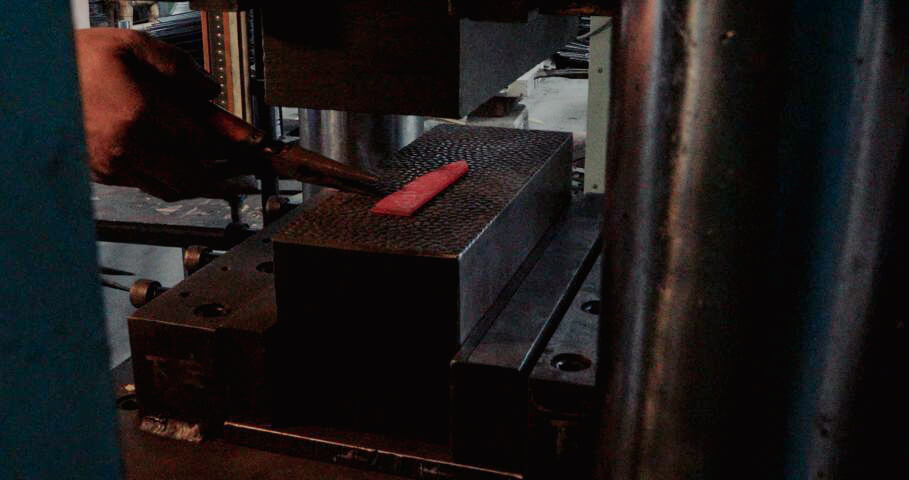
Looking to build a mid-range knife line with proven market appeal? Keganico produces 9Cr18MoV knives for leading international brands, with the process control this steel rewards.
Our expertise includes:
- Precision heat treatment certified to your target 58–60 HRC
- Blade geometry optimized for 9Cr18MoV’s edge-stability window
- Batch hardness testing and full QC documentation
- Competitive Yangjiang pricing with fast turnaround
We offer multiple partnership models:
- Private Label Knives — Put your brand on proven 9Cr18MoV designs
- OEM Manufacturing — Custom designs engineered and built to spec
- Wholesale Service — Stock quality knives at competitive prices
Get Your Quote Now and discover why leading brands trust Keganico for their knife production needs.
Related Reading
- 440C Steel: Why It Remains a Valued Choice
- 8Cr13MoV Steel Review
- 8Cr13MoV vs 440C: Which Budget Steel Is Better?
- VG-10 Steel Guide
Frequently Asked Questions
Is 9Cr18MoV a good knife steel?
Yes. With 4.5/10 edge retention, 7.5/10 corrosion resistance, and 7/10 sharpening ease at 58–60 HRC, it is one of the best-value mid-range stainless steels available. It is the proven choice behind many best-selling Civivi and Kizer models.
What is 9Cr18MoV steel equivalent to?
It is the closest Chinese equivalent to 440C, with nearly identical chemistry and performance. Artisan’s AR-RPM9 is also a spray-formed version of the same base steel, per Knife Steel Nerds. Some sources describe it as a modified 440B; in practice, treat it as 440C-tier.
Is 9Cr18MoV stainless steel?
Yes. At 17–19% chromium, it sits well above the ~13% stainless threshold and scores 7.5/10 for corrosion resistance. It handles kitchens, sweat, and humid climates with basic care, though it is not suited to prolonged saltwater exposure.
Which is better, 9Cr18MoV or D2?
For most users, 9Cr18MoV. It matches D2’s toughness, sharpens more easily, and is far more rust resistant (7.5 vs 4.5). D2 only wins on edge retention (5.0 vs 4.5) and makes sense for dry-environment utility blades where maintenance is acceptable. See our 8Cr13MoV vs D2 analysis for the full trade-off.
Which is better, 9Cr18MoV or 8Cr13MoV?
9Cr18MoV is the upgrade: it scores 4.5/10 vs 3.0/10 on edge retention and resists rust slightly better, while 8Cr13MoV keeps the toughness advantage (6.0 vs 3.5). For product lines, 8Cr13MoV anchors the entry tier while 9Cr18MoV supports the mid tier. Our 8Cr13MoV steel review details the budget option.
What hardness is 9Cr18MoV, and which brands use it?
Production knives typically run 58–60 HRC. Civivi, Kizer, Artisan, and CJRB all use it extensively, and it is common in Chinese-made kitchen knives, scissors, and grooming tools. When sourcing, specify the HRC target on your purchase order—reputable OEM partners will certify it per batch.