
Most knife buyers judge a blade by its finish before they test the edge. PVD and DLC are the two most common premium coatings, but they are not the same thing.
PVD is a vacuum deposition process that adds color and corrosion resistance. DLC is a carbon-based coating that delivers extreme hardness and a black finish. Picking the right one affects your product’s look, durability, and margin.
This guide compares both coatings on hardness, color, cost, and use cases so you can choose the best fit for your knife line.
Key Differences at a Glance
| Feature | PVD | DLC |
|---|---|---|
| What it is | A deposition process | A carbon coating material |
| Common materials | TiN, ZrN, CrN, TiCN | Amorphous carbon |
| Surface hardness | 1500-3500 HV | 1500-4000 HV |
| Scratch resistance | Good | Excellent |
| Color options | Gold, rose gold, silver, black, gray | Black to dark gray |
| Friction coefficient | 0.2-0.6 | 0.08-0.2 |
| Heat limit | 600-900°C | 350-500°C |
| Coating thickness | 1-5 microns | 1-4 microns |
| Recoating | Easier | Harder |
| Best for | EDC, kitchen, gift knives | Tactical, outdoor, premium knives |
What Is PVD Coating on Knives?
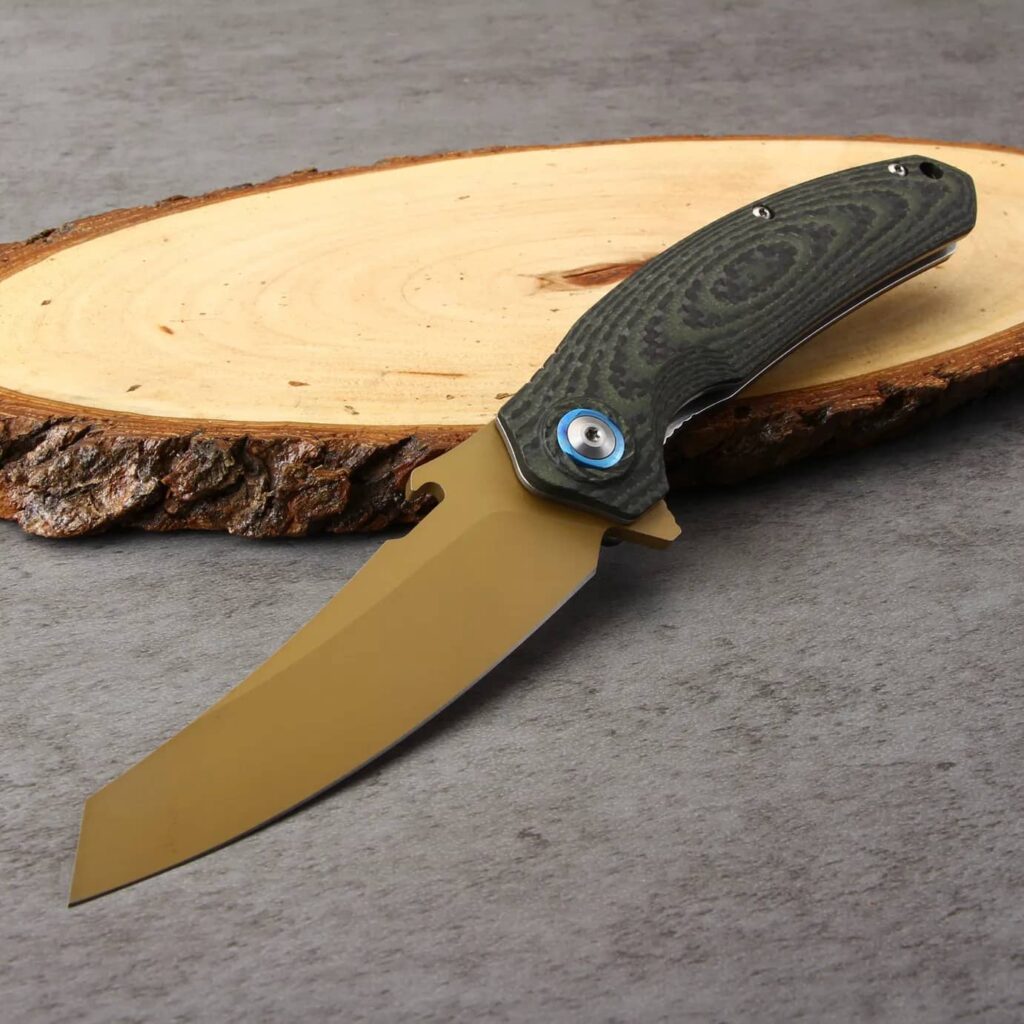
OEM Liner Lock Knife Fused Carbon Fiber + G10 Handle, Gold PVD Coated (3.82 Inch D2 Blade)
PVD stands for Physical Vapor Deposition. It is a vacuum process that turns a solid target material into vapor and deposits it onto a blade surface. The result is a thin, hard, and well-bonded film.
PVD coatings protect the blade from corrosion and minor scratches. They also give knives colors that plain steel cannot achieve. For B2B sellers, this means more SKU options and stronger product differentiation.
Common PVD Coating Materials for Knives
| Material | Color | Hardness | Common Knife Use |
|---|---|---|---|
| TiN | Gold | 2000-3000 HV | Gift knives, kitchen knives, EDC |
| ZrN | Champagne / brass | 2500-2700 HV | Premium kitchen knives, medical-grade blades |
| CrN | Silver | 1400-2500 HV | Corrosion-resistant blades |
| TiCN | Gray-black | 2800-3800 HV | Black tactical knives, tool knives |
| AlTiN | Black-purple | 3000-3500 HV | High-temperature tooling |
TiN produces a gold finish. ZrN gives a warmer champagne tone. CrN looks like silver or chrome. TiCN and AlTiN are common choices when you want a black or dark finish without paying DLC prices.
PVD Process Types
Three main methods are used for knife blades:
- Sputtering creates a smooth surface. It is ideal for decorative finishes.
- Cathodic arc creates a denser coating. It works well for hard-use tool knives.
- Ion plating improves adhesion. It is often used for premium folding knives.
The choice of process affects surface finish, coating density, and cost. Ask your supplier which method they use for your blade steel. A decorative EDC knife may use sputtering. A heavy-use outdoor knife may need cathodic arc.
Note: Coating quality depends heavily on surface preparation. Mirror-polished blades produce glossy finishes; bead-blasted surfaces yield matte looks. Always specify your base finish when requesting samples.
What Is DLC Coating on Knives?
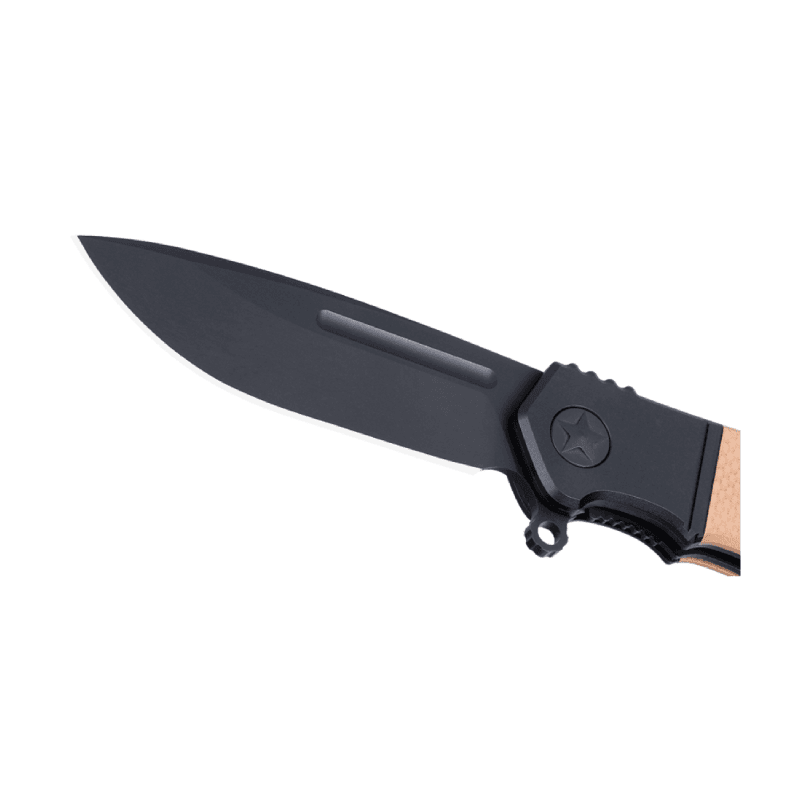
OEM Liner Lock Knife G10 Handle, DLC Coated (2.91 Inch S35VN Blade)
DLC stands for Diamond-Like Carbon. It is an amorphous carbon coating that contains both diamond-like (sp³) and graphite-like (sp²) bonds. This mix gives DLC its unusual combination of extreme hardness and low friction.
DLC coatings are popular on premium knives because they resist scratches better than almost any other finish. They also give blades a deep black look that buyers associate with high-end products.
Common DLC Types for Knives
- a-C:H is hydrogenated amorphous carbon. It is tough and works well on folding knives.
- ta-C is tetrahedral amorphous carbon. It has the highest hardness and is used on premium fixed blades.
- W-DLC is tungsten-doped DLC. It adds toughness and suits outdoor knives that take impacts.
Each type balances hardness and toughness differently. Not every DLC coating is the same. When you source DLC, ask your supplier which type they apply and what hardness range they guarantee.
PVD vs DLC for Knives: Detailed Comparison
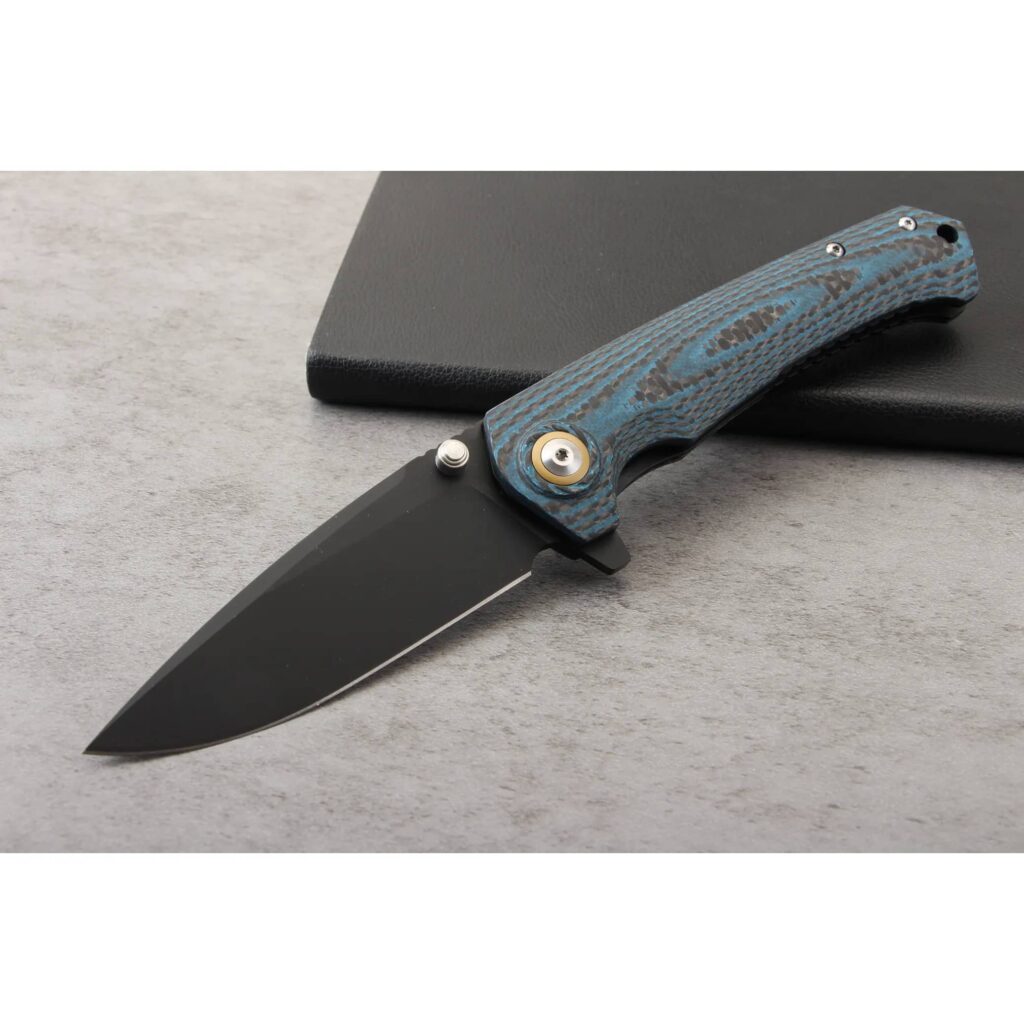
OEM Liner Lock Knife Fused Carbon Fiber + G10 Handle, Black PVD Coated (3.70 Inch 14C28N Blade)
This section breaks down each performance dimension. Use it to match the coating to your product.
Hardness and Scratch Resistance
PVD coatings range from 1500 to 3500 HV. DLC coatings range from 1500 to 4000 HV, with ta-C at the top end. For comparison, a typical stainless steel blade is 200-300 HV, and a hardened tool steel blade is 600-900 HV.
DLC resists scratches from keys, coins, sand, and other everyday contacts better than PVD. PVD resists light scuffs but will show base steel under deep scratches.
One note: coating hardness does not mean the edge stays sharp longer. Edge retention depends on the blade steel and heat treatment.
Color and Aesthetics
PVD wins on color variety. You can get gold, rose gold, silver, black, gray, bronze, and gunmetal from different PVD materials. This makes PVD ideal for product lines that need seasonal colors or regional preferences.
DLC is mostly black to dark gray. You can choose matte, semi-gloss, or glossy finishes, but the color range is narrow. DLC works best when the product goal is “premium black.”
For sellers, PVD supports SKU expansion. DLC supports flagship positioning.
Sharpening and Re-Coating
Blade coatings are thin. They range from 1 to 5 microns. Normal sharpening removes the coating at the edge and exposes the base steel.
This happens with both PVD and DLC. The rest of the blade keeps its coating. Only the sharpened bevel changes color.
PVD is easier and cheaper to reapply. DLC needs chemical stripping or regrinding before recoating. For mass-market knives, most brands do not re-coat. They treat the blade as a consumable finish.
Tell customers that sharpening may expose base steel at the edge. This simple note reduces complaints and returns.
Temperature Resistance
PVD nitride coatings stay stable up to 600-900°C. DLC starts to degrade above 350-500°C.
For most knives, this difference does not matter. Kitchen knives and EDC knives never reach those temperatures.
But if your blades go through industrial sterilization or extreme friction heat, PVD is the safer choice.
Durability and Lifespan
Which one lasts longer? There is no single answer.
DLC lasts longer in high-contact, high-friction use. PVD lasts longer if you need color variety and easy recoating. Appearance life depends on how the knife is used, stored, and sharpened.
For hard-use knives, DLC usually wins. For display, gift, and kitchen knives, a quality PVD finish is often enough.
Edge Retention
Does coating help? No, not directly.
Sharpness and edge retention come from the blade steel and heat treatment. The coating sits on the surface. It does not change the steel underneath.
However, coatings do help indirectly. They reduce friction during cutting, so food or material sticks less. They protect the blade flats from corrosion. They keep the blade looking new longer.
These benefits matter for customer satisfaction, even if they do not make the edge sharper.
Do not market coatings as “making the blade sharper.” Market them for durability, appearance, and feel.
Blade Steel and Coating Compatibility
Not every steel takes coating equally well. Stainless steels like 9Cr18MoV and S35VN bond strongly with both PVD and DLC. High-carbon steels like D2 need extra surface prep to prevent delamination.
Hardness matching also matters. DLC is extremely hard, so it pairs best with blades hardened to 58 HRC or above. On softer steels, the coating can crack under impact. PVD is more forgiving and works well on 55–58 HRC blades.
Always ask your supplier if they have coated your specific steel grade before, and request adhesion test data. This prevents batch failures.
PVD vs DLC: Cost Comparison for Knife Production
Cost is often the deciding factor for B2B buyers. Here is what to expect.
| Cost Factor | PVD | DLC |
|---|---|---|
| Bulk coating cost | $1-5 per blade | $5-20 per blade |
| Small batch / complex shape | $5-15 per blade | $20-50 per blade |
| Cost vs. standard PVD | 1x | 2-3x |
| Retail price premium | 10-30% | 30-80% |
PVD Coating Costs
Based on typical China-manufacturing quotes for 1,000+ pieces, PVD typically costs $1 to $5 per blade. Small batches or complex shapes can run $5 to $15 per blade. Gold TiN often costs slightly more than black TiCN because of material prices.
DLC Coating Costs
DLC usually costs $5 to $20 per blade in volume. High-end ta-C or W-DLC can reach $20 to $50 per blade. In most cases, DLC is 2 to 3 times more expensive than standard PVD.
What Drives the Price
Several factors affect the final quote:
- Blade size and geometry
- Order volume
- Single-sided or double-sided coating
- Masking requirements
- Surface preparation needs
- Coating thickness and hardness target
Higher volume almost always lowers the per-blade cost. Ask your supplier for pricing at 1,000, 5,000, and 10,000 pieces. Many suppliers also charge setup fees for each color or batch.
Retail Pricing Impact
PVD can support a 10-30% retail price premium. DLC can support a 30-80% premium, depending on the market. Tactical and outdoor buyers often expect to pay more for DLC. Gift and kitchen buyers may care more about color than maximum hardness.
Which Coating Should You Choose for Your Knife Line?
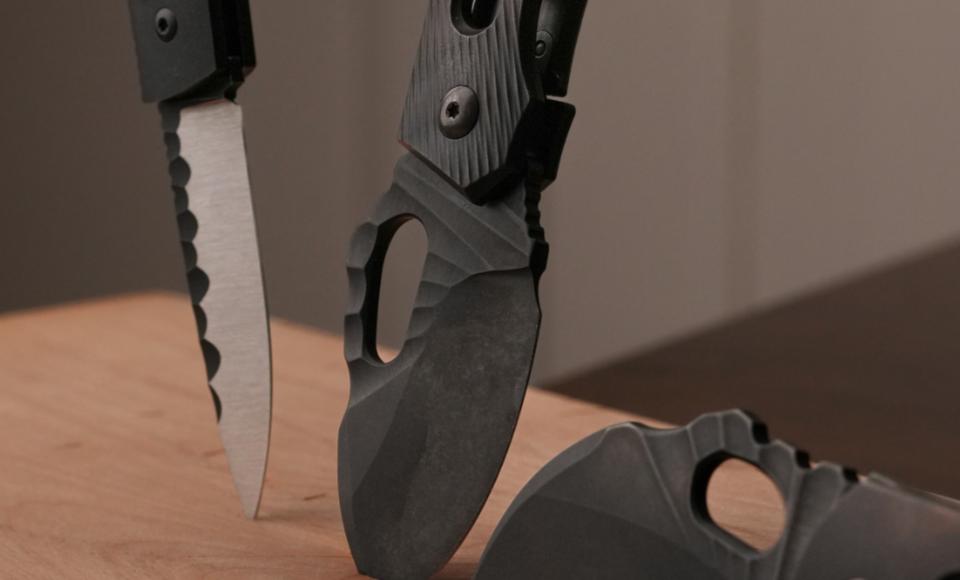
Your product strategy should guide the choice.
Choose PVD When
- You need multiple colors.
- You want lower unit cost.
- You target EDC knives, kitchen knives, or gift markets.
- You plan high-volume production.
- You want short lead times.
Choose DLC When
- You target tactical knives or fixed blade knives buyers.
- You want a premium black finish.
- Scratch resistance is a top priority.
- You can absorb higher unit cost.
- You want a strong marketing story.
Choose by Knife Type
| Knife Type | Best Coating | Reason |
|---|---|---|
| Kitchen knife | PVD (ZrN, CrN) | Corrosion resistance, color choices |
| EDC folding knife | PVD black or DLC | Cost vs. durability balance |
| Tactical knife | DLC | Maximum hardness, black finish |
| Outdoor fixed blade | DLC or PVD | Depends on budget and positioning |
| Gift knife | PVD (TiN gold) | Visual appeal |
| Collector knife | PVD | Color variety and detail |
The Dual-Strategy Option
Many successful brands use both. They launch a standard PVD version for volume and a DLC version for premium buyers. This captures two price points without redesigning the blade.
For example, an EDC brand might sell a black PVD model at $45 and a black DLC model at $75. Both share the same blade and handle. Only the coating changes. This lets you serve budget buyers and premium buyers with one design.
Decision Checklist
Before you decide, answer these questions:
- Who is the target buyer?
- What is the target retail price?
- How many color SKUs do you need?
- Where will the knife be used?
- What is your annual volume?
- What blade steel are you using?
Quick Decision Table
| Your Product Line | Recommended Coating |
|---|---|
| High-volume EDC with colors | PVD (TiCN black, TiN gold) |
| Premium tactical or outdoor | DLC |
| Kitchen knife series | PVD (ZrN, CrN) |
| Gift or collector knives | PVD (TiN gold, rose gold) |
| Flagship model | DLC |
| Budget-sensitive line | PVD |
OEM Coating Options at Keganico
PVD offers color variety and lower cost for EDC, kitchen, and gift knives, while DLC delivers maximum hardness and a premium black finish for tactical and outdoor blades.
The right coating strengthens your product positioning and protects your margin, and many brands use both to serve different buyers without redesigning the blade.
At Keganico, we simplify blade coating sourcing for B2B buyers. Instead of managing multiple coating vendors, you work with one partner who understands both knife manufacturing and finishing requirements.
Our advantages include:
- Vetted coating partners: We work with finishing suppliers who have proven knife-blade experience, so you avoid trial-and-error with general-purpose coaters.
- Process guidance: We help you choose between PVD and DLC based on your steel, target market, and budget—not just on price.
- Prototype to scale: Start with coated samples for validation, then ramp to 1,000, 5,000, or 10,000+ pieces without switching partners.
- Built-in quality checks: We coordinate thickness, adhesion, salt spray, and visual inspections as part of the production workflow.
- Flexible service models: Route your project through our OEM knife service, private label knives program, or wholesale knives options depending on how much customization you need.
Whether you need PVD color variety or DLC durability, we guide the process from material selection to final delivery. Request a free quote.
Start Working with a Professional Now
Frequently Asked Questions
Does PVD shine like real gold on knives?
TiN and ZrN can look close to real gold. The shine depends on how polished the blade is before coating. High-quality gold PVD is popular in the Middle East and gift markets.
Do DLC-coated knife blades scratch easily?
No. DLC is much harder than stainless steel and most blade steels. The edge may show bare steel after sharpening, but that is normal, not a defect.
Does PVD coating fade on knives?
Quality PVD finishes are color-stable. Strong acids, alkalis, or long saltwater exposure can change some colors. PVD is more durable than electroplating or paint in most conditions.
How long does PVD coating last on a knife?
There is no fixed lifespan. A quality PVD finish can last for years with normal use and proper storage. Lifespan depends on how often the blade contacts hard surfaces, exposure to moisture or chemicals, and how often it is sharpened.
How long does DLC coating last on a knife?
DLC typically lasts longer than PVD in hard-use conditions because of its higher hardness. With normal pocket or kitchen use, it can stay intact for years. Edge sharpening will expose base steel, but the blade flats keep their coating.
Can you remove DLC coating from a knife?
Yes, but it requires chemical stripping or grinding. You cannot patch a small spot. The whole blade usually needs to be recoated. This is why DLC is better planned into the product from the start.
Can PVD coating be removed from a knife?
Yes. PVD is easier to remove than DLC. It can be stripped chemically or ground off, and then reapplied. This makes PVD a practical choice if you need to refresh the finish after sharpening or rework.
Is DLC coating worth it for knives?
For premium tactical, outdoor, or collector markets, yes. For high-volume EDC or budget lines, PVD usually makes more financial sense. Test samples with your target buyers before committing to large orders.
Are PVD and DLC Coatings Food-Safe?
Yes, both can be food-safe when applied correctly, but certification matters.
Common PVD materials like TiN, CrN, and ZrN are widely used on food-processing blades and meet FDA food-contact requirements. DLC is chemically inert and also safe for kitchen use.
The key is verifying your supplier’s compliance with FDA 21 CFR or EU 1935/2004 standards—not all coatings are produced under food-grade protocols.
Is DLC a PVD Coating on Knives?
No. This is a common source of confusion.
PVD is a process. DLC is a material. A DLC coating can be applied using PVD equipment, but it can also be applied using PACVD or PECVD. The two terms describe different things.
Some suppliers say “PVD black coating” when they mean black TiCN. Others say “DLC coating by PVD” to describe the process route. When you source coatings, ask for the exact material and hardness value. Do not assume “black PVD” equals DLC.