
Most knife buyers spend hours choosing a blade and seconds choosing a sheath. That is a mistake. The sheath decides how the knife carries, how fast it comes out, and whether the blade stays sharp and rust-free.
Kydex and leather are the two dominant sheath materials. Kydex is a molded thermoplastic that clicks onto the knife and shrugs off water and mud. Leather is a stitched hide that sits quietly on the belt and ages with the blade.
In this guide, we break down the differences between a kydex sheath and a leather sheath in retention, weather resistance, comfort, and cost so you can choose the right material for your product line.
Key Takeaways
- Kydex gives mechanical click-fit retention. Leather relies on friction, molded fit, and often a snap strap.
- Kydex handles rain, sweat, mud, and salt better than leather.
- Leather is quieter and more comfortable on the belt. It also suits traditional knives visually.
- A well-made Kydex sheath does not dull a blade. Grit, poor fit, or cheap glass-filled plastics do.
- Leather can trap moisture and tanning chemicals, so it is poor for long-term storage.
What Is a Kydex Knife Sheath?
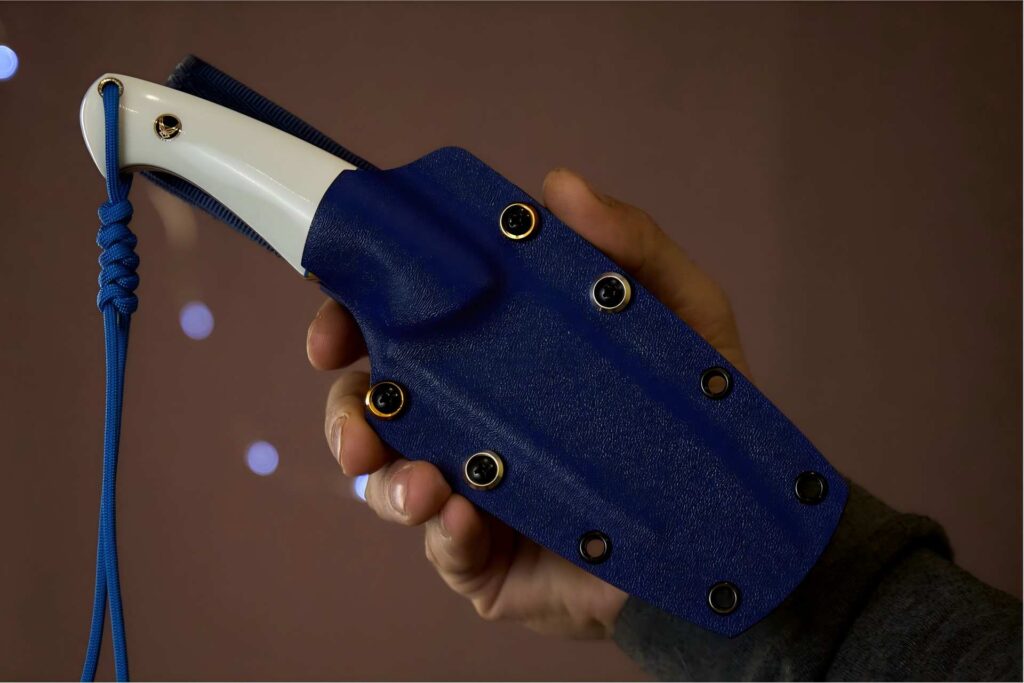
Kydex is a thermoplastic acrylic-PVC composite sheet. A sheath maker heats it until pliable, then vacuum-forms or press-molds it around a specific knife.
Once cooled, the sheet keeps that shape and grips the knife by its handle, guard, or choil. Users call this “click retention.”
Common sheath thicknesses range from .060 inch for compact EDC knives to .125 inch for large fixed blade knives. Thinner sheets flex more. Thicker sheets survive harder use.
Kydex is non-porous, so water, blood, and field dressing fluids do not soak in. A quick rinse cleans it.
Makers also drill standard hole patterns for Tek-Lok, UltiClip, MOLLE clips, and scout carry mounts. Users can switch carry positions without buying a new sheath.
Kydex is the best-known thermoplastic sheath material, but it is not the only one. Brands also use Boltaron for similar applications. See our Boltaron vs Kydex comparison for a detailed breakdown.
Pros
- Mechanical click-fit retention
- Waterproof, non-porous, and easy to clean
- Modular carry with Tek-Lok, UltiClip, MOLLE, and scout mounts
- Retention stays stable over time
Cons
- Audible click on draw and re-sheathing
- Rigid shell can dig into the belt during long wear
- Modern/tactical look may not suit traditional knives
- Trapped grit can scratch blade finish
- Heat-sensitive; can warp if left in a hot vehicle
What Is a Leather Knife Sheath?
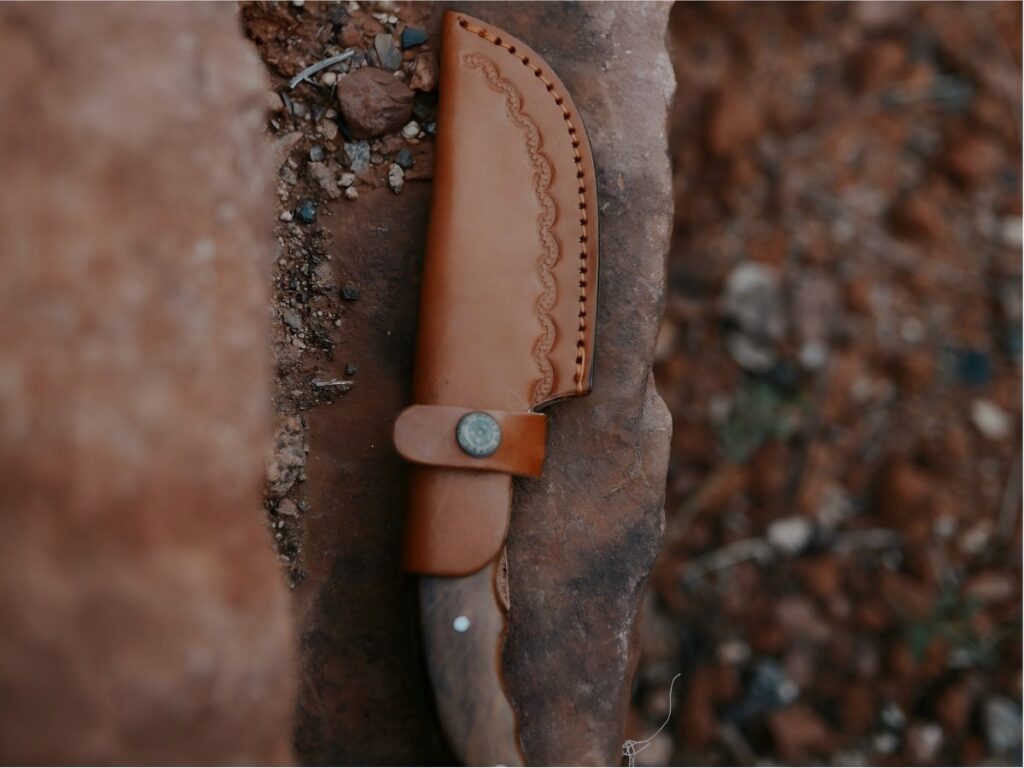
A leather sheath is made from stitched, molded, or layered hide. Most quality sheaths include a welt, a strip that protects the stitching from the edge.
Retention comes from a snug molded fit and friction, sometimes with a snap strap. Leather does not lock the knife mechanically. As it softens, the fit loosens. A strap compensates but slows draw and re-sheathing.
Leather grades matter. Full-grain and top-grain leather last longest. Chrome-tanned leather resists water better. Vegetable-tanned leather molds more tightly. Many makers oil or wax the surface to improve water resistance.
The material ages visibly. It darkens, softens, and develops a patina. For traditional and handmade knives, that aging is part of the appeal.
Pros
- Quiet draw and re-sheathing
- Soft and comfortable on the belt
- Classic look that suits traditional knives
- Field-repairable with basic tools
- Develops a patina that collectors value
Cons
- Absorbs water, sweat, and blood; can mildew
- Requires regular cleaning, drying, and conditioning
- Retention loosens as leather softens
- Traps moisture and tanning chemicals against the blade
- Limited carry options; mostly fixed belt loops
Kydex vs Leather Knife Sheath: Side-by-Side Comparison
| Feature | Kydex | Leather | Winner |
|---|---|---|---|
| Retention | Click-fit lockup | Friction, molded fit, strap | Kydex |
| Weather resistance | Waterproof, non-porous | Absorbs water, can mildew | Kydex |
| Maintenance | Rinse and dry | Clean, dry, condition | Kydex |
| Noise | Audible click | Nearly silent | Leather |
| Belt comfort | Rigid, can dig in | Soft, conforms to body | Leather |
| Aesthetics | Modern, tactical | Classic, traditional | Leather |
| Modularity | Tek-Lok, MOLLE, scout carry | Usually fixed belt loop | Kydex |
| Blade finish wear | Grit can scratch | Gentle on finish | Leather |
| Long-term storage | Safe | Traps moisture, risks rust | Kydex |
| Factory cost | $10–$50 | $15–$60 | Similar; custom work costs more |
Retention and Security
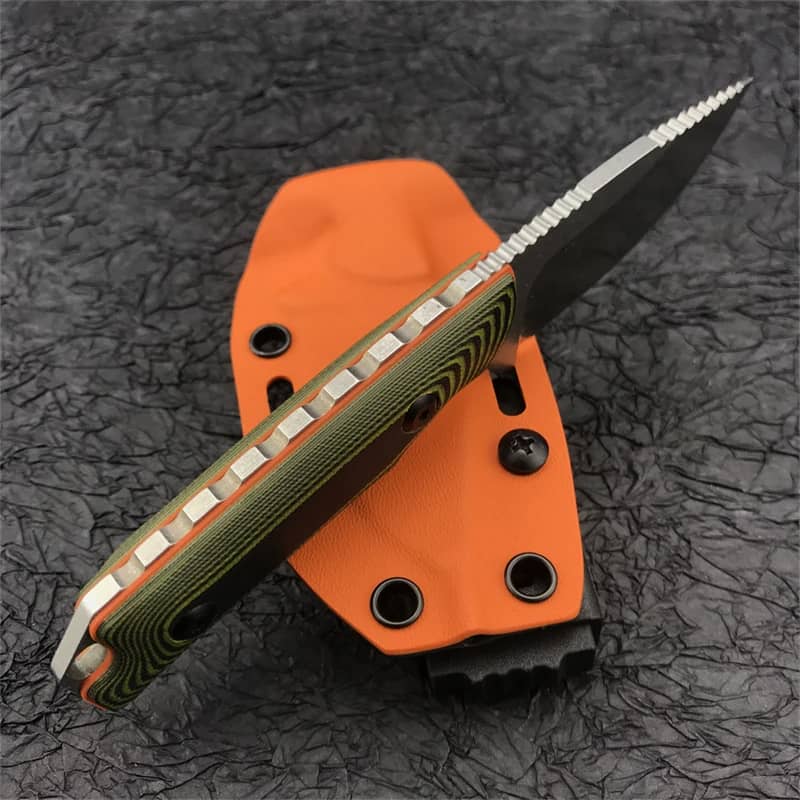
OEM Fixed Blade Knife G10 Handle with Kydex Sheath (2.40 Inch 8Cr13MoV Blade)
Kydex wins on retention. The sheath clicks onto the knife and holds it until the user pulls with deliberate force. This is why tactical knives and EDC fixed blades almost always ship with Kydex.
Leather relies on fit and friction. A well-made leather sheath can be secure enough for hiking and horseback riding. But retention depends on fit quality and maintenance. As the leather softens, the knife sits looser.
BladeForums users often debate retention straps. Some cut them off because a tight sheath does not need one. Others keep them for falls, car accidents, or dense brush where any sheath might release a knife.
Weather Resistance
Kydex is the clear choice for wet, humid, or dirty environments. It does not absorb water. It does not mildew. It holds its shape through repeated wet-dry cycles.
Leather suffers in wet conditions. Even waxed or oiled leather needs care after exposure. A Bushcraft USA user put it simply: “For a river or ocean knife, I require kydex. Most every other knife, I prefer waxed leather.”
Maintenance
Kydex maintenance is fast. Rinse the inside, wipe the outside, check screws, and avoid heat. That is it.
Leather maintenance takes more time. Wipe off blood and dirt. Let the sheath dry away from heat. Apply conditioner every few months. Re-oil or re-wax if water resistance drops.
Noise and Comfort
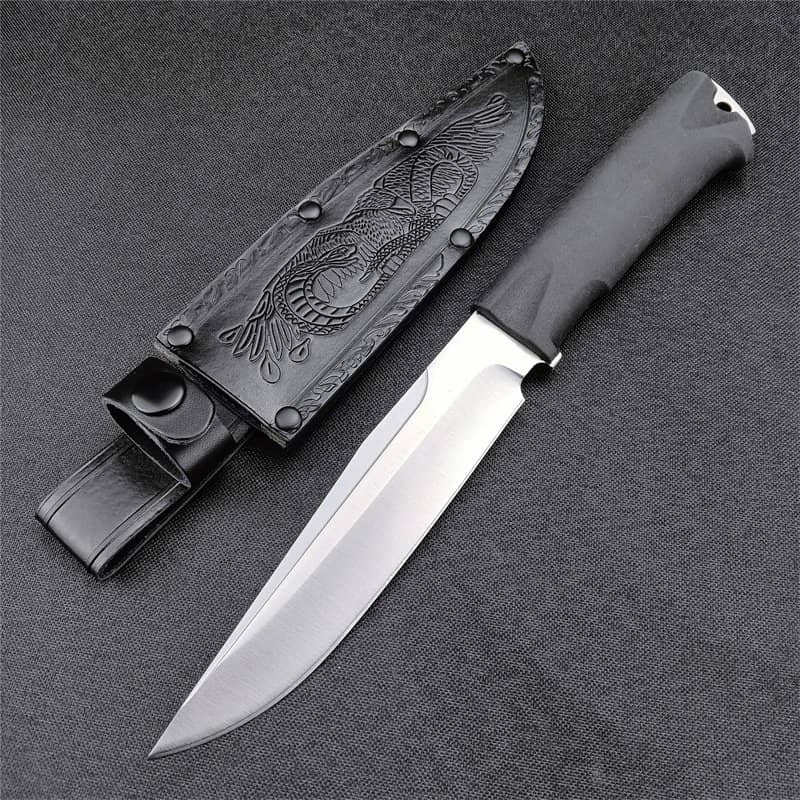
OEM Fixed Blade Knife TPR Handle with Leather Sheath (3.74 Inch D2 Blade)
Leather is quieter and more comfortable. It flexes against the body and does not click or rattle.
Kydex is louder and more rigid. Some makers reduce this by adding a leather backer or lining to the Kydex shell.
Blade Protection
Neither material is perfect. Kydex is inert and safe, but trapped grit can scratch the finish. Leather is gentle on the finish, but moisture and tanning chemicals can corrode the steel.
Carbon steel knives face the highest risk. Stainless steels resist better, yet they are not immune.
BladeForums users agree: a properly molded Kydex sheath should not contact the edge. Dulling comes from poor fit, off-center blades, or grit inside the sheath.
One user reported, “The sheath itself doesn’t dull the knife, but working in dusty, gritty environments, sand and grit get in it and dull/chip the edge.”
Carry Modularity
Kydex accepts standard aftermarket clips. Users can switch from belt carry to scout carry to pack carry in minutes.
Leather is usually fixed. Custom makers can add danglers or thigh straps, but these are less interchangeable than Kydex hardware.
Best Use Cases by Knife Type
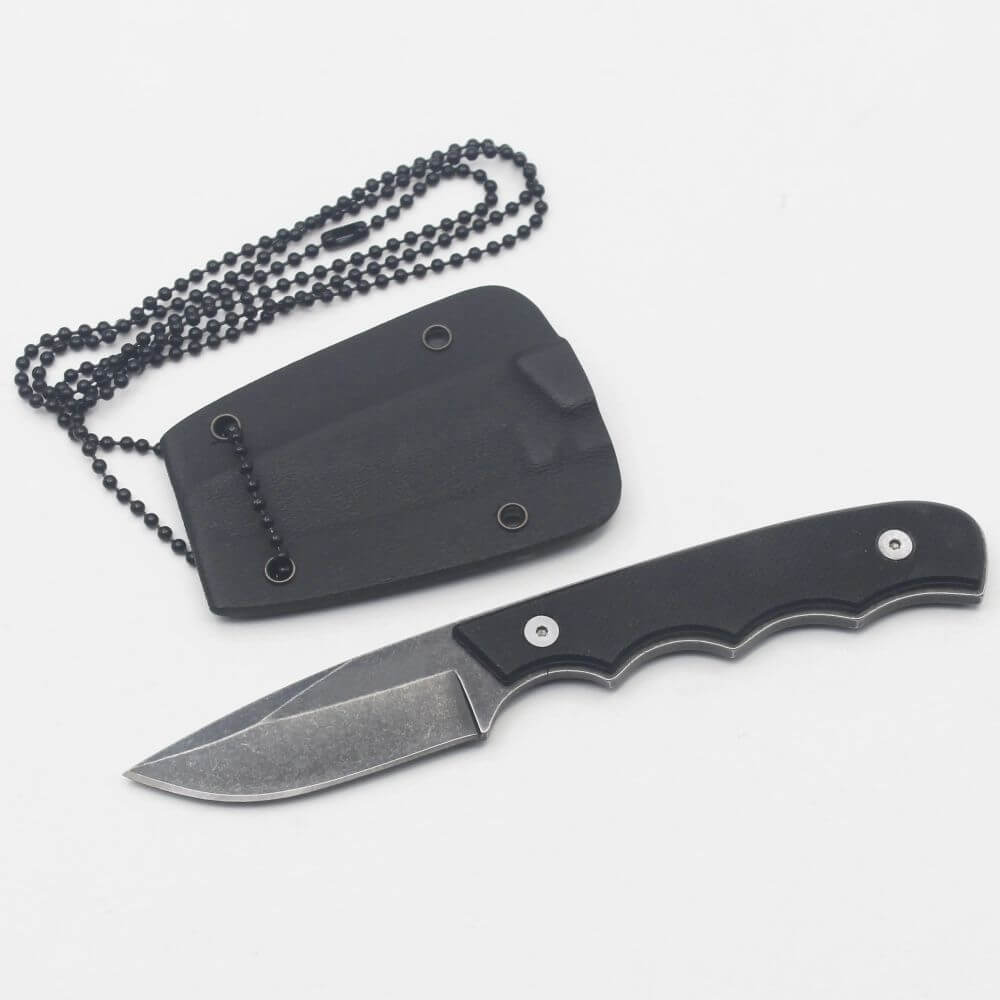
OEM Fixed Blade Neck Knife G10 Handle with Kydex Sheath
Choose Kydex For
Kydex works best when the knife will see hard use, moisture, or frequent carry-position changes.
- EDC fixed blade knives – slim profiles and reliable retention make all-day carry practical.
- Tactical and duty knives – fast one-handed draw and secure lockup are critical in high-stakes situations.
- Fishing and marine knives – saltwater and fish slime rinse off easily without damaging the sheath.
- Work knives in dirty or wet conditions – mud, blood, and grime clean out in seconds.
- Users who want retention without a strap – the click-fit holds the knife even when inverted.
- Buyers who switch carry positions often – standard clip holes support vertical, horizontal, scout, and pack carry.
Choose Leather For
Leather suits knives where tradition, silence, and belt comfort matter more than all-weather toughness.
- Hunting knives where silence matters – no click gives away position when drawing in the field.
- Bushcraft knives with traditional styling – leather complements wood, bone, and antler handles.
- Handmade or collector knives – the patina and craftsmanship support a premium story.
- Users who value belt comfort during long wear – leather flexes and conforms to the hip over time.
- Brands targeting heritage or premium aesthetics – full-grain leather with visible stitching signals quality.
- Buyers who enjoy maintaining their gear – oiling and conditioning become part of the ownership ritual.
Start Working with a Professional Now
B2B Sourcing Guide
Fit Quality First
A bad sheath ruins a good knife. For Kydex, ask whether the supplier molds from the actual blade or from a dummy. For leather, ask about welt construction, stitching thread, and whether the sheath is hand-boned or machine-pressed.
Request sample sheaths with your exact knife model. Test retention, draw angle, and re-sheathing one-handed.
Plan Cost and MOQ
Factory Kydex sheaths typically cost $10–$50 each. Custom molded Kydex with hardware runs $40–$120. Leather sheaths range from $15–$60 factory-made to $50–$200+ for handmade pieces.
The real cost difference is in scaling.
Kydex uses a one-time mold. Once the mold is cut, per-unit cost drops sharply at 500+ units.
Leather relies on manual cutting, stitching, and boning. This means leather often requires higher MOQ or longer lead times to justify setup labor.
If you plan to launch with 300 units, Kydex is usually the safer cost choice. If you plan a 5,000-unit heritage run, leather labor costs amortize well.
Customization and Branding
This is where most factory quotes hide surprises. Ask your supplier specifically:
- Kydex color: Do they stock standard colors (black, FDE, OD green) or can they match Pantone? Is there a color MOQ?
- Leather embossing: Can they deboss or hot-stamp your logo? What is the maximum stamp size?
- Hardware: Do they use genuine Tek-Lok / UltiClip, or unbranded clones? Clones fail faster and hurt your brand.
- Stitching: Can thread color match your brand palette?
- Packaging: Is the sheath shipped in a poly bag, or can it be inserted into your retail box?
Choose Hardware Carefully
For Kydex, confirm clip compatibility, screw spacing, and retention screw adjustability. Wrong spacing locks out common aftermarket mounts, and poorly set retention screws either wear the blade or let the knife rattle loose.
For leather, confirm loop width, stitching reinforcement, and whether a snap strap is included. A 1.5-inch or 1.75-inch loop fits standard belts, and reinforced stitching prevents loop failure.
Consider a Hybrid Strategy
A Kydex body with a leather belt loop or dangler gives retention and comfort. The thermoplastic shell locks the blade and blocks moisture, while the leather backer softens contact and reduces noise.
This works well for brands that want modern function with traditional looks, and it avoids running two separate sheath SKUs.
Build Your Knife Line with Kegani
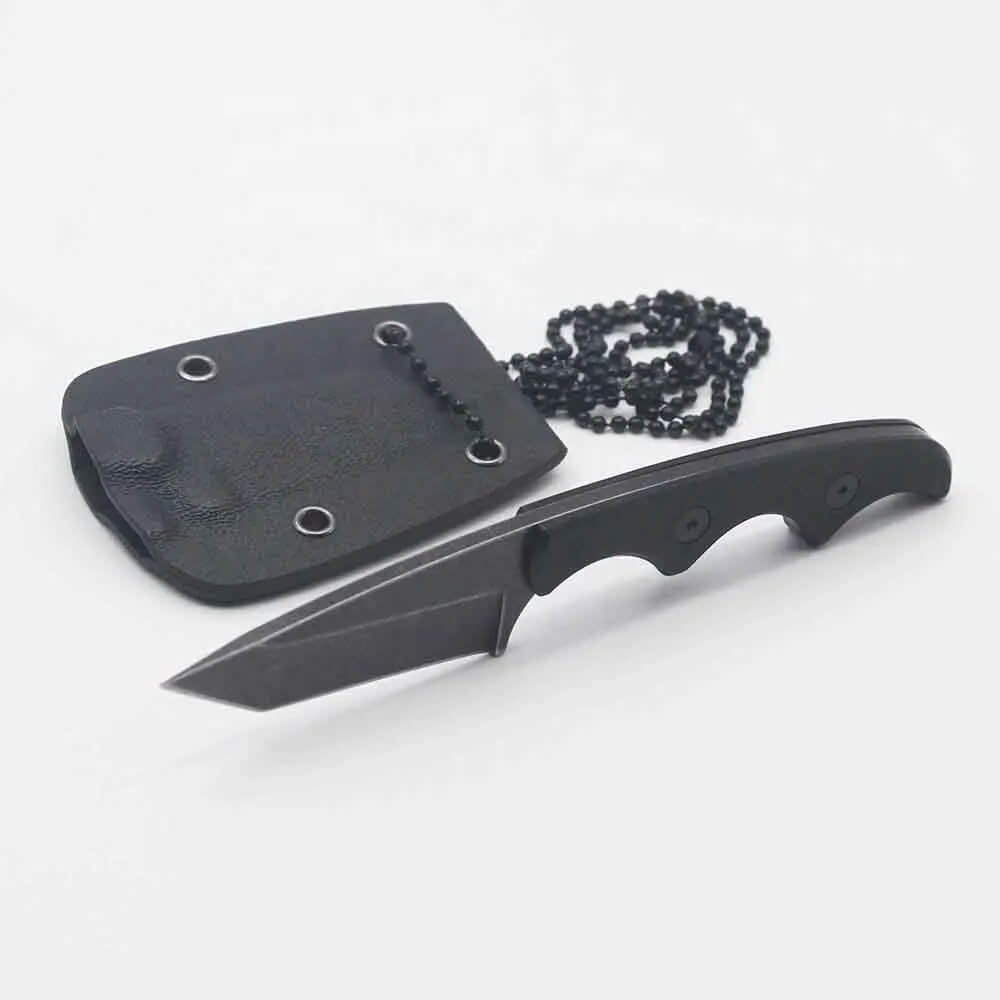
OEM Fixed Blade Neck Knife G10 Handle with Kydex Sheath
Sheath choice is only one detail in a complete product decision. At Keganico, we manufacture the blade, handle, and carry system as one unit from our Yangjiang facility.
Whether you need a tactical fixed blade with a Kydex rig, a heritage hunter with a leather dangler, or a hybrid system that covers both markets, we engineer the full product—not just the shell around it.
- OEM Knife Manufacturing: Custom steel, grind, heat treatment, and handle construction built to your spec.
- Private Label Programs: Your logo, your colorway, your box—on a proven design.
- Wholesale Knife & Sheath Bundles: Pre-matched SKUs ready for your catalog, with consistent fit and finish.
Request a Knife Sample — Send us your target spec or reference blade. We will quote steel options, handle materials, and matching sheath systems within 48 hours.
Frequently Asked Questions
Do Kydex sheaths dull blades?
No, not by themselves. A properly molded Kydex sheath should not touch the edge. Dulling happens when the sheath is poorly fitted, when the blade is inserted at an angle, or when grit and sand get trapped inside.
Are Kydex sheaths good?
Yes, for hard use, wet conditions, and modern carry systems. They are not ideal if silence, traditional looks, or maximum belt comfort are the top priorities.
Will a leather sheath dull a knife?
Leather itself is soft and unlikely to dull an edge. The bigger risk is corrosion. Leather can trap moisture and tanning chemicals against the blade, especially during long-term storage.
What is the best material for a knife sheath?
There is no single best material. Kydex is best for wet, dirty, high-retention needs. Leather is best for comfort, silence, and traditional style. Nylon is cheaper but offers weaker retention and durability.
Is Kydex just plastic?
No. Kydex is an acrylic-PVC thermoplastic composite. It is more rigid, heat-formable, and durable than ordinary plastic. Cheaper glass-filled plastic sheaths can be more abrasive to blades.