
You drop your knife on concrete. If it’s M390, you pray it didn’t chip. If it’s MagnaCut, you just pick it up.
For over a decade, Böhler M390 (and its American twin CPM 20CV) was the default choice for premium cutlery. It offered incredible edge longevity and a luxury finish. But it had one weakness: brittleness.
CPM MagnaCut arrived to fix that. It is the first “no-compromise” steel designed to offer tool-steel toughness without sacrificing stainless properties.
For brands and retailers, the decision isn’t just about which steel is “better.” It is about application risk: Do you need the specialized slicing stamina of M390, or the structural durability of MagnaCut?
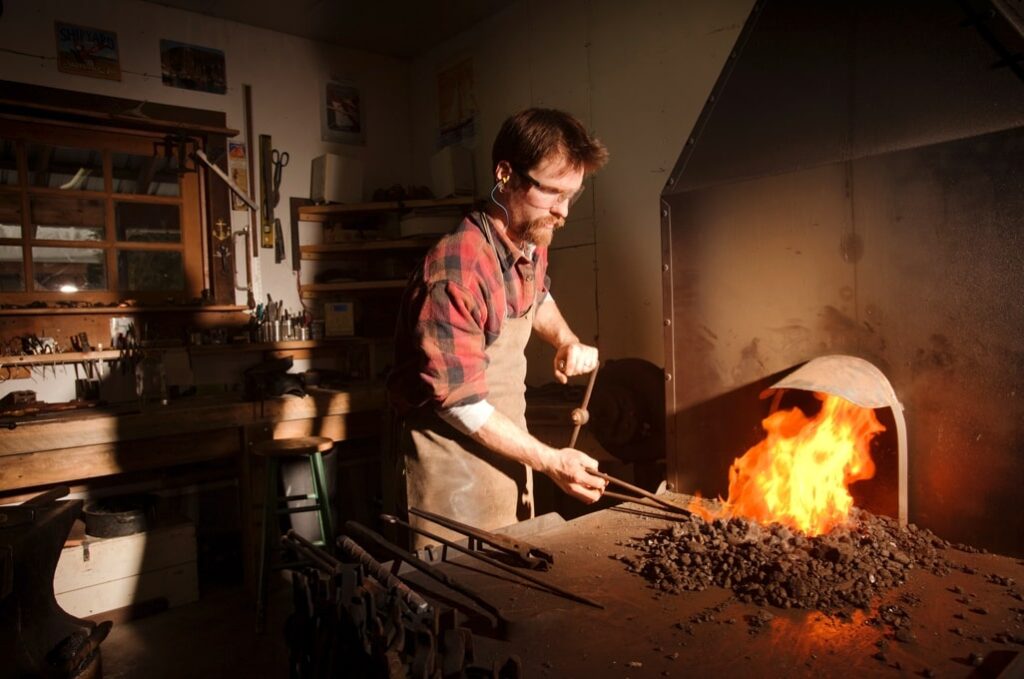
Background: What Are These Steels?
Böhler M390 (and CPM 20CV)
M390 (Austria) and 20CV (USA) are functionally identical. Originally designed for the plastics industry to resist abrasive wear, they became famous in the knife world for their high volume of hard carbides. They remain the benchmark for premium folding knives intended for slicing tasks.
CPM MagnaCut
Unlike industrial steels adapted for knives, MagnaCut was engineered specifically for cutlery by metallurgist Dr. Larrin Thomas. Launched in 2021, its goal was to create a “stainless CPM 4V.” It eliminates the large chromium carbides found in M390, resulting in a steel that can handle aggressive impacts without the risk of edge failure.
Chemical Composition Comparison
| Element | CPM MagnaCut | Bohler M390 / CPM 20CV |
| Carbon (C) | 1.15% | 1.90% |
| Chromium (Cr) | 10.70% | 20.00% |
| Vanadium (V) | 4.00% | 4.00% |
| Molybdenum (Mo) | 2.00% | 1.00% |
| Niobium (Nb) | 2.00% | – |
| Nitrogen (N) | 0.20% | – |
| Tungsten (W) | – | 0.60% |
Core Interpretation:
The result: MagnaCut is actually more corrosion-resistant than M390 despite having less Chromium, and significantly tougher because it lacks those brittle carbide clusters.
The critical difference is Chromium — but not in the way most people assume. M390’s 20% chromium sounds superior, but most of it gets locked inside carbides during heat treatment, contributing nothing to rust prevention.
Only chromium dissolved in the steel matrix forms the protective oxide layer that makes steel stainless. M390 ends up with roughly 10–13% chromium actually “in solution” — similar to MagnaCut’s 10.7%, which stays almost entirely free.
Performance Comparison Chart
| Performance Indicator | MagnaCut | M390 / 20CV | Winner |
| Edge Retention | 5.0/10 ★★★ | 6.5/10 ★★★★ | M390 (Better for abrasive slicing) |
| Toughness | 7.0/10 ★★★★★ | 3.5/10 ★★ | MagnaCut (Resists chipping) |
| Corrosion Resistance | 9.5/10 ★★★★★ | 9.0/10 ★★★★ | MagnaCut (Saltwater ready) |
| Ease of Sharpening | 7.0/10 ★★★★ | 4.0/10 ★★ | MagnaCut (Faster maintenance) |
| Typical Hardness | 62–64 HRC | 60–62 HRC | MagnaCut (Runs harder) |
Detailed Performance Analysis
Edge Retention
M390 wins on pure wear resistance. Its high Carbon and Chromium content creates a dense forest of carbides that act like microscopic teeth. This makes it ideal for cutting soft but abrasive materials like cardboard or rope. MagnaCut has respectable edge life—comparable to S35VN—but it will lose its “bite” sooner than M390 in high-volume slicing.
Curious how M390 compares to the industry workhorse S35VN?
Check out our deep dive: S35VN vs. M390.
Toughness
This is the biggest gap. M390 is prone to micro-chipping when it hits hard objects (staples, bone, hard wood). MagnaCut’s refined microstructure allows the edge to roll slightly rather than snap.
Manufacturer’s Note: For brands, this is a warranty issue. Using MagnaCut significantly reduces customer returns related to broken tips and chipped edges.
Design Implication: MagnaCut edges can be run at 15° per side versus 18–20° for M390 — a thinner edge that cuts more efficiently with less force. M390 needs the extra metal behind the edge to absorb impact without chipping. With MagnaCut, that safety margin isn’t required.

Corrosion Resistance
While both are “super stainless,” MagnaCut is technically superior. Because it lacks chromium carbides, more free chromium is available to prevent rust. It is effectively a “salt” steel, immune to corrosion in most environments.
Processing & Finishing
M390’s vanadium carbides have a hardness that exceeds conventional aluminum oxide whetstones — the abrasive simply can’t cut through them efficiently. Diamond or CBN sharpening systems are effectively required to maintain an M390 edge.
MagnaCut’s finer, more dispersed carbide structure sharpens readily on quality ceramic stones, and forms a clean burr without the wire-edge issues common with high-carbide steels.
Production Insight: From a factory perspective, MagnaCut takes an exceptionally clean bead-blast or stonewash finish. M390 is better if your design requires a high-polish mirror finish.
HRC Targeting Note: Targeting 62.5–63 HRC delivers the optimal balance for most production runs. At 66 HRC, MagnaCut’s toughness drops to roughly half of what it delivers at 63 HRC — speccing higher hardness without understanding this tradeoff defeats the purpose of choosing MagnaCut over M390 in the first place.
Start Working with a Professional Now
Application Guide: Choosing the Right Steel
Instead of asking ‘which is better,’ brands should consider the mechanics. Understanding the structural differences in a Fixed Blade vs Folding Knife scenario is key to choosing the right steel.
Scenario A: Fixed Blades & Large Choppers
- Verdict: Use CPM MagnaCut.
- Reasoning: Putting M390 on a large fixed blade is a design risk. The impact shock of chopping can cause M390 to shatter or chip. MagnaCut provides the shock absorption of a tool steel (like CPM-3V) with the rust resistance of a diving knife. It is the only logical choice for high-end outdoor fixed blades.
Scenario B: Slim EDC Folders (Slicers)
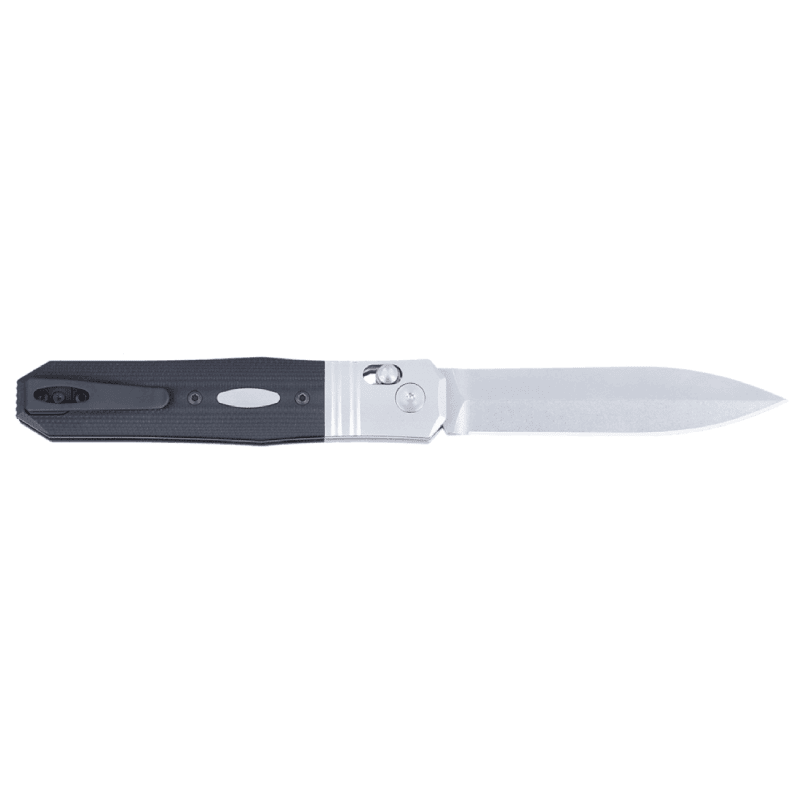
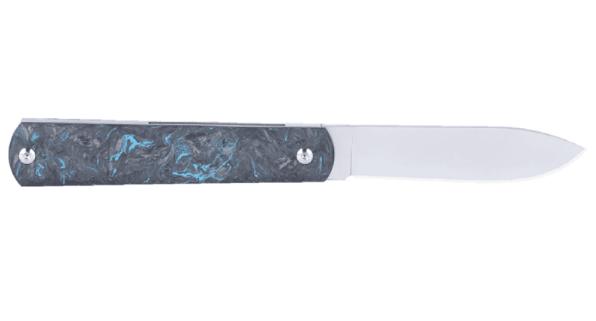
- Verdict: CPM 20CV / M390 is still King.
- Reasoning: For a gentleman’s folder or a daily package opener, the user rarely encounters high impact. They value intervals between sharpening. M390’s aggressive carbide structure will slice cardboard longer than MagnaCut.
Scenario C: Hard-Use / Tactical Folders
- Verdict: CPM MagnaCut.
- Reasoning: If the folder has a robust tip and is marketed for “survival” or “tactical” use, MagnaCut is safer. It prevents the tip from snapping during prying tasks and keeps the pivot area rust-free in sweaty pockets.
Cost & Pricing Analysis: MagnaCut vs. M390 / 20CV
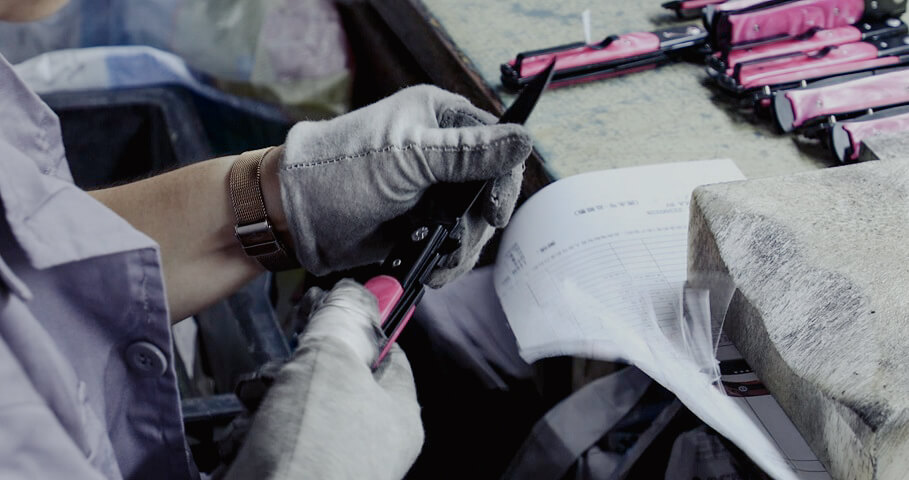
Choosing between MagnaCut and M390 isn’t just a performance decision — it’s a margin decision. The two steels carry different cost structures across the supply chain, and understanding where the money goes helps brands price accurately and protect their margins.
Manufacturing Cost Breakdown
| Cost Factor | CPM MagnaCut | M390 / 20CV |
|---|---|---|
| Raw Material Cost | Higher (~15–20% premium over M390) | Baseline reference |
| Grinding Belt Consumption | Low (grinds freely, like carbon steel) | High (hard carbides wear belts faster) |
| Heat Treatment Complexity | Moderate (tighter window: 63–64 HRC target) | Standard |
| Finishing | Stonewash/bead-blast: fast & clean | Mirror polish: labor-intensive, premium look |
| Overall Manufacturing Cost | Slightly higher material, lower processing | Lower material, higher processing labor |
| Net Cost Difference | ~10–15% more expensive per finished blade | Baseline |
Based on Keganico’s internal manufacturing data across multiple production runs.
Supply Chain Risk
- M390 is sourced from Böhler-Uddeholm (Austria/Sweden). Pricing is subject to European steel market fluctuations and import logistics. Lead times for large orders can run 8–12 weeks from distributors.
- MagnaCut is produced exclusively by Crucible Industries (USA), with a single-source dependency. Supply was constrained in 2022–2023 as demand surged. For brands placing large OEM orders, we recommend planning 12–16 weeks of lead time.
Supply update: Crucible Industries was acquired by Erasteel in 2024. Production continues under the same specifications, distributed through Niagara Specialty Metals. Supply has stabilized since the 2022–2023 constraints, but single-source dependency remains a structural risk worth factoring into your procurement planning.
Retail Price Benchmarks (MSRP, production folders)
| Steel | Entry Price Point | Mid-Range | Premium |
|---|---|---|---|
| M390 / 20CV | $120–$180 | $180–$300 | $300+ |
| CPM MagnaCut | $150–$220 | $220–$350 | $350+ |
MagnaCut currently commands a $30–$60 premium at retail, driven partly by brand positioning and market novelty. This premium is not fully justified by raw material costs alone—it reflects consumer demand and perceived exclusivity.
B2B Takeaway
- If your margin model targets $150–$250 MSRP, M390 offers a better cost-to-performance ratio and is easier to source at scale.
- If your line sits $250+ or targets premium/outdoor channels, MagnaCut’s market hype justifies the uplift and reduces warranty risk from toughness-related returns.
- For private label brands entering the market: MagnaCut is a strong storytelling steel right now. “Engineered for knives, not adapted” is a defensible marketing angle.
Final Verdict: MagnaCut or 20CV?
The choice is clear:
- Choose M390 / 20CV for Slicing Efficiency. It remains the luxury standard for urban carry and light-duty tasks.
- Choose MagnaCut for Structural Integrity. It is the superior choice for any tool that will face impact, moisture, or neglect.
Partner with Keganico: OEM, Private Label & Wholesale
Steel is only as good as its heat treatment. At Keganico, we specialize in the precision manufacturing of powder metallurgy steels. We don’t just cut the steel; we optimize it with specific protocols (like hitting 63-64 HRC for MagnaCut).
We support knife brands at every stage of growth with flexible solutions:
- Custom Manufacturing: As an experienced OEM knife manufacturer, we can build your proprietary designs from scratch using premium steels like MagnaCut and 20CV.
- Brand Expansion: Looking for a private label knife manufacturer? Choose from our catalog of high-end, ready-made designs and add your logo for a quick market launch.
- Retail Stock: We also offer competitive pricing on wholesale pocket knives for retailers needing immediate high-quality inventory.
Planning your 2026 product line? Contact our Team to discuss which business model fits your budget and design requirements.