For knife sellers, the wrong blade finish raises returns and eats margin.
DLC (Diamond-Like Carbon) is harder and more scratch-resistant, with a low-friction surface built for blades, bearings, and parts that take daily abrasion against metal or Kydex. Cerakote offers more colors and stronger corrosion protection, built for full-knife coatings, handle scales, and any product line where custom finishes and salt-water durability drive the sale.
Most product lines need one or the other, not both.
This guide compares the two coatings from a sourcing and selling perspective. You will see how each performs, what it costs, and which knife types it suits.
The goal is simple: help you pick the finish that fits your price point, your customers, and your production plan.
Quick Answer: DLC vs Cerakote for Knives
| Factor | DLC Coating | Cerakote | Winner |
|---|---|---|---|
| Surface hardness | 1,500–9,000 HV | ~9H pencil hardness | DLC |
| Scratch resistance | Excellent | Good | DLC |
| Corrosion resistance | Good to excellent | Excellent | Cerakote |
| Color options | Black, dark gray | 200+ colors | Cerakote |
| Coating thickness | 1–4 microns | ~12–25 microns | DLC |
| Heat tolerance | 350–500°C | Higher (color-dependent) | Cerakote |
| Batch cost | $5–20+/blade | $3–12/blade | Cerakote |
| Retail premium | 30–80% | 15–40% | DLC |
- Choose DLC for tactical knives, premium EDC folders, outdoor fixed blades, and any line where wear resistance supports a higher price.
- Choose Cerakote for colorful EDC lines, kitchen knives, gift knives, and budget-friendly custom runs where color variety matters more than maximum hardness.
What Is DLC Coating on Knives?
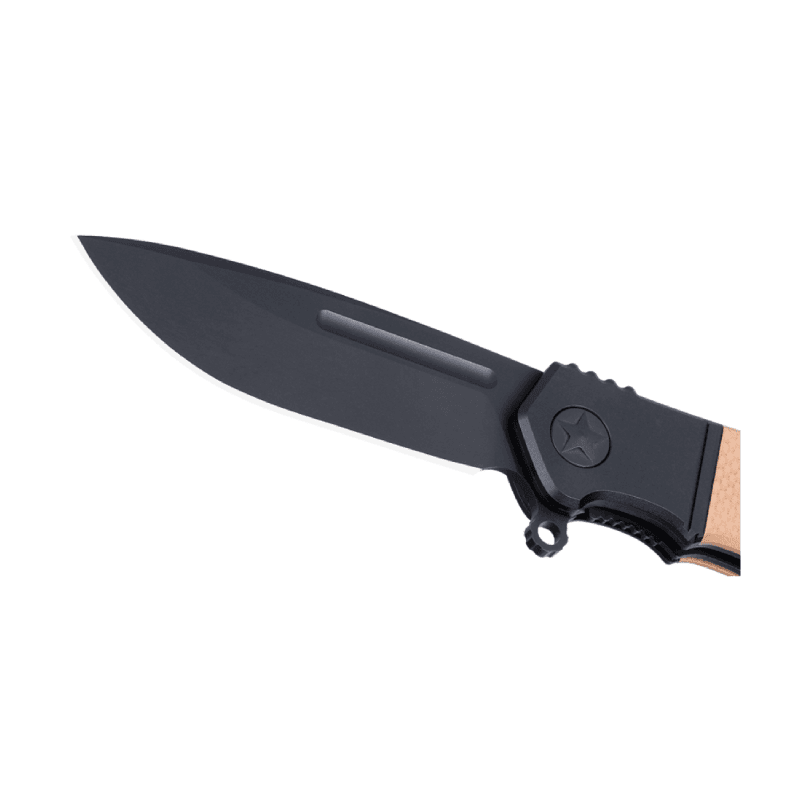
OEM Liner Lock Knife G10 Handle, DLC Coated (2.91 Inch S35VN Blade)
DLC stands for Diamond-Like Carbon. It is an amorphous carbon coating applied by PVD, PACVD, or PECVD in a vacuum chamber. The carbon structure mixes diamond-like sp³ bonds with graphite-like sp² bonds. That gives the coating high hardness and low friction at the same time.
For knives, common DLC types include:
- a-C:H — hydrogenated amorphous carbon, good toughness for folding knives
- ta-C — tetrahedral amorphous carbon, the hardest option, used on premium fixed blades
- W-DLC — tungsten-doped DLC, better impact resistance for outdoor and tactical knives
You can read more about how these DLC coating types differ from standard PVD finishes.
A DLC film is thin. Typical thickness is 1–4 microns. That means it adds almost no measurable dimension to the blade. It does not change edge geometry or pivot tolerances. The trade-off is color: most DLC is black or dark gray.
The main selling points for knife lines are:
- High surface hardness resists keys, coins, sand, and Kydex sheath wear
- Low friction coefficient makes blades feel smooth during cutting
- Deep black finish signals premium positioning
- Long appearance life under hard use
What Is Cerakote on Knives?
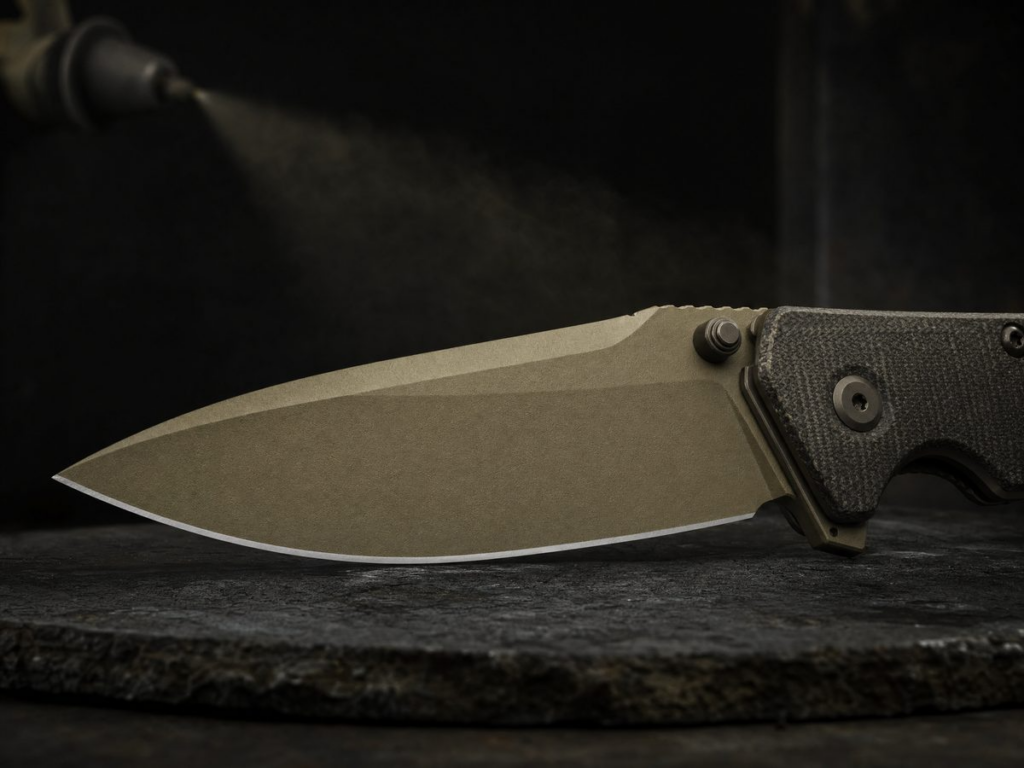
Cerakote is a ceramic-polymer coating sprayed onto a surface and then cured. It bonds to metal, plastic, wood, and composites. For knife blades, the most relevant lines are H-Series and Elite Series.
- H-Series is oven-cured at around 250°F. It is the most common choice for metal blades and offers the widest color range.
- Elite Series is thinner and harder than standard H-Series. It works well on precision blades where tolerances matter.
- C-Series is air-cured and mainly used for handles and polymer parts.
According to the Cerakote H-Series technical data sheet, H-Series achieves 9H gouge hardness, 5B adhesion, and passes 2,000+ hours of ASTM B117 salt spray testing. Those numbers explain why Cerakote is popular for corrosion-heavy environments.
Cerakote films are thicker than DLC. A typical H-Series coating is 1.0 mil, or about 25 microns. On a folding knife, that thickness can affect pivot tolerances if the coating is applied too heavily. On fixed blades and handles, the added thickness is rarely a problem.
The main selling points are:
- Over 200 colors and custom patterns
- Strong salt spray and chemical resistance
- Lower application cost than DLC
- Easy color matching for brand lines and seasonal SKUs
DLC vs Cerakote: Head-to-Head Comparison
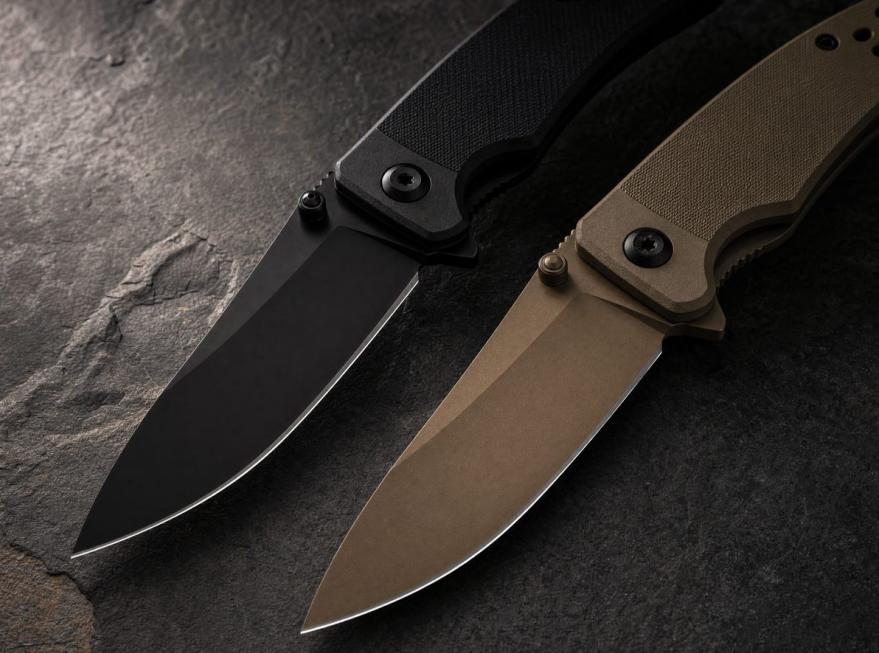
Hardness and Scratch Resistance
DLC is harder. A typical DLC coating measures 1,500–9,000 HV on the Vickers scale. Bare stainless steel blades usually measure 200–300 HV. Tool steel blades reach 600–900 HV. That means DLC is significantly harder than the blade underneath.
Cerakote is rated by pencil hardness. H-Series reaches 9H gouge hardness and 8H scratch hardness. Pencil hardness and Vickers hardness are not directly comparable, but the practical difference is clear: DLC resists abrasion and scratching better in everyday knife use.
For B2B buyers, this matters for returns. A DLC-coated tactical folder is less likely to come back with visible wear after normal carry — only diamond abrasives, CBN (cubic boron nitride) grinding media, or tungsten carbide will scratch the surface.
A Cerakote-coated blade, however, can pick up visible marks from everyday contact: keys in the same pocket, sand or quartz grit, metal zipper pulls, the inner lip of a Kydex sheath, or another knife blade. That wear typically shows first on high-contact areas like holster mouths or sheath lips.
Corrosion and Chemical Resistance
Cerakote leads here. The H-Series TDS lists 2,000+ hours of salt spray resistance per ASTM B117. That is well above the requirements for most marine, kitchen, and food-contact applications.
DLC corrosion resistance depends heavily on surface preparation. A properly applied DLC layer acts as a barrier, but pinholes or poor substrate prep can create weak spots. In normal use, both coatings protect against sweat and humidity. In aggressive environments, Cerakote has the edge.
Color and Aesthetics
DLC is mostly black. Some suppliers offer gray or near-black finishes. Color DLC exists but is rare and expensive.
Cerakote offers the full palette: matte, gloss, metallic, battleworn, camouflage, and custom-matched brand colors. For product lines that rely on visual variety, Cerakote is the practical choice.
Thickness and Edge Geometry
DLC is 1–4 microns thick. It preserves tight tolerances on folding knives.
Cerakote is roughly 12–25 microns thick. On a folder pivot or stop pin, that can matter. Most applicators can mask critical surfaces, but the added process step raises cost and complexity.
Both coatings will expose base steel at the edge after the first sharpening. The coating protects the blade faces, not the cutting edge itself.
Temperature Resistance
Cerakote wins on temperature resistance.
DLC begins to graphitize above 350°C; oxidation accelerates above 400°C, and by roughly 800°C its corrosion protection is completely lost. Normal knife use never reaches this range, but industrial sterilization or extreme heat applications can.
Cerakote H-Series is an oven-cure coating designed for general-purpose durability rather than extreme heat. Its standard cure schedule is 250°F (121°C) for 2 hours.
For kitchen knives that see repeated dishwasher or sterilization cycles, standard H-Series remains stable because the temperatures involved stay well below its threshold, while Cerakote offers superior corrosion resistance in wet environments.
DLC vs Cerakote Cost Comparison
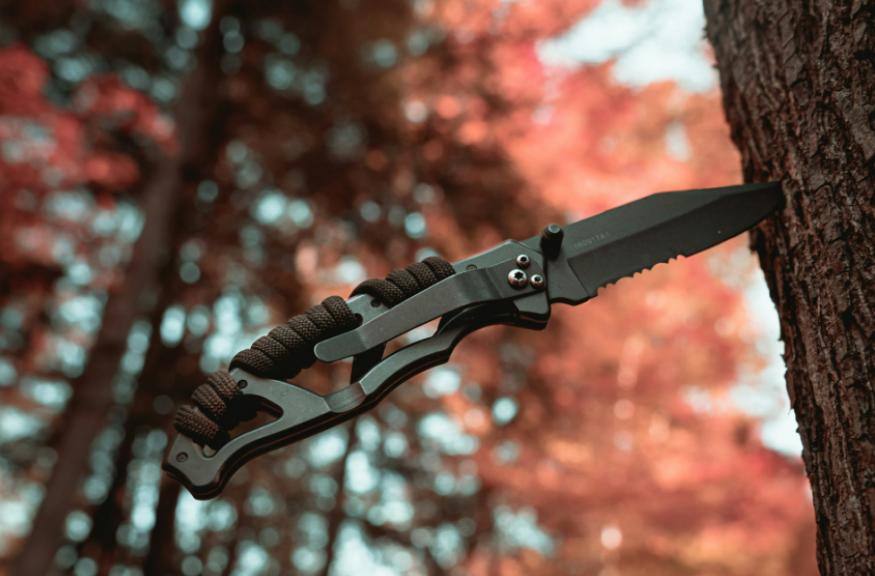
Coating cost affects both unit margin and perceived value. The two finishes sit at different price points.
| Cost Factor | DLC Coating | Cerakote |
|---|---|---|
| Batch production cost | $5–20+ per blade | $3–12 per blade |
| Retail premium | 30–80% over uncoated | 15–40% over uncoated |
| Setup flexibility | Better for large batches | Better for small runs |
| Color change cost | High (black/gray only) | Low (easy color switching) |
| Masking needs | Minimal | More common on folders |
| Rework / touch-up | Harder and more expensive | Easier and cheaper |
Batch Production Cost
- DLC: roughly $5–20+ per blade. ta-C and W-DLC run at the higher end.
- Cerakote: roughly $3–12 per blade, depending on color, complexity, and masking needs.
DLC requires vacuum chamber equipment. Setup and batch size affect pricing more than Cerakote, where spray application scales more flexibly.
Retail Pricing Impact
- DLC typically supports a 30–80% retail premium over an uncoated equivalent.
- Cerakote typically supports a 15–40% premium.
The right choice depends on what your customers pay for. Tactical and hard-use buyers often accept a higher price for wear resistance. Casual EDC and gift buyers may respond better to color and customization at a lower upcharge.
Cost Factors to Confirm with Suppliers
- Blade size and geometry
- Annual volume
- Double-sided or single-sided coating
- Masking requirements for folders and pivots
- Surface prep method (sandblast, ultrasonic clean, etc.)
- Rejection rate and rework policy
Get itemized quotes for both finishes on the same blade. The difference per unit may be small, but it changes quickly when you multiply by thousands of pieces.
Which Knife Types Suit DLC?
DLC works best when wear resistance and premium positioning justify the cost:
- Tactical knives
- Premium EDC folding knives
- Outdoor and survival fixed blades
- Military and law enforcement knives
- Limited flagship models
The black finish also has a practical benefit for tactical users: low reflectivity.
Which Knife Types Suit Cerakote?
Cerakote works best when color variety and corrosion resistance matter more than maximum hardness:
- Colorful EDC folders
- Kitchen and chef knives
- Gift and collectible knives
- Budget-friendly custom lines
- Brand-color matched product families
For kitchen knives, the chemical resistance is a strong selling point. Cleaners, acids, and dishwasher exposure are harder on a finish than casual pocket carry.
How Do You Choose Between DLC and Cerakote for Your Knife Line?
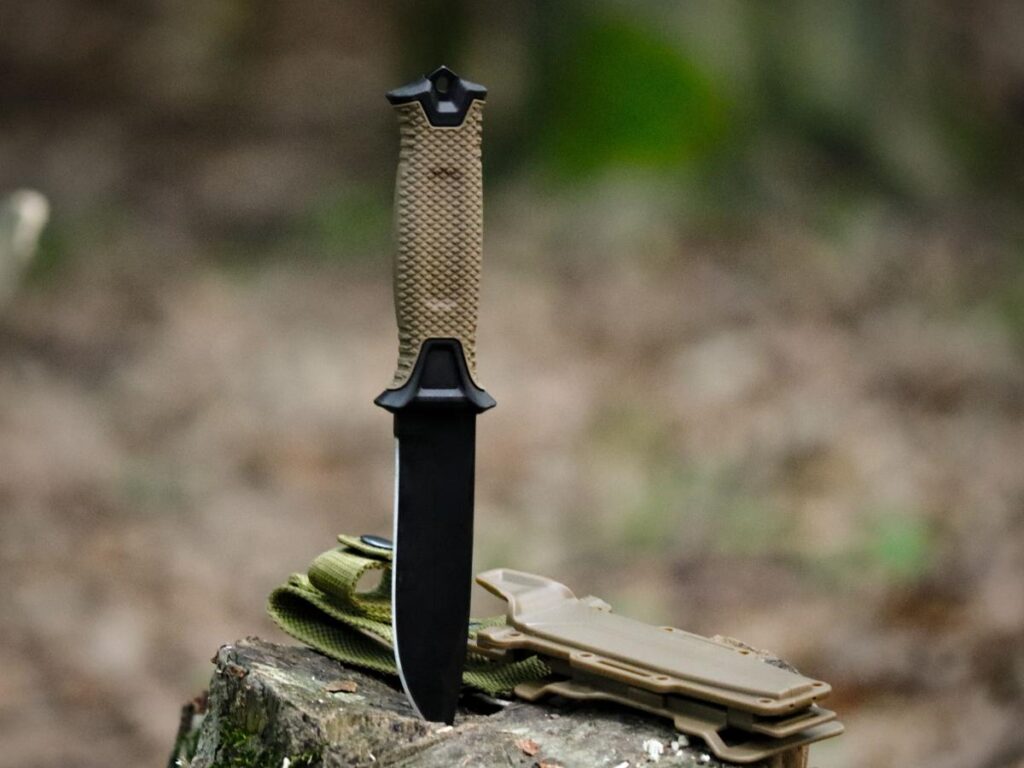
Ask these questions before you choose:
- Who is the end user? Tactical, outdoor, kitchen, or casual EDC?
- What is the target retail price?
- How many color SKUs do you need?
- Will the knife see heavy contact with holsters, sheaths, or abrasive surfaces?
- Will it face salt water, cleaners, or repeated sterilization?
- What is your annual volume?
- Do you need tight folding-knife tolerances?
Use this table to narrow it down:
| Product Line | Recommended Finish | Reason |
|---|---|---|
| High-end tactical or outdoor | DLC | Maximum wear resistance, premium black look |
| Colorful EDC series | Cerakote | Wide color range, lower cost |
| Kitchen knives | Cerakote | Chemical and corrosion resistance |
| Limited flagship | DLC | Higher retail premium, durable reputation |
| Gift or collectible | Cerakote | Visual appeal and customization |
| Budget-sensitive volume | Cerakote | Lower unit cost |
| Military or security | DLC | Low reflectivity, hard-wearing finish |
Source Your Coated Knife Line with Keganico
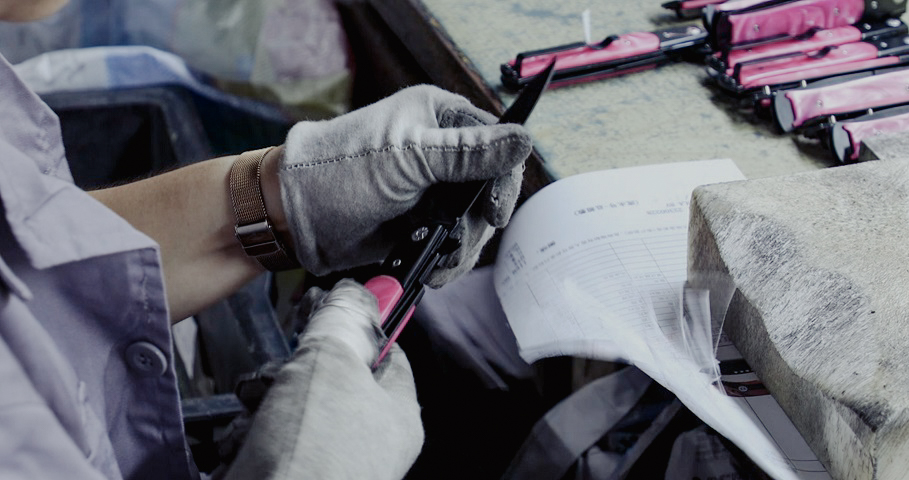
Choosing between DLC and Cerakote is only the first step. Execution matters just as much. A good coating partner controls surface prep, film thickness, and cure schedules. A weak one creates peeling, color mismatch, and returns.
Keganico runs production out of Yangjiang, China’s main knife manufacturing hub. We work with verified PVD, DLC, and Cerakote applicators and handle the sourcing steps that most buyers do not have time to manage:
- Finish selection — We match the coating to your blade steel, target price, and end use.
- Supplier qualification — We confirm salt spray, adhesion, and hardness reports before production starts.
- Sample approval — You evaluate coated samples before any mass order.
- Tolerance control — We mask folders and precision parts so coating thickness does not affect action or lock-up.
- Scalable runs — From small private-label batches to high-volume OEM orders.
If you are building a new knife line or switching finishes on an existing one, we can shorten the trial-and-error phase. Request a free quote.
Start Working with a Professional Now
Frequently Asked Questions
Is DLC better than Cerakote?
Not always. DLC is harder and more scratch-resistant. Cerakote offers more colors and better chemical resistance. The better choice depends on the knife type and the customer.
Does DLC coating wear off?
Under normal use, DLC rarely wears through. It holds up well to keys, coins, and sheath friction. Sharpening will remove the coating at the edge, but the blade faces stay protected.
Can you scratch DLC coating?
Everyday materials usually will not scratch DLC. Only harder substances like ceramic or tungsten carbide can mark it. DLC outperforms Cerakote and most PVD coatings in scratch resistance.
Is DLC coating always black?
Most DLC is black or dark gray. Color DLC exists but is limited and expensive. For broad color choice, Cerakote is the better option.
Does DLC coating rust?
DLC itself is chemically inert and does not rust. However, rust can form at coating defects or worn areas if the underlying steel is exposed. Regular wiping is enough for normal use.
How long does DLC coating last on a knife?
The blade face coating can last for years under normal use. The edge coating disappears after the first sharpening. Actual life depends on use intensity and environment.
How long does Cerakote last on a knife?
On blade faces, Cerakote can last for years. High-friction areas like sheath openings may show wear within months. Worn spots should be touched up to prevent localized corrosion.
Can you Cerakote over DLC coating?
Technically yes, but the DLC must be fully stripped first. Spraying Cerakote directly over DLC hurts adhesion. Most manufacturers choose one finish and stick with it.
Is Cerakote worth the money?
Yes, for lines that need color variety or work in corrosive environments. No, if the main selling point is maximum scratch resistance. Match the finish to the value proposition.
What is the most durable knife coating?
For abrasion resistance, DLC is more durable. For corrosion and chemical resistance, Cerakote is more durable. There is no single winner for every application.