If you’re sourcing knives and wondering whether to stick with G10 or switch to a lighter, cheaper polymer like Grivory, Ultem, or FRN—you’re not alone. It’s one of the most common decisions we face in OEM production. G10 delivers premium feel and proven grip, but polymers can cut unit costs by 30-60% while shedding real weight. The right choice depends entirely on your target price point and end user.
At Keganico, we’ve run this exact comparison across hundreds of OEM knife projects. From EDC folders retailing at $30 to premium tactical knives at $300+, the handle material often makes or breaks your margin.
This guide breaks down the real trade-offs: performance data, unit costs, and when to choose each material. Let’s find the right fit for your next product line.
Quick Comparison Table for B2B Buyers
| Material | Best For | Unit Cost (MOQ 500) | Weight | Target MSRP | Key Advantage |
|---|---|---|---|---|---|
| G10 | Premium tactical/EDC | $3.50–$5.00 | Heavy (1.7–1.9 g/cm³) | $80–$200 | Best grip in wet conditions |
| Grivory | Mid-range EDC | $1.20–$2.00 | Light (1.3–1.5 g/cm³) | $30–$80 | Best value balance |
| Ultem (PEI) | Premium flagship | $2.50–$4.00 | Light (1.27 g/cm³) | $150–$300+ | Best strength-to-weight |
| FRN | Budget/high-volume | $0.50–$1.20 | Lightest (1.1–1.3 g/cm³) | $20–$60 | Lowest cost at scale |
For a deeper side-by-side breakdown of just these two materials, see our guide on Grivory vs G10 handle material .
Material Overview
G10: The Premium Fiberglass Composite
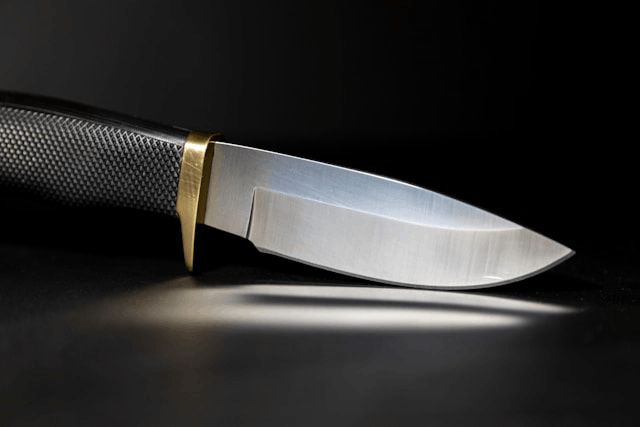
G10 is a high-strength laminate made by compressing layers of fiberglass cloth with epoxy resin under heat and pressure. It’s the go-to choice when you need a handle that feels premium and delivers reliable grip in any condition.
Pros:
- Excellent strength-to-weight ratio
- Superior wet/cold grip performance
- Highly resistant to moisture and chemicals
- CNC-machined textures look premium
Cons:
- Heavier than injection-molded polymers
- Higher machining cost per unit
- Hard feel may not suit all user preferences
Typical Use: Mid-to-premium EDC knives, tactical folders, outdoor fixed blades.
Grivory: The Lightweight Engineering Polymer
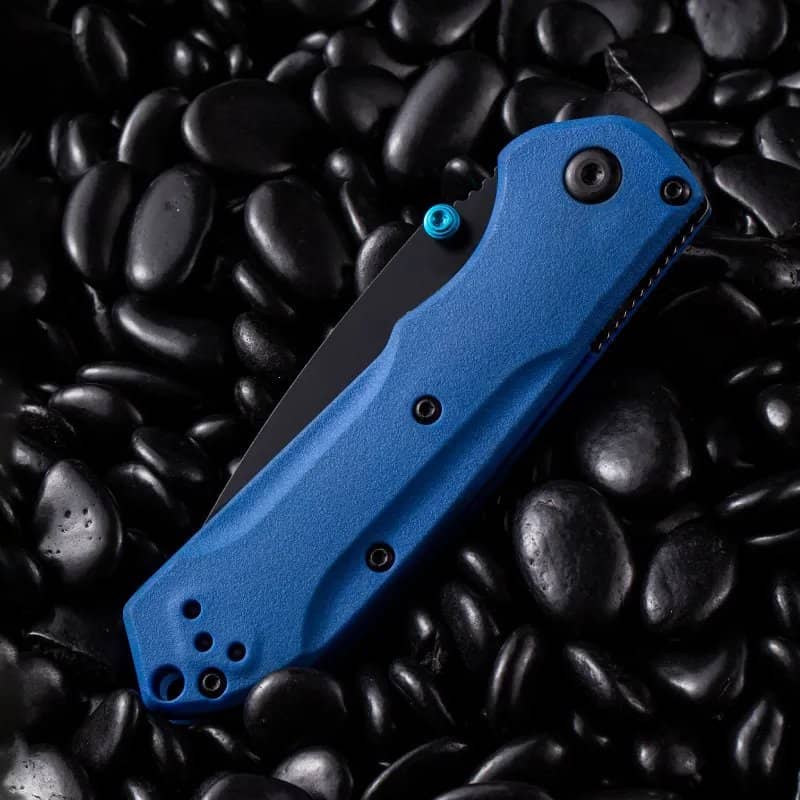
Grivory is a high-performance semi-crystalline polyamide developed by Swiss EMS-GRIVORY. It uses glass-fiber reinforcement to achieve rigidity close to metal while staying extremely light—ideal for high-volume injection molding.
EMS-Grivory GVX technical specifications confirm 50–70% glass fiber reinforcement for high rigidity. Source: EMS-Grivory GVX Datasheet
Pros:
- Up to 40% lighter than G10
- Fast injection molding cycle = lower unit cost
- Good heat and chemical resistance
- Complex textures possible in-mold
Cons:
- Lower rigidity than Ultem
- Texture depends on mold quality
- Feels more “plastic” than G10
Typical Use: Budget EDC folders, high-volume tactical lines.
Start Working with a Professional Now
Ultem: The Premium Thermoplastic Powerhouse
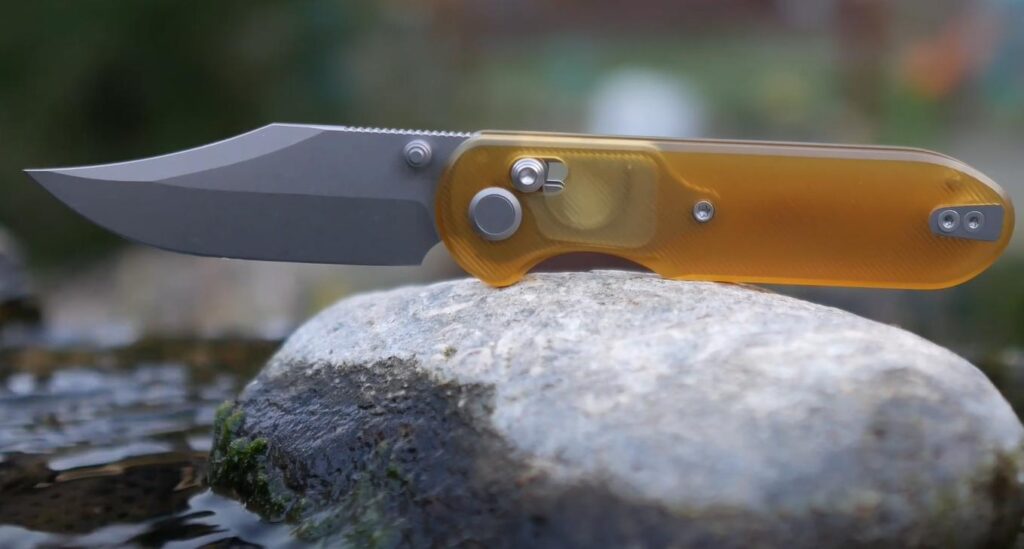
Ultem (PEI, polyetherimide) is a high-performance thermoplastic manufactured by SABIC. It delivers near-G10 strength at near-Grivory weight, with exceptional heat resistance and a distinctive amber-translucent appearance that signals “premium” on the shelf.
Pros:
- Highest strength-to-weight ratio in this group
- Outstanding heat resistance (up to 170°C / 338°F)
- Unique amber-translucent look stands out
- Naturally UV and chemical resistant
Cons:
- Most expensive polymer option
- Requires precision injection molding
- Limited color range (natural amber is standard)
Typical Use: Flagship EDC knives, premium tactical/outdoor lines.
Data Verified: SABIC ULTEM™ resin specifications confirm glass transition temperature of 217°C and heat resistance up to 170–200°C. Source: SABIC ULTEM Technical Data.
FRN: The Budget-Friendly Workhorse
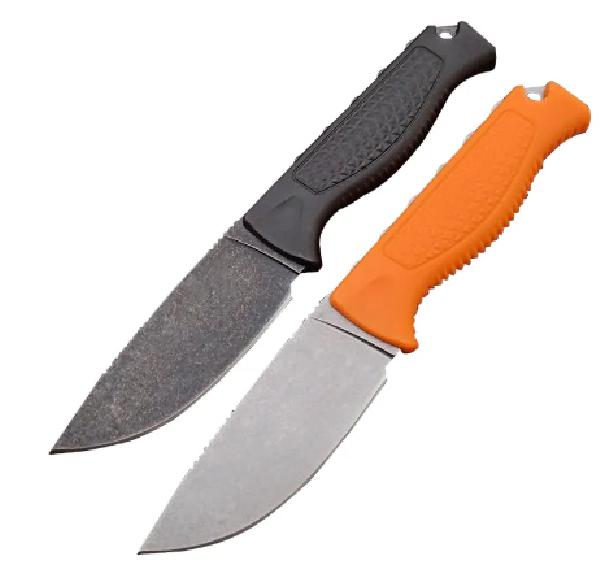
FRN (Fiberglass Reinforced Nylon) is a glass-fiber filled polyamide engineered for maximum toughness at minimum cost. It’s the material of choice when you need a handle that survives daily abuse without adding weight or driving up unit cost.
Pros:
- Lightest option in this comparison
- Lowest per-unit cost at scale
- Natural textured grip—no secondary machining needed
- Excellent impact resistance
Cons:
- Lower rigidity than G10 and Ultem
- Prolonged UV exposure can cause surface degradation
- Perceived as “budget” by end users
Typical Use: Entry-level EDC, high-volume production, lightweight carry.
Head-to-Head Comparison
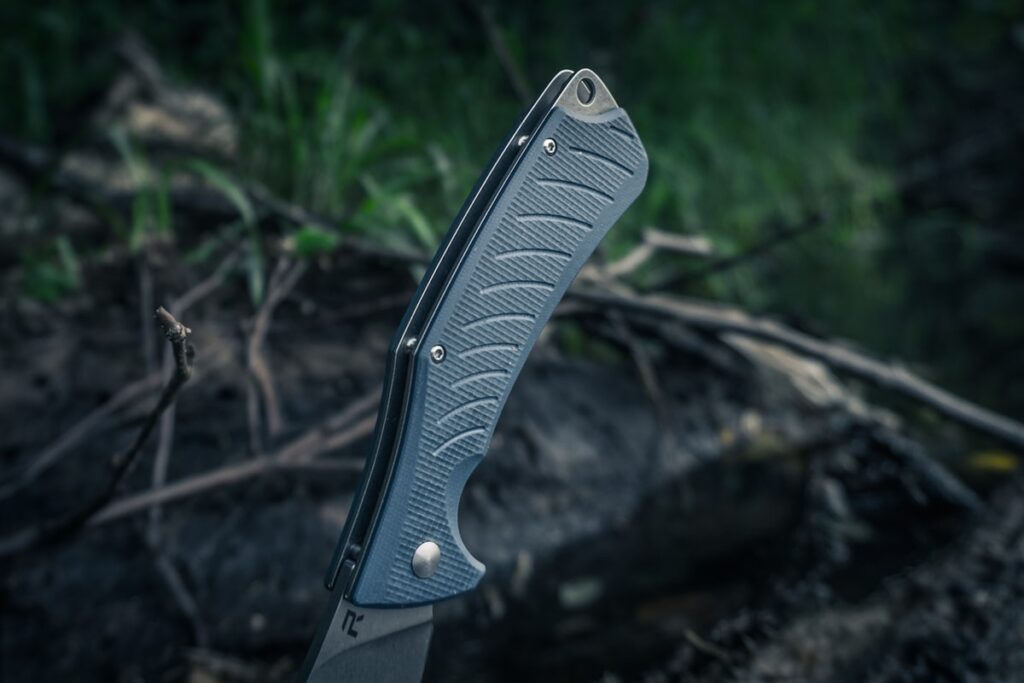
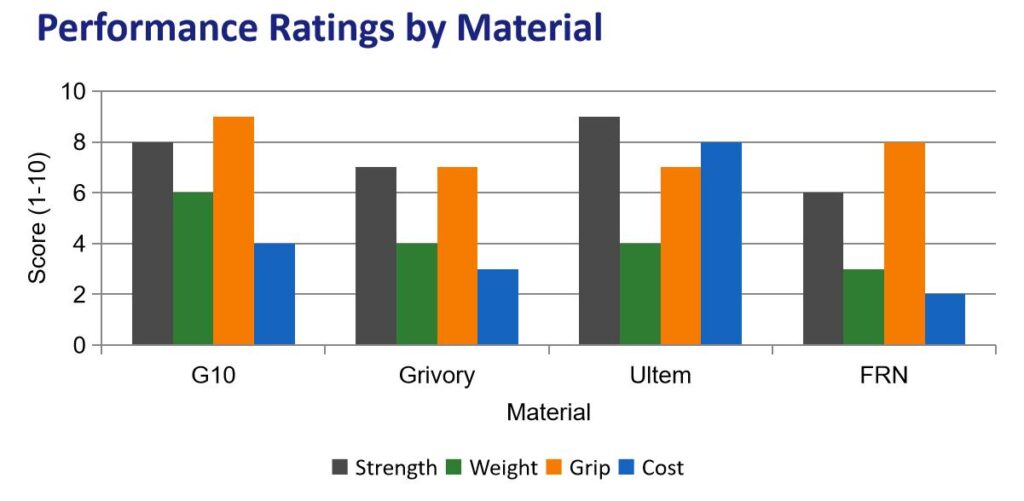
Quick Take: G10 dominates in raw strength and grip. Ultem offers the best strength-to-weight ratio. Grivory and FRN win on cost efficiency. The right choice depends on your target price tier.
| Feature | G10 | Grivory | Ultem (PEI) | FRN |
|---|---|---|---|---|
| Density (g/cm³) | 1.7–1.9 | 1.3–1.5 | 1.27 | 1.1–1.3 |
| Tensile Strength (MPa) | 250–350 | 120–180 | 105–150 | 80–120 |
| Heat Resistance (°C) | 140–160 | 120–150 | 170–200 | 80–120 |
| Impact Resistance | Good | Very Good | Excellent | Excellent |
| Grip (Dry/Wet) | Excellent / Excellent | Good / Good | Good / Fair | Good / Good |
| Processing Method | CNC Machining | Injection Molding | Injection Molding | Injection Molding |
| Unit Cost (MOQ 500) | $3.50–$5.00 | $1.20–$2.00 | $2.50–$4.00 | $0.50–$1.20 |
| Color Customization | Limited | Good | Limited | Good |
| Target MSRP | $80–$200 | $30–$80 | $150–$300+ | $20–$60 |
Data Sources: Manufacturer datasheets (SABIC, EMS-GRIVORY), industry benchmarks, Keganico production data.
Detailed Performance Breakdown
Weight & Density
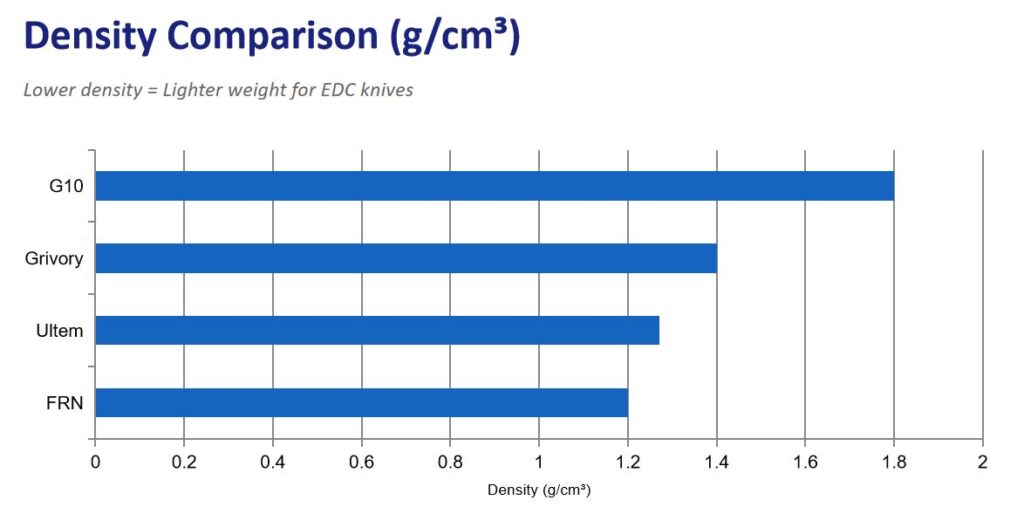
For EDC knives, every gram matters. FRN is the lightest at 1.1–1.3 g/cm³, roughly 35% lighter than G10. Grivory and Ultem sit in the middle at ~1.3–1.5 g/cm³.
For OEM brands, this translates directly to carry comfort. A 120mm folding knife with FRN handles can save 20–30g compared to G10—enough to shift the knife from “noticeable in pocket” to “forget-it’s-there” territory.
B2B Impact: Lighter knives also reduce shipping costs per unit, which compounds quickly at 1,000+ piece orders.
Strength & Durability
G10 leads in tensile strength (250–350 MPa)—nearly double that of FRN and significantly higher than Grivory. This makes G10 the material of choice for hard-use tactical and outdoor knives where the handle may experience impact or torque.
Ultem, despite its lower density, delivers impressive impact resistance thanks to its amorphous polymer structure. It absorbs shock rather than cracking, making it surprisingly tough for its weight.
Grivory and FRN both excel in impact resistance but lack the rigidity needed for heavy prying or batoning tasks. For typical EDC and everyday slicing, however, both are more than sufficient.
Bottom Line: If your knife faces real abuse, G10 or Ultem. For daily carry and light tasks, Grivory and FRN hold up just fine.
Grip & Texture
G10’s layered fiberglass structure allows aggressive CNC-milled patterns—checkering, jimping, stippling—that deliver reliable grip in wet, muddy, or bloody conditions. This is why it’s the default for tactical and survival knives.
FRN and Grivory rely on molded-in textures, which are consistent and cost-effective but lack the crisp bite of machined G10. FRN’s natural surface tends to be slightly grippier than Grivory’s smoother finish.
Ultem’s naturally smooth surface can be texturized during molding, but it’s typically left polished to showcase its amber-translucent aesthetic. Grip is adequate but not outstanding.
Quick Reference:
| Condition | G10 | Grivory | Ultem | FRN |
|---|---|---|---|---|
| Dry | ★★★★★ | ★★★☆ | ★★★ | ★★★★ |
| Wet | ★★★★★ | ★★★☆ | ★★☆ | ★★★★ |
| Oily/Greasy | ★★★★ | ★★★ | ★★☆ | ★★★ |
Weather & Chemical Resistance
All four materials resist moisture far better than natural options like wood or Micarta, but they differ in extremes:
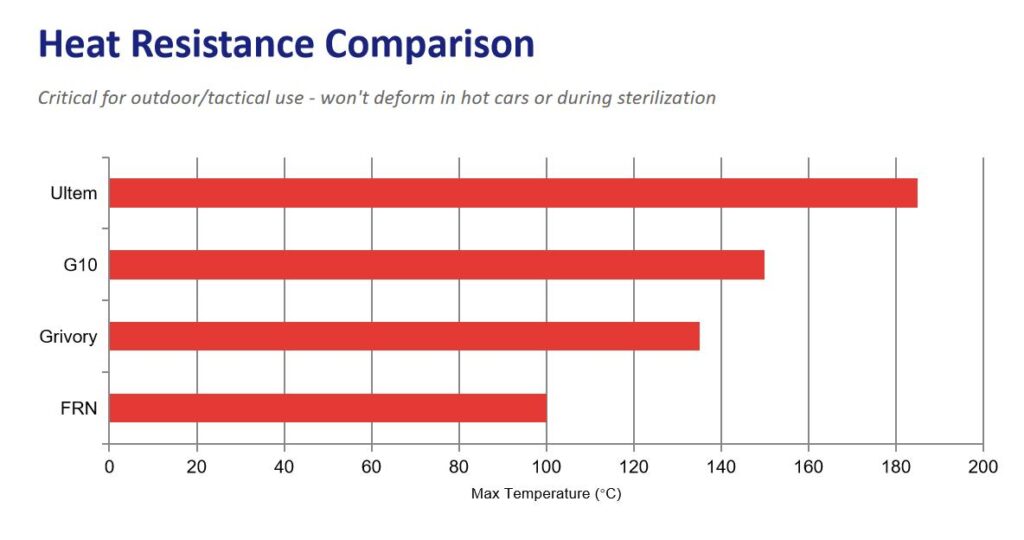
- Ultem stands alone with heat resistance up to 170–200°C. It won’t deform in a hot car or during sterilization processes.
- G10 handles 140–160°C and resists most solvents, oils, and salts.
- Grivory performs well up to 120–150°C with good chemical resistance.
- FRN is the weakest link here—prolonged UV exposure can cause surface chalking, and it softens above 80–120°C.
For coastal or humid markets: G10 or Ultem are your safest bets. For general use, all four outperform metals in corrosion resistance.
Manufacturing & Cost
This is where the decision becomes business-critical.
G10 requires CNC machining, which means higher labor costs, slower production rates, and more material waste. Unit cost at MOQ 500: $3.50–$5.00 per pair.
Grivory, Ultem, and FRN all use injection molding. Once the mold is paid for ($1,500–$3,000 depending on complexity), per-unit cost drops dramatically:
| Material | Mold Cost | Unit Cost (MOQ 500) | Unit Cost (MOQ 2,000) |
|---|---|---|---|
| G10 | N/A (CNC) | $3.50–$5.00 | $2.80–$4.00 |
| Grivory | $1,500–$2,500 | $1.20–$2.00 | $0.80–$1.40 |
| Ultem | $2,000–$3,000 | $2.50–$4.00 | $1.80–$2.80 |
| FRN | $1,000–$2,000 | $0.50–$1.20 | $0.30–$0.80 |
Production Timeline: Injection-molded handles typically require 25–35 days from mold approval to finished parts. G10 CNC runs take 15–20 days for the same quantity but at higher per-unit cost.
For OEM brands: If you’re launching a new line and expect reorders, injection molding pays for itself by the second batch. For small runs or prototypes, G10’s lower upfront cost makes more sense.
Best Use Cases by Material
So which material should you actually choose? Here’s how we typically guide OEM partners based on real production experience.
Choose G10 If:
You’re building a mid-to-premium knife where grip reliability and perceived quality matter more than weight savings.
G10 is the proven choice for tactical folders, hunting knives, and EDC knives designed for hard use. Its CNC-machined textures deliver unmatched grip in wet or muddy conditions—something injection-molded polymers struggle to replicate.
B2B Scenario: You’re launching a tactical line targeting the $80–200 MSRP range. Your buyers are outdoorsmen, first responders, or military personnel who prioritize function over weight. G10’s higher unit cost is justified by the premium feel and proven field performance.
We also recommend G10 when:
- Your knife will face harsh environments (rain, mud, blood, oil)
- You want aggressive texturing without secondary treatments
- Your brand positioning emphasizes “rugged” over “lightweight”
Choose Grivory If:
You need a balance of durability, light weight, and cost efficiency for high-volume production.
Grivory sits in the sweet spot between FRN’s budget pricing and Ultem’s premium performance. It’s 30–40% lighter than G10 while maintaining good structural integrity. The injection molding process also means faster turnaround and lower per-unit cost at scale.
B2B Scenario: You’re expanding your EDC lineup with a $40–80 everyday carry model. You want a handle that feels modern and lightweight without the “cheap plastic” stigma of basic FRN. Grivory’s engineering-grade reputation helps you position the knife as “thoughtfully designed” rather than “budget-cut.”
We also recommend Grivory when:
- You need complex handle geometries (integrated guards, finger grooves)
- Your target market values carry comfort over absolute strength
- You plan to reorder in batches of 1,000+ units (mold amortization kicks in)
Start Working with a Professional Now
Choose Ultem If:
You want flagship-level performance with a distinctive look that commands premium pricing.
Ultem (PEI) is the material that makes buyers stop scrolling. Its amber-translucent appearance catches light differently than any opaque polymer, signaling “this isn’t your average handle.” Beneath the surface, it delivers near-G10 strength at half the weight, with heat resistance up to 170°C.
B2B Scenario: You’re launching a limited-edition or flagship model targeting the $150–300+ range. You need a material that justifies the price tag through both performance and aesthetics. Ultem’s unique look differentiates your product on crowded retail shelves or e-commerce listings.
We also recommend Ultem when:
- You’re competing in the premium EDC or tactical market
- You want a signature material that becomes part of your brand identity
- Your end users value material innovation and story (EDC enthusiasts, collectors)
Choose FRN If:
Your priority is maximum value: light weight, reliable performance, and the lowest possible unit cost.
FRN is the undisputed champion of cost-effective handle materials. It’s the lightest option in this group, it molds easily with textured surfaces, and it absorbs impact without cracking. Yes, it reads as “budget”—but that doesn’t mean it performs like one.
B2B Scenario: You’re building an entry-level EDC knife or a high-volume promotional run targeting the $20–60 MSRP range. You need a handle that keeps unit cost down while still delivering acceptable grip and durability. FRN lets you hit aggressive price targets without sacrificing reliability.
We also recommend FRN when:
- You’re launching a new brand and need to minimize upfront investment
- Your end users prioritize affordability over premium materials
- You’re producing in large quantities (3,000+ units) where per-unit savings compound significantly
Quick Decision Matrix
| Your Priority | Recommended Material |
|---|---|
| Maximum grip in harsh conditions | G10 |
| Best strength-to-weight ratio | Ultem |
| Lowest cost at scale | FRN |
| Balance of weight, cost, and quality | Grivory |
| Premium aesthetics + performance | Ultem |
| Fastest production turnaround | FRN / Grivory |
B2B Sourcing Guide
For OEM brands and sourcing managers, the handle material decision extends beyond performance—it directly impacts your supply chain, margin structure, and reorder strategy. Here’s what you need to know before placing your next order.
Cost & MOQ Comparison
Material Unit Cost (500 pcs) Unit Cost (2,000 pcs) Mold/Setup Cost Lead Time G10 $3.50–$5.00 $2.80–$4.00 $200–$500 (CNC fixture) 15–20 days Grivory $1.20–$2.00 $0.80–$1.40 $1,500–$2,500 25–35 days Ultem $2.50–$4.00 $1.80–$2.80 $2,000–$3,000 30–40 days FRN $0.50–$1.20 $0.30–$0.80 $1,000–$2,000 20–30 days Note: Prices are for handle scales only. Final cost depends on blade steel, lock type, and finishing requirements.
Why Source from Yangjiang?
Yangjiang accounts for approximately 70% of China’s knife production, with a mature supply chain spanning raw materials, CNC machining, injection molding, heat treatment, and surface finishing. For handle materials specifically:
- G10: Multiple certified suppliers with CNC capacity for complex textures and tight tolerances (±0.05mm).
- Polymers (Grivory/Ultem/FRN): Established injection molding partners with in-house mold design, reducing lead time by 5–7 days compared to outsourcing.
- Quality Control: ISO 9001-certified factories with incoming material inspection, in-process checks, and final audit before shipment.
This concentration means faster turnaround, lower communication overhead, and more competitive pricing than sourcing from fragmented suppliers.
OEM vs ODM: Which Route Fits Your Business?
OEM (Your Design, Our Production): You provide CAD files or samples. We handle material sourcing, mold development, CNC programming or injection molding, and assembly. Ideal for established brands with existing designs.
ODM (Our Design, Your Brand): Choose from our ready-to-launch knife platforms, customize the handle material, blade steel, and finish, then apply your logo and packaging. Faster time-to-market with lower upfront investment.
For new brands: We typically recommend starting with ODM to validate the market, then transitioning to full OEM once you have sales data and customer feedback.
Partner with Keganico for Your Next Knife Line
Choosing the right handle material is just the first step. Bringing it to market requires a manufacturing partner who understands material behavior, cost optimization, and consistent quality control.
At Keganico, we specialize in helping brands scale—from single prototype samples to full production runs. Our Yangjiang-based facility handles G10 CNC machining, Grivory injection molding, Ultem thermoplastic forming, and FRN mass production under one roof.
How we support your business:
- Material Optimization: We recommend the best handle material based on your target MSRP and use case.
- Flexible Engagement: Choose from OEM Manufacturing (your design), Private Label (our platforms, your brand), or Wholesale Supply (ready-to-ship inventory).
- Fast Turnaround: 15–35 days from approval to finished goods, depending on material and volume.
- Transparent Pricing: No hidden mold fees, no surprise material substitutions.
Whether you’re launching a new EDC line, expanding your tactical offerings, or exploring cost-effective alternatives to your current supplier, we’re ready to help.
Tell us your specs and target price. We’ll reply with material recommendations, pricing, and available samples within 48 hours.
Frequently Asked Questions
Is G10 or FRN better for EDC knives?
It depends on your target price point and user priorities. G10 offers superior grip and a premium feel, making it ideal for mid-to-premium EDC knives ($80+). FRN is lighter and significantly cheaper, perfect for budget-friendly everyday carry knives under $60. For most EDC users, FRN is functionally sufficient—but G10 justifies a higher retail price.
What is Ultem (PEI) handle material?
Ultem is a high-performance polyetherimide (PEI) thermoplastic manufactured by SABIC. It delivers exceptional strength-to-weight ratio, heat resistance up to 170°C, and a distinctive amber-translucent appearance. In the knife industry, it’s positioned as a premium alternative to G10—offering similar performance at roughly half the weight, though at a higher material cost.
Is Grivory durable enough for tactical use?
Yes. Grivory’s glass-fiber reinforced polyamide structure provides solid impact resistance and good rigidity for most tactical applications. It won’t match G10’s absolute strength or grip texture, but for tactical knives in the $40–100 range, it delivers reliable performance with significant weight savings. Many major tactical brands already use Grivory for their mid-tier lines.
Which handle material is most cost-effective for mass production?
FRN is the most cost-effective at scale. At MOQ 2,000+, FRN handle costs drop to $0.30–$0.80 per pair, with fast injection molding cycles enabling high throughput. Grivory is a close second at $0.80–$1.40 per pair. Both materials amortize mold costs quickly across large orders, making them ideal for high-volume production runs.
Can I customize colors and textures for these materials?
Yes, but the flexibility varies. FRN and Grivory offer the best color customization through pigment additives during injection molding. G10 is typically limited to natural tan, black, or custom-colored layers (at higher cost). Ultem is most commonly left in its natural amber-translucent state—coloring is possible but reduces its unique aesthetic advantage. Texture is CNC-machined for G10 and mold-designed for all three polymers.
What’s the typical lead time for a custom handle material order?
For G10 (CNC machined): 15–20 days after design approval. For injection-molded polymers (Grivory, Ultem, FRN): 25–35 days, including mold fabrication (if new) and first production run. Rush orders are possible for existing mold designs—contact our team for specific timelines based on your project scope.