
Originally developed in 1943 for aerospace applications, Richlite has become a preferred handle material for brands like Benchmade, Kizer, and Artisan Revere due to its exceptional water resistance, heat tolerance up to 350°F (176°C), and NSF-certified food safety.
This guide covers Richlite’s material properties, how it compares to Micarta, G10, and wood, and what to look for when sourcing knives with Richlite handles.
Key Takeaways
- Eco-Friendly Composition: Richlite is a dense, non-porous composite made from ~65% FSC-certified recycled paper and ~35% phenolic resin.
- High Durability: It is heat-resistant up to 350°F (176°C ), highly water-resistant, and NSF-certified for food contact with natural antimicrobial properties.
- Richlite vs. Micarta: Compared to traditional Micarta, Richlite offers a smoother, more uniform wood-like finish and superior eco-credentials.
- Brand Adoption: Top knife brands including Benchmade, Kizer, and Artisan Revere use Richlite handles in their production models.
- Low Maintenance: It requires minimal care; simply clean with mild soap and warm water, avoiding strong alkaline cleaners.
What is Richlite knife scales?
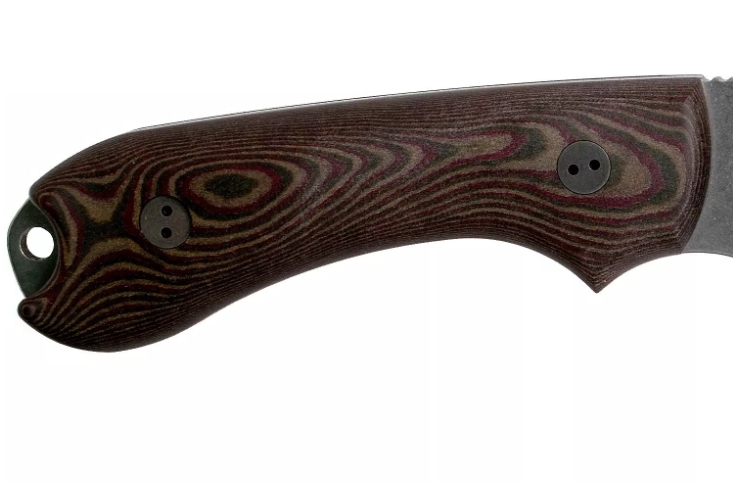
Richlite knife scales are highly durable, eco-friendly knife handles made from a dense composite of approximately 65% FSC-certified recycled paper and 35% phenolic resin. Unlike natural wood that can warp or crack, or plastics that feel cheap, Richlite is compressed under extreme heat and pressure to create a solid, non-porous material. It is completely waterproof, heat-resistant up to 350°F (176°C), and possesses natural antimicrobial properties.
Because of its high density (about 75.84 lb/ft³), a Richlite handle feels solid and substantial in the hand, much like a premium hardwood, making it a top choice for custom knife makers, premium EDC folders, and high-end kitchen cutlery.
Originally used in aerospace and skate parks, Richlite has found its niche in the world of cutlery as a durable option for knife scales.
How is Richlite made?
Wondering what goes into creating this material? Here’s a quick rundown of the steps:
- Start with layers of recycled paper.
- Soak with phenolic resin.
- Compress under heat and pressure.
- Cure through baking to solidify.
Firstly, Richlite is crafted from layers of recycled paper. These aren’t just any paper but high-quality, post-consumer recycled paper that is a great choice for environmentally conscious users like you.
Then, these paper layers are soaked in a resin. It’s not just any resin, but a phenolic resin, which acts as a hardening agent. Using such resins ensures that Richlite has a sturdy and lasting bond between the paper fibers.
Following the infusion with resin, the layered material undergoes a compression process. This is done under high temperature and pressure, which is significant as it combines the paper and resin into a solid, non-porous slab.
Richlite’s finishing touch involves curing through a baking process that transforms it into a dense and stable product.
This handling of the material is similar to working with popular culinary materials like Micarta or G-10, which means that if you’re familiar with those, you’ll take to Richlite like a knife to butter:
Micarta
Micarta is s made from layers of cloth that are soaked in a phenolic resin, causing it to harden into a sturdy material.

G-10
Think of G-10 as Micarta's close cousin, but instead of cloth, it uses fiberglass.
Start Working with a Professional Now
Richlite Material Properties and Specifications
To understand why Richlite performs so well as a knife handle, it helps to look at the hard data. According to official material specifications, Richlite offers engineering-grade performance:
| Property | Specification | Practical Benefit for Knives |
| Density | ~75.84 lb/ft³ (SG ~1.213) | Heavier than most woods; provides a solid, balanced feel in hand. |
| Tensile Strength | 13,100–19,200 psi | Extremely strong and resistant to breaking under heavy use. |
| Heat Resistance | Up to 350°F (176°C) | Safe for hot kitchen environments and dishwashers (though hand washing is recommended). |
| Water Absorption | Non-porous | Excellent waterproofing; will not swell, warp, or retain odors. |
| Food Safety | NSF-certified, JIS Z 2801 | Safe for direct food contact with natural antimicrobial properties. |
Pros and cons of Richlite knife scales
When you’re considering the materials for your knife scales, Richlite offers some notable advantages and drawbacks you’ll want to keep in mind:
Pros: Is Richlite good for knife handles?
Yes, Richlite is an exceptional material for knife handles due to its unique blend of toughness and sustainability.
- Durability: It’s tough, durable, and heat-resistant up to 350°F (176°C), meaning it can take a beating without showing much wear.
- Lightweight: You won’t feel weighed down, which makes handling a breeze.
- Sustainable Choice: Richlite scales are eco-friendly, made from recycled content, and endorsed by environmental stewardship entities like the FSC and Greenguard.
- Ease of Work: If you need to customize your scales, Richlite shapes up nicely with sanding and polishing.
- Water Resistance: No need to worry about moisture; Richlite is non-porous and resists water damage.
- Evolving Aesthetic Appeal: Their mottled appearance enriches over time.
Cons: : What are the disadvantages of Richlite?
While highly durable, Richlite does have a few limitations depending on your specific needs.
- Does Richlite scratch easily? While it is highly impact-resistant, the smooth, matte surface of Richlite can show surface scratches and scuffs more easily than heavily textured materials like G10. However, these superficial marks often blend into the material’s patina over time.
- Potential Color Shifts: Due to the thermosetting resin, Richlite knife scales might change hue over time, which could be a downside for collectors who prize consistent aesthetics.
- Uniform Appearance: Unlike natural wood grains, Richlite has a more uniform appearance, especially in darker shades. This might not appeal to those charmed by the uniqueness of traditional wooden textures.
- Specific Maintenance: While generally low maintenance, using a specialized plant-based emulsion is recommended to enhance luster and protect Richlite scales long-term.
Richlite vs Micarta: Is Richlite like Micarta?
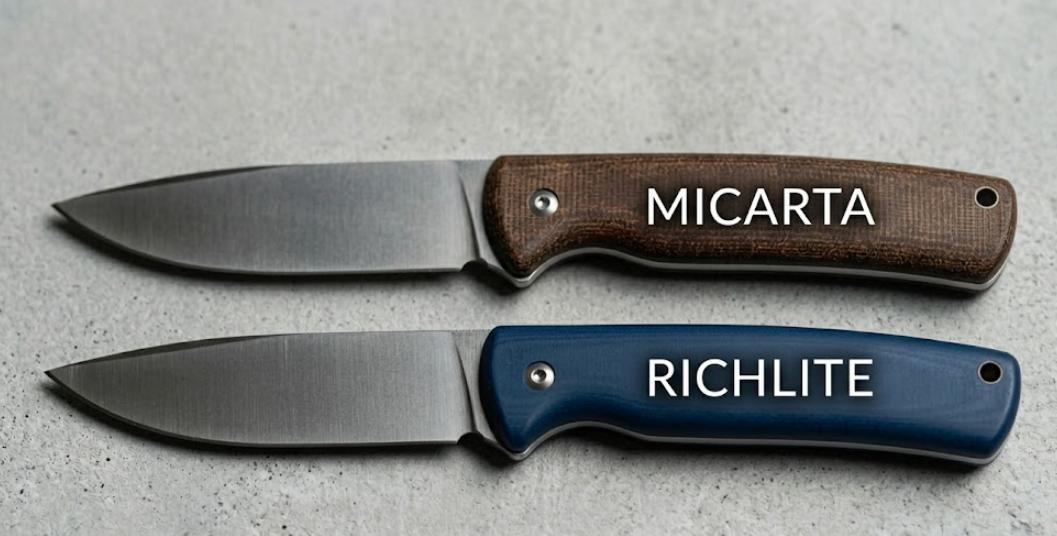
Richlite is actually a specific brand of paper-based Micarta — so in the strictest sense, you’re comparing a subcategory to its parent category. When knife makers ask “Richlite vs Micarta,” they almost always mean Richlite (paper-based) versus traditional Canvas or Linen Micarta.
The key difference lies in texture and maintenance.
Canvas and linen Micarta have exposed fabric fibers that create an aggressive, grippy texture — excellent for wet-condition tactical or hunting knives. But those same fibers can absorb oils, blood, and dirt over time, requiring more frequent cleaning.
Richlite, being paper-based and fully non-porous, offers a smoother, wood-like finish that wipes clean easily and won’t harbor bacteria — making it the stronger choice for kitchen knives and premium EDC folders.
| Feature | Linen/Canvas Micarta | Richlite (Paper Micarta) |
| Materials | Linen or Canvas + Phenolic Resin | FSC-Certified Recycled Paper + Phenolic Resin |
| Texture | Rougher, excellent grip | Smoother, wood-like feel |
| Appearance | Visible fabric texture | Wood-like grain |
| Heat Resistance | Good (up to 150°C) | Excellent (up to 176°C) |
| Eco-Friendliness | Moderate | High (uses recycled materials) |
| Water Resistance | Good | Better (fully non-porous) |
| Customization | Limited color options | Wide range of colors available |
| Maintenance | Medium (can absorb surface oils/dirt) | Very Low (wipes clean easily) |
| Best For | Tactical, hunting, hard-use outdoor knives | Kitchen knives, premium EDC, custom scales |
So, when choosing between Micarta and Richlite for your knife handle, the decision comes down to use case. If you need a battle-ready grip for a hunting or tactical knife that sees rough, wet conditions, traditional canvas or linen Micarta is the better fit. If you want a handle that looks refined, stays hygienic, and requires almost no upkeep — whether it’s a chef’s knife or a gentleman’s folder — Richlite is the clear winner.
Richlite vs G10
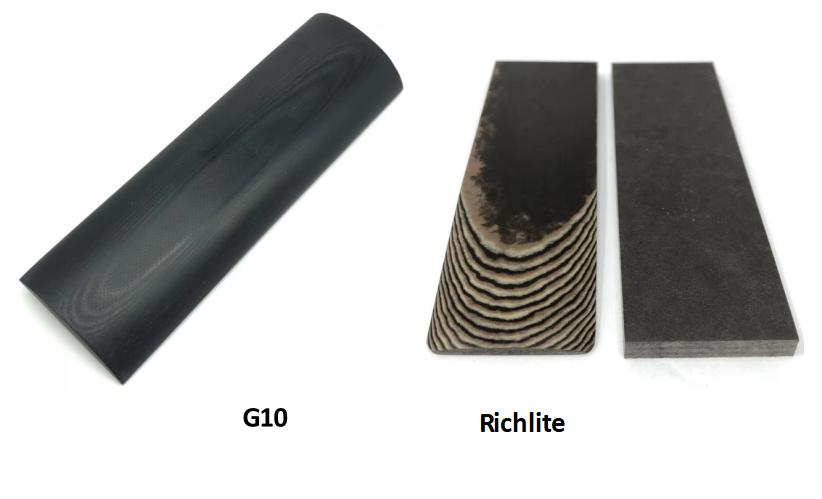
G10 and Richlite are both high-quality, durable, and moisture-resistant materials used for knife handles, but they serve different priorities. G10 is constructed from layers of fiberglass laminate baked in epoxy resin — the undisputed choice when maximum grip and near-indestructible impact resistance are the only priorities. In contrast, Richlite is crafted from paper pulp and resin, resulting in a handle that feels smoother and warmer to the touch, and develops a subtle natural patina over time, much like premium hardwood.
The practical gap shows up in two areas.
First, aesthetics: G10 has a cold, industrial look that suits tactical folders but feels out of place on a chef’s knife or a premium gentleman’s EDC. Richlite bridges the gap between synthetic durability and natural beauty.
Second, machinability: G10 is notoriously hard on cutting tools and produces hazardous fiberglass dust when shaped. Richlite machines more like dense hardwood, making it significantly easier and safer to work with for custom knife makers.
| Attribute | G10 | Richlite |
| Material | Fiberglass laminate | Paper pulp/fibers with resin |
| Texture | Rougher to the touch | Smoother and warmer to the touch |
| Grip Strength | Outstanding | Good |
| Impact Resistance | Exceptional | Excellent |
| Aesthetic | Industrial look | Natural and rustic appearance |
| Machinability | Difficult; produces hazardous fiberglass dust | Easy; machines like dense hardwood |
| Best For | Survival knives, hard-use tactical folders | Kitchen knives, premium EDC, custom scales |
The Verdict: If you need a knife handle that can survive extreme abuse in the field and grip performance is everything, G10 is the right call. But if you want a handle that performs at the same high level while still looking elegant enough for a chef’s kitchen or a gentleman’s pocket — Richlite is the better choice.
Richlite vs wood
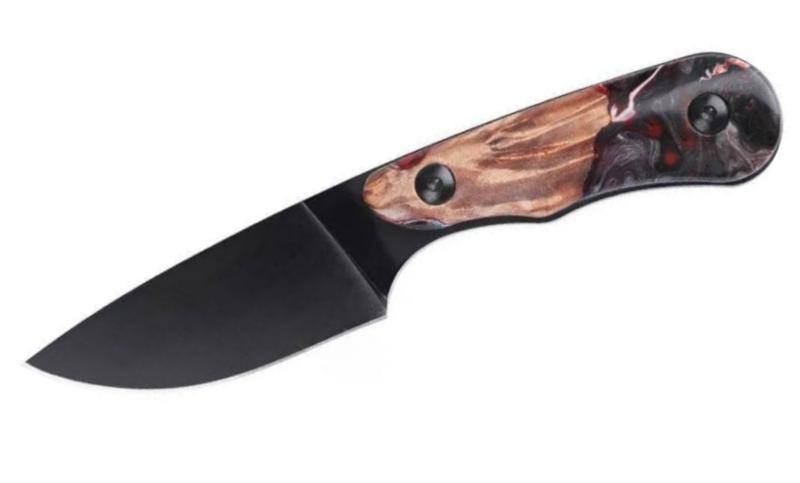
Richlite and wood are both quality materials used for knife handles. They are durable, look good, and offer a comfortable grip.
The main differences are in the material properties and maintenance needs. Richlite is made from paper pulp and resin, which gives it great waterproof qualities and impact resistance, and it doesn’t need much upkeep. Wood, on the other hand, requires regular maintenance like oiling or waxing to prevent it from drying out and absorbing water.
Here’s a table that summarizes their differences:
| Feature | Richlite | Wood |
| Material | Paper + Resin | Natural Wood |
| Waterproofing | Excellent | Average |
| Impact Resistance | Excellent | Depends on the Wood Type |
| Maintenance Needs | Low | High |
| Texture | Smooth and Warm | Naturally Warm |
| Aesthetic | Industrial | Classic Elegance |
So, if you’re looking for a knife handle that requires low maintenance and is highly durable, Richlite is a good fit. Wood, on the other hand, offers a classic beauty and a natural feel in the hand.
Richlite vs FRN
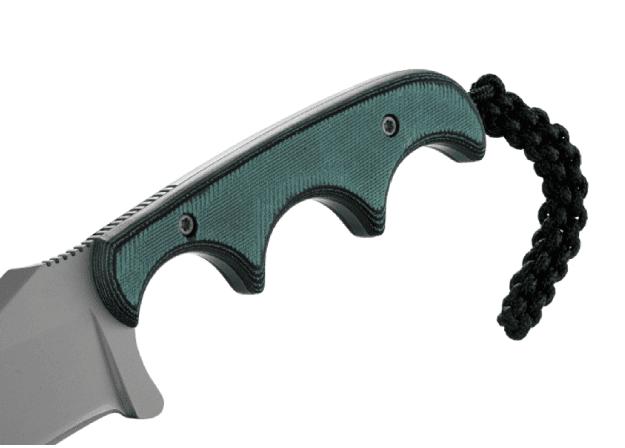
Richlite and FRN (Fiberglass Reinforced Nylon) are both strong materials used for knife handles. They’re known for their durability and strength. Both materials are waterproof, stain-resistant, and easy to clean.
The key differences lie in what they’re made of and how they feel. Richlite is created from paper pulp and resin, giving it a smooth and warm texture with a natural look. FRN is made from nylon mixed with glass fibers, which makes it a bit rougher to the touch but provides better grip and impact resistance.
Here’s a table that shows the differences:
| Feature | Richlite | FRN |
| Material | Paper + Resin | Nylon + Glass Fiber |
| Texture | Smooth and Warm | Rougher |
| Waterproofing | Excellent | Excellent |
| Impact Resistance | Excellent | Exceptional |
| Aesthetic | Natural Wood Grain | Industrial |
| Maintenance | Low | Low |
So, if you prefer a knife handle with a natural beauty and a warm feel, Richlite might be your choice. For those who need a strong grip and high durability, FRN could be the better option.
Start Working with a Professional Now
Which knives complement Richlite knife scales?
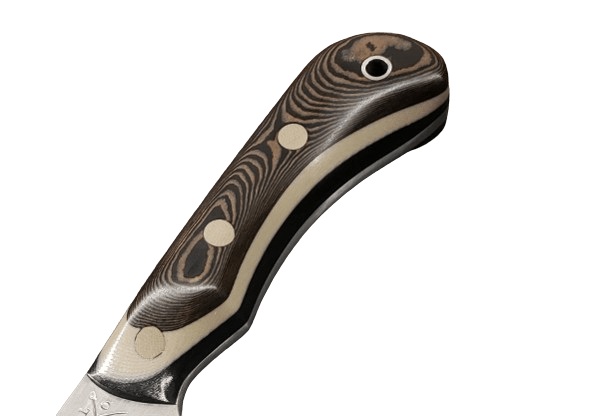
Many top-tier brands, including Benchmade, Kizer, and Artisan Revere, have adopted Richlite for their production models. Here is how it fits different knife types:
1. Custom and handmade knives
Richlite offers unique possibilities for custom and handmade knives. Due to its machinability, Richlite allows for a high degree of design flexibility. This means creators can easily sculpt the material into various shapes, catering to individual preferences.
The wide range of color options further enhances creative freedom, making Richlite suitable for knives intended for culinary use or personal collections.
Key features:
- Highly machinable for custom designs
- Available in a variety of colors
2. Kitchen knives
Richlite handles offer both aesthetic appeal and practical benefits for kitchen knives. Their attractive appearance and comfortable grip enhance the user experience. Additionally, Richlite boasts antimicrobial properties and heat resistance, making it suitable for long cooking sessions. They are also known for their resilience and ease of maintenance, qualities valued by many chefs.
Key features:
- Easy to clean
- Heat and impact resistant
3. Outdoor and tactical knives
Richlite’s durability and water resistance make it a viable option for outdoor and tactical knives. These handles can withstand the elements and require minimal care, making them suitable for various outdoor activities. Richlite’s strength allows it to endure harsh use in the field.
Key features:
- Weatherproof
- Stands up to demanding use
Closing insight: sourcing knives with Kegani
At Kegani, we don’t just source knives; we master the materials that make them exceptional. Whether you are looking to build a premium brand or scale your inventory, our deep expertise in handling technical composites like Richlite, G10, and Micarta ensures your designs are executed with surgical precision.
- Direct Manufacturing & Craftsmanship: Our facility combines traditional hand-finishing with modern CNC precision. By working directly with our engineering team, you ensure that every Richlite handle is perfectly contoured, finished, and fitted to the blade, meeting the highest standards of professional cutlery.
- Full-Scale Customization (OEM/ODM): We specialize in transforming your concepts into market-ready products. From custom handle textures and proprietary blade grinds to full private-label branding, our manufacturing capabilities are tailored to your precise technical specifications.
- Global Distribution: Benefit from our established export infrastructure, ensuring your custom orders are delivered from our workshop to your warehouse with full transparency and efficiency.
Ready to elevate your collection with knives that define quality and innovation? Request a Free Manufacturing Quote today, and let’s discuss how our craft can help your brand stand apart.
Frequently asked questions
What are the advantages of using Richlite over Micarta for custom knife scales?
Richlite offers unique advantages such as being highly eco-friendly since it’s made from recycled paper. It tends to have a more uniform color and a smoother, more wood-like finish compared to the fabric texture of traditional canvas or linen Micarta.
Why might knife enthusiasts choose Richlite scales for their custom projects?
Knife enthusiasts are drawn to Richlite for its sustainability, exceptional durability, ease of maintenance, and the sleek, warm look it offers. It perfectly blends traditional craftsmanship aesthetics with modern, environmentally responsible engineering.
Does Richlite contain microplastics?
No, Richlite does not contain microplastics. It is made entirely from FSC-certified recycled paper and phenolic resin. This makes it an exceptionally safe and healthy choice, especially for kitchen knives and culinary surfaces.
Does Richlite need to be oiled?
Richlite does not require oiling for structural integrity or waterproofing, as it is non-porous. However, applying a light coat of food-safe mineral oil can help restore its dark, rich color and mask minor surface scuffs.
Is Richlite completely waterproof?
Yes, Richlite is 100% waterproof. Because it is manufactured by saturating paper fibers with phenolic resin and baking it under extreme pressure, the resulting material is completely non-porous. It will not absorb water, swell, warp, or harbor moisture-loving bacteria, making it an exceptional material for kitchen knives and outdoor gear that frequently gets wet.
Does Richlite have formaldehyde?
While phenolic resins are used in the manufacturing process, the final baked and cured Richlite product is completely inert. It is Greenguard certified for indoor use, meaning it meets strict chemical emissions limits and is safe for everyday handling.
Where is Richlite manufactured?
Richlite is proudly manufactured in the United States, specifically in Tacoma, Washington, where the company has been producing paper-composite materials since 1943.
What is the lifespan of Richlite?
With proper basic care, Richlite knife scales can easily last a lifetime. The material is incredibly stable and resistant to the environmental factors (like moisture and temperature swings) that typically degrade other handle materials.