When sourcing knife handle materials for OEM production, the debate often comes down to Micarta vs. G10, carbon fiber, or wood. As a premium phenolic resin composite, Micarta knife handles deliver a unique aesthetic depth and superior wet grip that injection-molded plastics simply cannot match.
But is Micarta the most cost-effective choice for your 1,000+ unit run?
Balancing raw material costs, CNC machinability, and target MSRP is critical. Drawing from Keganico’s extensive factory experience, this guide breaks down Micarta substrates (canvas, linen, paper) and compares them head-to-head against every major alternative to help you spec the perfect handle for your next project.
Micarta vs. All Handle Materials: Master Comparison Table
Before diving into each matchup, here’s a consolidated view of every major handle material across the dimensions that matter most to OEM buyers and end users.
| Material | Durability | Wet Grip | Weight | Raw Material Cost (Per Pair, Bulk) | Maintenance | Heat Tolerance | QC Consistency (1,000+ Units) | Best For |
|---|---|---|---|---|---|---|---|---|
| Canvas Micarta | ★★★★★ | ★★★★★ | Medium | $1.50 – $3.50 | Low | Up to 300°F | >99% pass rate | Tactical, outdoor, heavy-use |
| Linen Micarta | ★★★★☆ | ★★★★☆ | Medium | $2.00 – $4.50 | Low | Up to 300°F | >99% pass rate | Premium EDC, everyday carry |
| G10 | ★★★★★ | ★★★★☆ | Light | $0.80 – $2.00 | None | -100°F to 300°F | >99% pass rate | Budget-friendly, high-volume |
| Carbon Fiber | ★★★★☆ | ★★☆☆☆ | Very Light | $8.00 – $25.00+ | None | Up to 500°F | >98% pass rate | Luxury, collector editions |
| Stabilized Wood | ★★★☆☆ | ★★★☆☆ | Medium-Heavy | $4.00 – $15.00 | Medium | Varies | 90–95% pass rate | Traditional, heritage designs |
| Richlite | ★★★★☆ | ★★★☆☆ | Medium | $3.00 – $6.00 | Low | Up to 350°F | >98% pass rate | Eco-friendly brands, urban EDC |
| Bone | ★★☆☆☆ | ★★☆☆☆ | Medium | $1.75 – $4.50 | High | Low | 85–90% pass rate | Vintage, collector pieces |
| Ultem (PEI) | ★★★★☆ | ★★☆☆☆ | Very Light | $6.00 – $12.00 | None | Up to 340°F | >99% pass rate | Tech-aesthetic, urban EDC |
How to read this table:
- Wet Grip is the #1 differentiator for tactical/outdoor knives — Micarta dominates here.
- Raw Material Cost reflects unfinished scale blanks; finished CNC-machined scales add $2–$8/pair depending on complexity.
- QC Consistency directly impacts your landed cost — a 10% rejection rate on bone scales means 10% wasted material and labor.
Data Sources:
- Raw Material Cost: Based on Keganico’s 2025–2026 procurement records.
- QC Consistency: Based on Keganico internal first-pass yield (FPY) data across 50,000+ units/year.
- Heat Tolerance: Per ASTM D709 Standard Specification for Laminated Thermosetting Materials (for Micarta/G10) and manufacturer datasheets.
Micarta Substrates: Canvas vs. Linen vs. Paper vs. Burlap
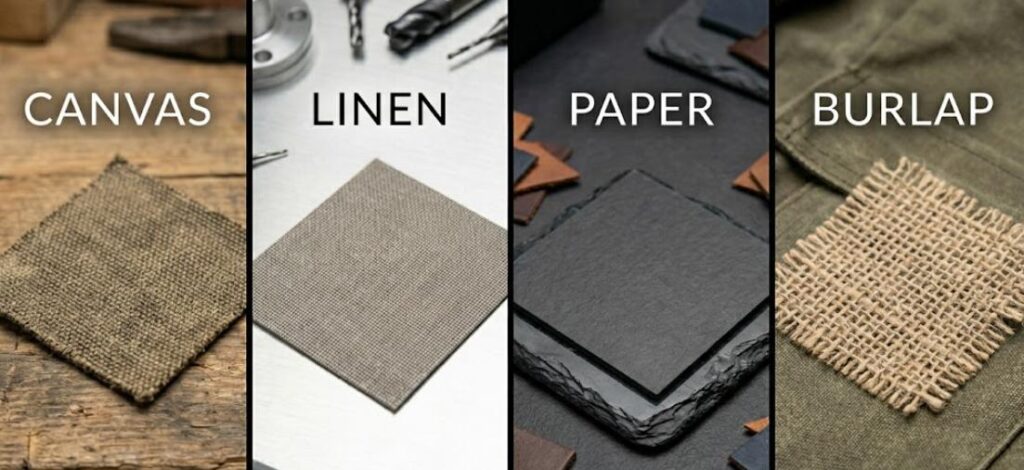
Micarta isn’t a single material — it’s a family of composites built by layering different substrates with phenolic resin under high pressure. The substrate you choose directly impacts grip texture, machining behavior, and final aesthetics.
| Substrate | Raw Cost (1k+ MOQ) | Wet Grip | CNC Machinability | Best For |
|---|---|---|---|---|
| Canvas Coarse Cotton |
$1.50 – $3.50 /pair | Fast (High Dust) | Tactical / Survival | |
| Linen Fine Fabric |
$2.00 – $4.50 /pair | Precise (Clean) | Premium EDC | |
| Paper Cellulose |
Custom RFQ | ⚠️ -15% Speed (Brittle) | Boutique / Custom | |
| Burlap Woven Jute |
Custom RFQ | Requires Specialty Tooling | Heritage Editions |
Canvas Micarta
Canvas Micarta uses coarse cotton fabric as its base material, creating an aggressive, highly textured surface. This makes it ideal for knives that demand maximum grip security in wet or muddy conditions — think outdoor survival knives, tactical blades, and hunting tools.
Why OEM buyers choose canvas Micarta:
- Highest friction coefficient among all Micarta types when wet
- Machines cleanly on standard CNC toolpaths
- Produces more dust than linen — requires HEPA-grade dust mitigation at scale
- Raw material cost: $1.50 – $3.50/pair at 1,000+ MOQ
From a manufacturing standpoint, canvas Micarta machines cleanly but produces more dust than linen variants. Keganico’s CNC knife manufacturing facilities use dust-mitigation protocols to ensure worker safety and consistent tolerances at scale.
Linen Micarta
Linen Micarta replaces coarse canvas with fine linen fabric, resulting in a smoother surface with more refined aesthetics. The grip remains secure but feels less aggressive against the palm — making it the preferred choice for everyday carry knives and premium product lines.
Why OEM buyers choose linen Micarta:
- Smoother finish that responds well to polishing — highlights layered grain structure
- Best substrate for knives targeting the $80–$150 MSRP range
- CNC tolerances achievable to ±0.02mm on screw counterbores
- Raw material cost: $2.00 – $4.50/pair at bulk
In our OEM experience, linen Micarta is the most frequently specified substrate for knives where buyers expect both grip performance and refined aesthetics.
Paper Micarta
Paper Micarta produces an exceptionally smooth, almost stone-like surface that’s popular with custom knife makers and boutique brands. The fine substrate requires precise CNC machining to avoid chipping, but the result is a handle that feels luxurious and looks distinctive.
Key considerations for OEM:
- Mimics the look of ivory or bone — without CITES export restrictions
- Requires slower CNC feed rates (10–15% slower than canvas)
- Best suited for limited-edition runs or flagship models where premium pricing justifies extra machining care
Burlap & Specialty Micarta
Burlap Micarta uses jute fabric to create a rustic, woven appearance that appeals to collectors and heritage-focused brands. Specialty variants — including carbon fiber blends and colored layer combinations — offer unique visual depth that injection-molded materials simply can’t replicate.
These custom options require close collaboration with your manufacturer. At Keganico, we work with brand owners to develop proprietary color palettes and layering patterns that become signature design elements.
Explore our Micarta handle knives collection for comparison.
Micarta vs. G10 Knife Handles
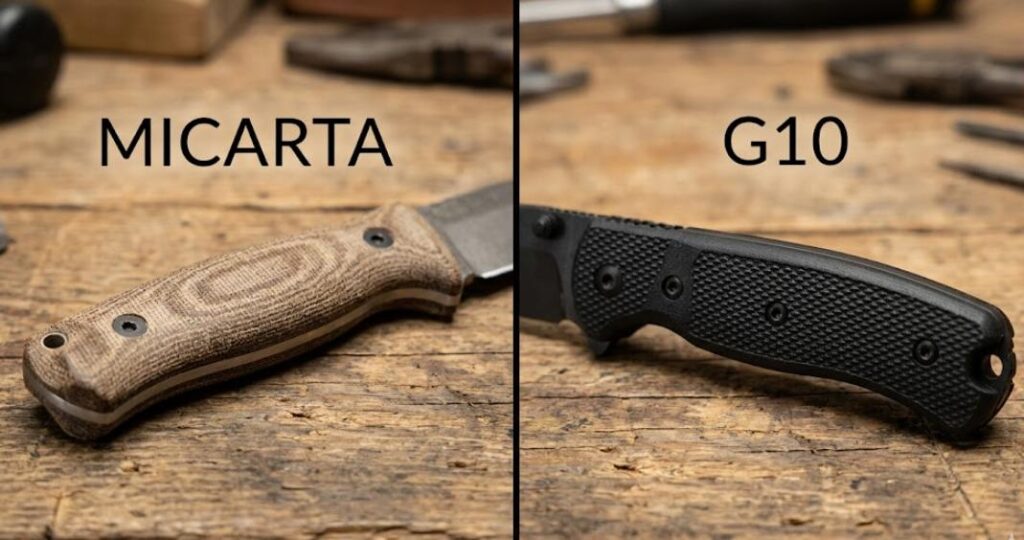
If you’re sourcing handle materials at scale, the Micarta vs. G10 debate is unavoidable. Both are composite laminates, but they deliver fundamentally different user experiences and manufacturing realities.
G10 replaces fabric substrates with fiberglass cloth and uses epoxy resin instead of phenolic. The result is a lighter, harder handle that machines cleanly without dust concerns. Micarta, on the other hand, offers superior grip texture and aesthetic depth that G10 struggles to replicate.
| Feature | Micarta | G10 |
|---|---|---|
| Base Resin | Phenolic | Epoxy |
| Substrate | Canvas / Linen / Paper | Fiberglass cloth |
| Weight | Slightly heavier | 15–20% lighter |
| Wet Grip | Superior — improves when wet | Good — unchanged when wet |
| Dry Grip | Excellent | Excellent (can be aggressive) |
| Moisture Absorption | <0.6% | <0.1% |
| Machining | Requires HEPA dust mitigation | Clean, fast, no special protocols |
| CNC Tool Wear | Baseline (1.0x) | Higher (1.8x — fiberglass is abrasive) |
| Raw Material Cost | $1.50 – $4.50/pair | $0.80 – $2.00/pair |
| Alibaba Supplier Count | ~1,200+ suppliers | ~5,000+ suppliers |
| Aesthetic Character | Organic, ages with patina | Uniform, synthetic, vibrant colors |
Data Sources:
- Pricing and supplier counts from Alibaba.com wholesale marketplace, April 2026.
- Tool wear index from Keganico CNC machining logs (carbide endmill lifespan comparison).
The bottom line:
- For high-volume runs targeting sub-$50 MSRP, G10 is the cost champion — lower material cost and faster machining.
- For premium lines where grip and aesthetics justify a higher price point, Micarta wins — especially in wet/outdoor conditions.
- Hidden cost alert: G10’s fiberglass content causes 45% faster carbide tool wear than Micarta. On runs of 5,000+ units, this can offset G10’s lower raw material price.
Explore our G10 handle knives collection for comparison. For a deep dive into the specific weight, texture, and pricing differences, read our complete guide on Micarta vs G10.
Micarta vs. Carbon Fiber Knife Handles
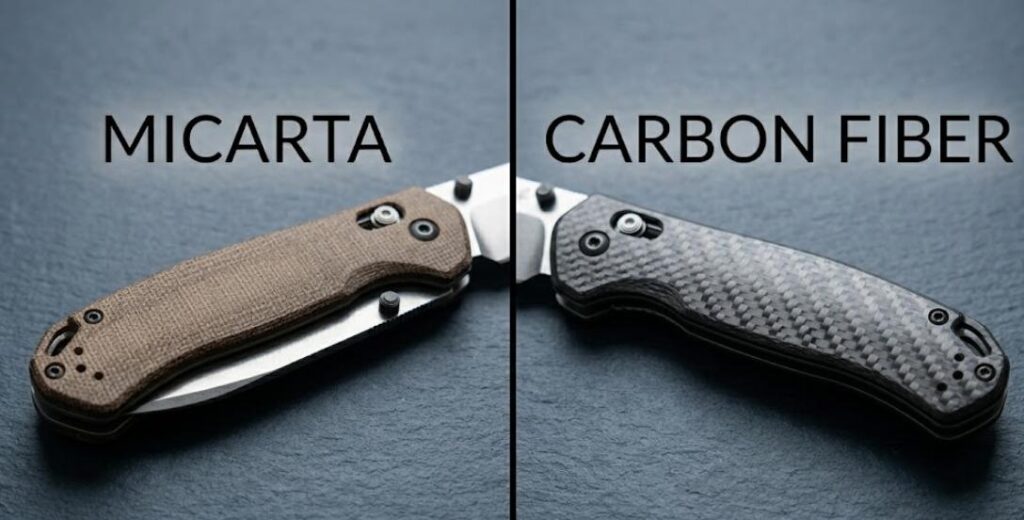
carbon fiber handles deliver unmatched visual prestige. The woven pattern screams “premium,” making it a natural fit for luxury EDC lines and collector editions. However, the cost gap is significant.
| Feature | Micarta | Carbon Fiber |
|---|---|---|
| Raw Material Cost | $1.50 – $4.50/pair | $8.00 – $25.00+/pair |
| Weight | Medium | Very light (30–40% lighter) |
| Wet Grip | ★★★★★ | ★★☆☆☆ — slippery without texturing |
| Impact Resistance | Excellent — absorbs shock | Moderate — can splinter under point impact |
| CNC Tool Life | Baseline | 20–40% faster tool wear; 15–25% slower feed rates required |
| Visual Appeal | Organic, layered depth | High-tech woven pattern |
| Target MSRP | $60 – $150 | $150+ |
Data Source: Carbon fiber scale pricing based on Alibaba.com carbon fiber knife handle listings (range: $4.62/kg for raw sheet to $20–$35/kg for premium 3K twill). Finished scale pair pricing at $8–$25+ reflects CNC machining and pattern selection.
Key takeaways:
- Carbon fiber’s machining cost is significantly higher — carbide tool life drops 20–40% compared to linen Micarta, and delamination risk requires 15–25% slower feed rates
- For 5,000-unit runs, this translates to measurable tooling cost premiums in your BOM
- Many brands pair carbon fiber bolsters with Micarta scales to balance aesthetics and grip — a proven strategy in the $120–$200 MSRP range
- Carbon fiber excels as a visual differentiator but falls short on wet grip and impact absorption
Micarta vs. Richlite and Terotuf
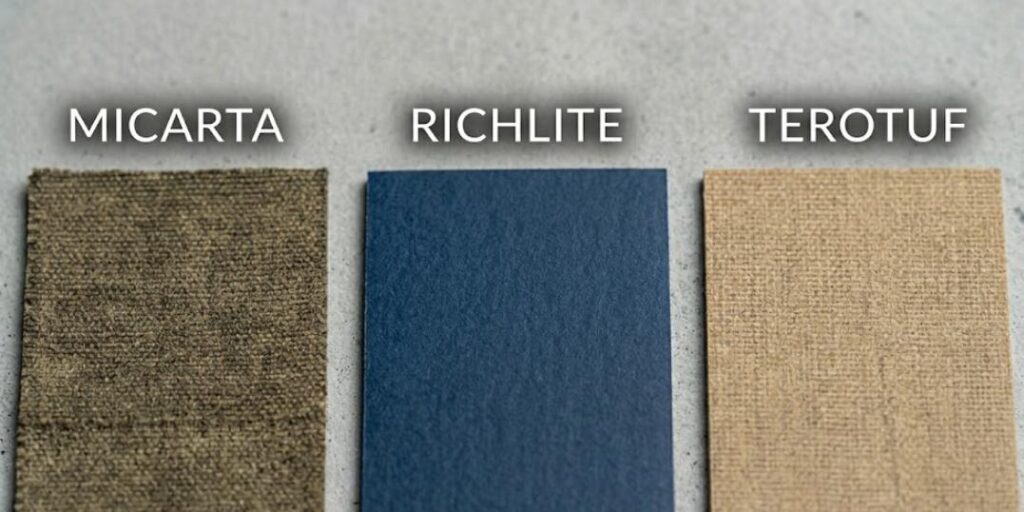
Micarta vs. Richlite
Richlite is a compressed paper composite similar to paper Micarta but uses a different resin system. It’s marketed as an eco-friendly alternative and delivers smooth aesthetics with good durability.
| Feature | Micarta | Richlite |
|---|---|---|
| Composition | Fabric + phenolic resin | FSC-certified paper + phenolic resin |
| Eco Credentials | Standard industrial composite | FSC-certified; Prop 65 compliant |
| Grip Texture Options | Full range (aggressive to smooth) | Smooth only — no aggressive grip option |
| Raw Material Cost | $1.50 – $4.50/pair | $3.00 – $6.00/pair |
| Lead Time | 15–25 days | 2–3 weeks longer than Micarta due to supply chain constraints |
| Best For | All-purpose tactical to EDC | Eco-focused brands, urban EDC |
Key takeaways:
- Richlite’s sustainability story (FSC-certified, Prop 65 compliant) is compelling for brands prioritizing green certifications
- However, it lacks Micarta’s aggressive grip options — no canvas-equivalent texture available
- Raw material lead times run 2–3 weeks longer than standard Micarta
Micarta vs. Terotuf
Terotuf is a newer impact-resistant polymer that excels in shock absorption. For tactical knives designed for extreme impact, Terotuf outperforms Micarta. But for brands prioritizing traditional looks with modern durability, Micarta’s layered structure offers more customization potential.
Micarta vs. Ultem (PEI) Knife Handles
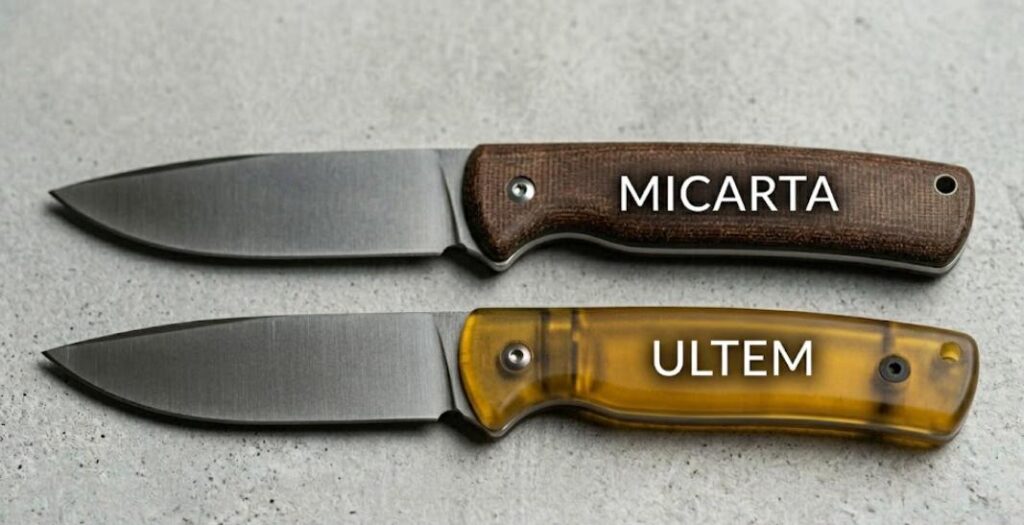
Ultem (PEI) has gained traction for its extreme heat resistance and chemical inertness. It machines cleanly and offers a uniform, modern aesthetic.
| Feature | Micarta | Ultem (PEI) |
|---|---|---|
| Heat Resistance | Up to 300°F | Up to 340°F |
| Chemical Resistance | Good | Excellent — fully inert |
| Wet Grip | ★★★★★ | ★★☆☆☆ — smooth surface |
| Aesthetic | Organic, layered | Translucent amber, modern |
| Weight | Medium | Very light |
| Best For | Outdoor, survival, marine | Urban EDC, tech-aesthetic lines |
Key takeaways:
- For OEM projects targeting outdoor, survival, or marine environments, Micarta’s proven wet-grip performance outweighs Ultem’s temperature advantages
- For urban EDC or tech-aesthetic lines, Ultem’s translucent amber look offers a distinctive shelf presence
- Ultem is primarily available in its natural amber hue — limited color customization compared to Micarta’s virtually unlimited palette
Deep Dive: Exploring Modern Synthetics

Are you considering Ultem or other advanced high-temperature plastics for your next EDC production run? To see how Ultem stacks up against injection-molded alternatives and fiberglass resins, read our complete material breakdown: G10 vs. Grivory vs. Ultem vs. FRN: The Ultimate Polymer Guide.
Micarta vs. Wood and Stabilized Wood Knife Handles
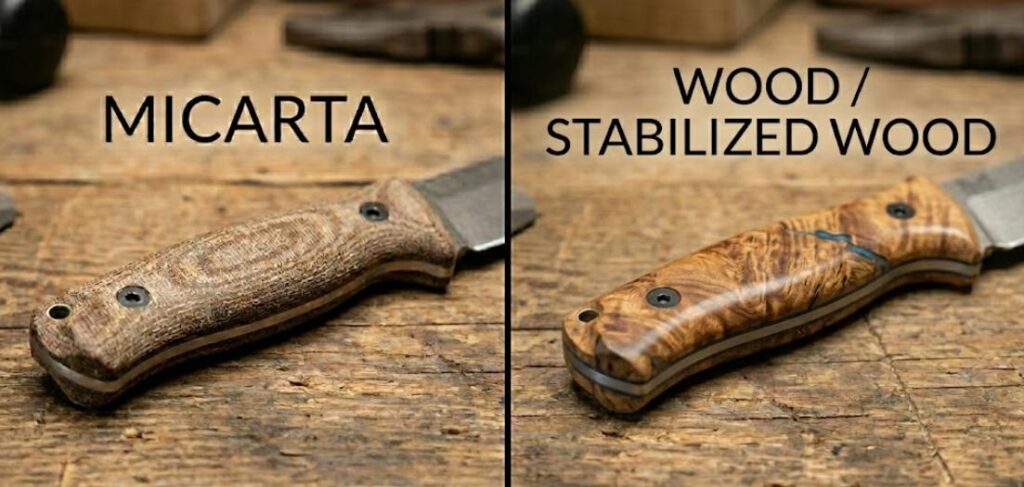
Natural wood handles carry undeniable heritage appeal. Desert ironwood, rosewood, and stabilized options like Pakkawood offer warm aesthetics that resonate with traditional knife buyers. However, natural wood introduces consistency challenges for OEM production.
| Feature | Micarta | Natural Wood | Stabilized Wood (Pakkawood) |
|---|---|---|---|
| Moisture Resistance | Excellent | Poor — swells, cracks | Moderate — improved by resin infusion |
| QC Rejection Rate (1,000+ units) | <1% | 5–10% | 3–5% |
| Wet Grip | ★★★★★ | ★★★☆☆ | ★★★☆☆ |
| UV Resistance | Excellent | Poor — fades, discolors | Moderate |
| Raw Material Cost | $1.50 – $4.50/pair | $4.00 – $15.00/pair | $4.50 – $8.00/pair |
| Machining Predictability | High — uniform density | Low — grain variations | Medium |
| Alibaba Supplier Count | ~1,200+ | Varies by species | Widely available (Yangjiang-based) |
Data Source: Stabilized wood (Pakkawood) pricing from Alibaba.com Pakkawood knife handle listings. Natural wood scale pricing varies significantly by species — rosewood $4.50+/pair, desert ironwood $10–$15+/pair.
Key takeaways:
- Wood varies batch-to-batch in density and moisture content — QC rejection rates of 5–10% for natural wood vs. <1% for Micarta across 1,000+ unit runs
- Micarta resists moisture absorption, cracking, and UV fading that plague untreated wood handles
- For brands wanting wood aesthetics with OEM reliability, stabilized wood (Pakkawood) is a viable middle ground — but it still can’t match Micarta’s grip durability in wet conditions
Explore our wood handle knives collection for comparison.
Micarta vs. Bone Knife Handle Scales
Bone handles carry vintage charm that appeals to traditionalists and collectors. However, bone is porous, absorbs moisture, and requires careful sealing to prevent odor and degradation over time.
| Feature | Micarta | Natural Bone |
|---|---|---|
| Porosity | Non-porous | Highly porous — requires sealing |
| QC Rejection Rate | <1% | 10–15% (porosity, color variation) |
| Moisture Resistance | Excellent | Poor — absorbs, can develop odor |
| Batch Scalability | 500 – 50,000 units | Typically limited to 200–500 units/batch |
| Raw Material Cost | $1.50 – $4.50/pair | $1.75 – $4.50/pair |
| Color Customization | Virtually unlimited | Natural only (white/cream) |
| Alibaba Supply Base | China-based (Guangdong, Liaoning) | Primarily India-based (Uttar Pradesh) |
Data Source: Bone scale pricing and supplier geography from Alibaba.com bone knife handle listings — the majority of bone scale suppliers are based in Uttar Pradesh, India, with MOQs as low as 10–50 pieces, reflecting the artisanal nature of bone sourcing.
Key takeaways:
- For wholesale knife programs, bone introduces supply chain variability — natural sourcing constraints limit batches to 200–500 units typically
- Bone QC rejection rates of 10–15% drive up effective per-unit cost despite similar raw material pricing
- If your brand targets the heritage aesthetic but needs modern reliability, linen or burlap Micarta provides similar visual warmth without the consistency headaches
Start Working with a Professional Now
Manufacturing Micarta: Finishes and Hardware for OEM Production
Choosing the right Micarta substrate is only half the equation. The finish and assembly method you specify directly impact per-unit cost, user experience, and brand positioning.
Polished vs. Matte Micarta Scales
| Finish | Wet Grip Retention | Per-Unit Add Cost | Production Time Impact | Best For |
|---|---|---|---|---|
| Raw Matte (P120 Sanded) | 95% of max friction | Baseline | Baseline | Tactical, field-use models |
| Satin Finish | ~85% | +$0.30–$0.60 | +3–5 min/unit | Mid-range EDC |
| High Polish | ~80–85% | +$0.80–$1.50 | +5–10 min/unit | Showroom editions, limited runs |
Key takeaways:
- Polishing reduces surface texture, translating to a 10–15% reduction in wet grip vs. raw matte
- Matte finishes eliminate one polishing step, reducing per-unit machining time by 5–10 minutes
- For brands running multiple SKUs, offer both — matte for field-use, polished for showroom editions
Assembly: Pin vs. Screw on Micarta Scales
The hardware you choose to attach Micarta scales to your knife tang affects assembly speed, field maintenance, and aesthetics.
Pin Construction:
- Permanent rivets or brass pins — clean, uninterrupted aesthetic
- Ideal for fixed-blade designs where users won’t disassemble the handle
- Assembly time: 30–60 seconds per scale
- Hardware cost savings: $0.50–$1.00/unit vs. screw systems
Screw Construction (Torx T6/T8):
- Users can remove, clean, and reattach scales — valuable for tactical/outdoor knives exposed to mud, salt, or debris
- Enhances perceived value and after-sale serviceability
- Recommended for any knife positioned above $100 MSRP
- Assembly time: adds ~12 seconds/unit vs. pin construction
Why Choose Keganico for OEM Micarta Knife Production?
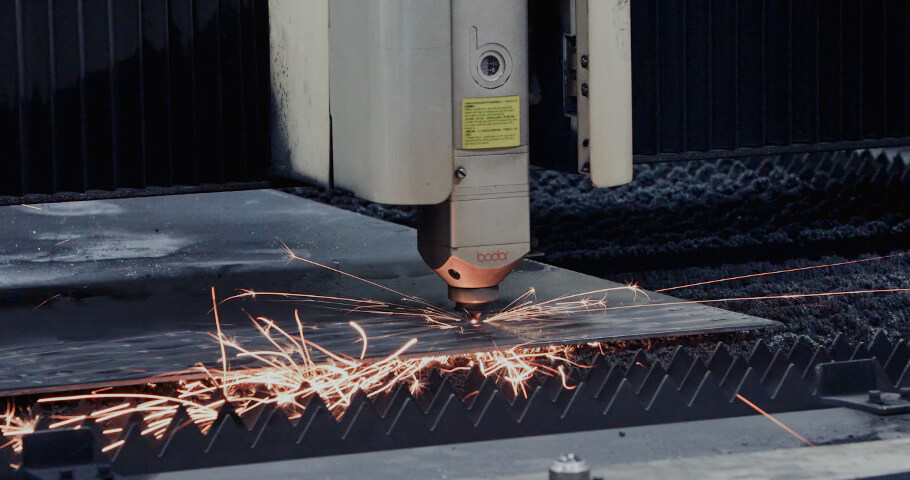
Micarta’s popularity among knife brands is growing, but not all manufacturers handle it equally. Phenolic resin composites demand specific machining protocols that general-purpose factories often overlook.
Precision CNC Machining for Tight Tolerances
Micarta scales require tolerances within ±0.05mm to ensure seamless fit against knife tangs without gaps or stress points. Keganico’s CNC facilities are calibrated specifically for composite materials, delivering consistent results across production runs from 500 to 50,000 units. Our OEM knife manufacturing team includes engineers who optimize feed rates, tool paths, and coolant strategies for each Micarta substrate type.
Dust Mitigation Protocols for Safe Scale Production
Machining phenolic resin composites generates fine dust that requires professional handling. Keganico follows OSHA-aligned dust collection and filtration protocols, ensuring worker safety and environmental compliance for long-term partnership stability. Our protocols include:
- Industrial-grade vacuum extraction at each CNC station
- HEPA filtration systems capturing particles down to 0.3 microns
- Scheduled maintenance cycles to prevent buildup and ensure consistent tolerances
For brand owners, this means your production partner operates safely, sustainably, and without the quality drift that comes from poorly managed dust accumulation.
Custom Color and Layering for Brand Differentiation
Micarta’s layered construction allows for virtually unlimited color combinations. Keganico works with wholesale buyers to develop proprietary color palettes — from OD green and coyote brown for tactical lines to vibrant blue, red, or multi-color laminations for limited editions.
Our private label knives program includes complimentary material sampling and prototyping, so you can validate handle aesthetics before committing to full production runs. Whether you need wholesale knives for retail distribution or custom OEM builds for your flagship brand, we deliver the balance of quality, consistency, and competitive pricing that growing knife businesses depend on.
Partner with Keganico for Your Micarta Knife Line
Micarta delivers a rare combination of grip performance, aesthetic versatility, and manufacturing scalability that few handle materials can match. Whether you’re launching a tactical fixed-blade series, a premium EDC collection, or a heritage-inspired lineup, choosing the right Micarta substrate and finish is critical to your product’s market positioning.
At Keganico, we specialize in helping knife brands navigate material selection, optimize CNC tolerances, and scale production without compromising quality. Our capabilities include:
- Precision CNC Machining – ±0.05mm tolerances across all Micarta substrates
- Dust Mitigation Protocols – OSHA-aligned safety standards for phenolic composite machining
- Custom Color & Layering – Proprietary palettes developed for your brand identity
- Flexible Production Volumes – From 300-unit prototype runs to 50,000-unit wholesale orders
We also offer multiple services to suit your business needs:
- Private Label Knives – Put your brand on our expertly crafted blades
- OEM Manufacturing – Custom designs brought to life
- Wholesale – Stock quality knives at competitive prices
Get Your Quote Now and discover why leading knife brands trust Keganico for their Micarta handle production needs.
Frequently Asked Questions
What is Micarta knife handle material?
Micarta is a composite material made by laminating layers of fabric (canvas, linen, paper, or burlap) with phenolic resin under high heat and pressure. The result is a durable, moisture-resistant handle material prized for its excellent grip, aesthetic depth, and CNC machinability in OEM knife production.
Is Micarta better than G10 for knife handles?
It depends on your target market. G10 is lighter, machines cleaner, and costs less — making it ideal for high-volume, budget-friendly lines. Micarta offers superior wet grip, richer aesthetics, and more customization options, which justifies higher price points for premium and tactical knife brands. For a detailed breakdown, see our Micarta vs G10 comparison.
Does Micarta require special maintenance?
Micarta is low-maintenance but benefits from occasional cleaning with mild soap and water to remove dirt and oils. Avoid harsh solvents that can degrade the phenolic resin surface. Unlike natural wood, Micarta does not require oiling or sealing and will not crack from moisture exposure.
Can Micarta handles be customized with brand colors?
Yes. Micarta’s laminated construction allows manufacturers to incorporate colored fabrics or dyes between layers, creating unique visual patterns. Keganico’s private label service offers custom color development and prototyping for brands seeking distinctive handle aesthetics.
What is the MOQ for custom Micarta knife handles at Keganico?
Our standard MOQ for custom Micarta handle projects is 200 units per design. For color or substrate variations on existing tang designs, we can often accommodate runs as low as 100 units. Contact our team to discuss your specific requirements and receive a detailed quote.
Is Micarta compliant with EU and US import regulations?
Micarta itself is an inert phenolic composite that does not contain restricted substances. Keganico sources Micarta materials from suppliers compliant with RoHS and REACH standards, ensuring your finished products meet EU and US import requirements without additional compliance testing.