
CTS-204P holds an edge about 30% longer. MagnaCut is twice as tough and easier to live with. Both are American-made powder metallurgy stainless steels, but they answer different briefs: 204P is the slicing specialist, MagnaCut the all-rounder.
For brands and sourcing managers, the choice shapes product positioning, warranty rates, and production cost. This guide compares both steels on test data first, then on what matters at the factory and on the shelf.
The Short Answer
| Category | CTS-204P | CPM MagnaCut | Winner |
|---|---|---|---|
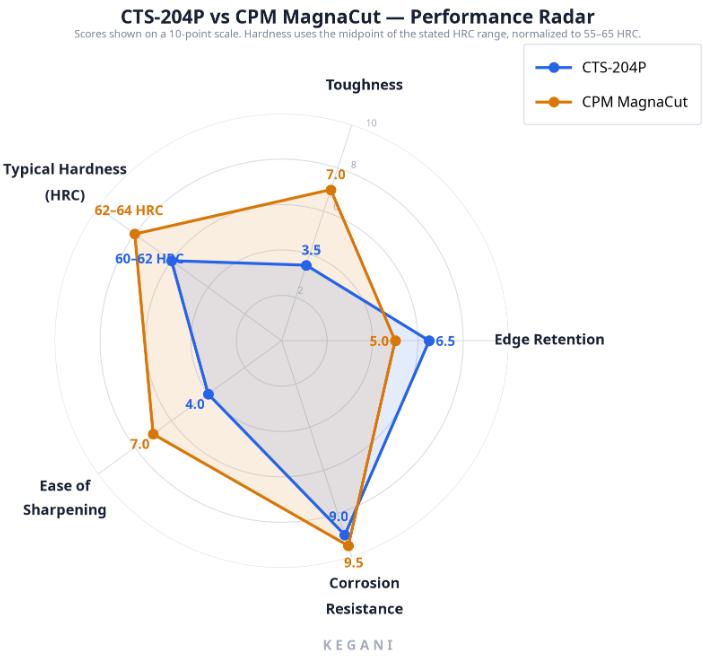
| Edge Retention | 6.5/10 | 5.0/10 | 204P — cuts ~30% longer in CATRA testing |
| Toughness | 3.5/10 | 7.0/10 | MagnaCut — 38 vs 15 ft-lbs in Charpy impact tests |
| Corrosion Resistance | 9.0/10 | 9.5/10 | MagnaCut — a tie in practice, gap shows only in saltwater |
| Ease of Sharpening | 4.0/10 | 7.0/10 | MagnaCut — standard stones vs diamond abrasives |
| Typical Hardness | 60–62 HRC | 62–64 HRC | MagnaCut — runs harder without getting brittle |
Data source: Knife Steel Nerds steel ratings
One-line verdict: pick 204P when edge retention is the selling point; pick MagnaCut for everything else.
Steel Overview: CTS-204P and MagnaCut
What Is CTS-204P Steel?
CTS-204P is a powder metallurgy stainless steel made by Carpenter Technology in Pennsylvania, using its proprietary Micro-Melt process. It shares nearly identical chemistry with Böhler M390 and CPM 20CV — together they form the “M390 family,” and testing treats them as one steel.
Carpenter built 204P as a cold-work die steel, not a knife steel. In industrial tooling it cuts tooling costs by up to 75% compared to conventional materials, and knife makers adopted it for the same reason: blades that stay sharp through months of use. The Micro-Melt process atomizes molten steel into powder and hot-presses it into billets, producing a fine, uniform carbide structure with lot-to-lot consistency that custom makers praise.
Spyderco sprint runs (Paramilitary 2, Para 3, Shaman), Zero Tolerance (0562CF, 0456), and Microtech (Ultratech) built its reputation. A decade of flagship use makes 204P a proven name with collectors.
What Is CPM MagnaCut Steel?
CPM MagnaCut was released by Crucible Industries in 2021 — one of the few modern steels designed specifically for knives, by metallurgist Dr. Larrin Thomas. It has since been adopted by Benchmade, Spyderco, Civivi, Kizer, and Leatherman.
We have covered its development and chemistry in our MagnaCut steel review. Here we focus on one question: what changes when the alternative on your spec sheet is CTS-204P?
Chemical Composition: CTS-204P vs MagnaCut

| Element | CTS-204P | CPM MagnaCut | The Role |
|---|---|---|---|
| Carbon (C) | 1.90% | 1.15% | Hardness and carbide volume |
| Chromium (Cr) | 20.00% | 10.70% | Primary corrosion resistance |
| Vanadium (V) | 4.00% | 4.00% | Hard vanadium carbides for wear resistance |
| Molybdenum (Mo) | 1.00% | 2.00% | Hardenability and strength |
| Niobium (Nb) | — | 2.00% | Key: Grain-refining carbides that boost toughness |
| Nitrogen (N) | — | 0.20% | Key: Hardens the steel without forming chromium carbides |
| Tungsten (W) | 0.65% | — | Secondary hardening and wear resistance |
Data source: Carpenter CTS 204P datasheet, Knife Steel Nerds
- 204P loads up on carbides. High carbon plus 20% chromium forms a dense carbide network. That network is why it outwears MagnaCut — and why it chips sooner.
- MagnaCut gets its hardness from nitrogen and niobium instead of carbon. No chromium carbides form, so the structure stays fine and tough.
- Why does the steel with less chromium resist rust better? Much of 204P’s chromium is trapped inside carbides; MagnaCut keeps its chromium dissolved in the matrix, where it forms the protective oxide layer.
Performance Comparison
Edge Retention
In Knife Steel Nerds CATRA testing — which measures how much cardstock a blade cuts before dulling — M390-class steel scored about 180% of 440C at 61.5 HRC, versus about 135% for MagnaCut at 62.5 HRC. For customers who cut cardboard, rope, or packaging daily, 204P simply needs sharpening less often.
Toughness
MagnaCut measured around 38 ft-lbs in Charpy impact testing at 62.5 HRC, versus roughly 15 ft-lbs for the 204P family at 62 HRC — more than double the impact energy before cracking. In production terms: MagnaCut tolerates thinner, more acute edge grinds, while 204P edges need more metal behind them. That difference shows up later in after-sales data as chipped-edge returns.
Corrosion Resistance
Both steels are effectively rust-proof for EDC, outdoor, and kitchen use — neither will generate rust complaints. The 9.0 vs 9.5 gap only matters at the extremes: after prolonged saltwater exposure, 204P can show light staining while MagnaCut stays clean. For dedicated marine lines, spec MagnaCut (or go further with LC200N); for everything else, treat this category as a draw.
Start Working with a Professional Now
Ease of Sharpening and Finishing
204P’s hard vanadium carbides resist conventional stones, so end users need diamond or ceramic abrasives. One upside from the workshop: 204P forms no stubborn burr, so there is no wire-edge risk once the right equipment is in place. MagnaCut sharpens on standard stones and strops cleanly — which means fewer “I can’t get it sharp” complaints from casual users.
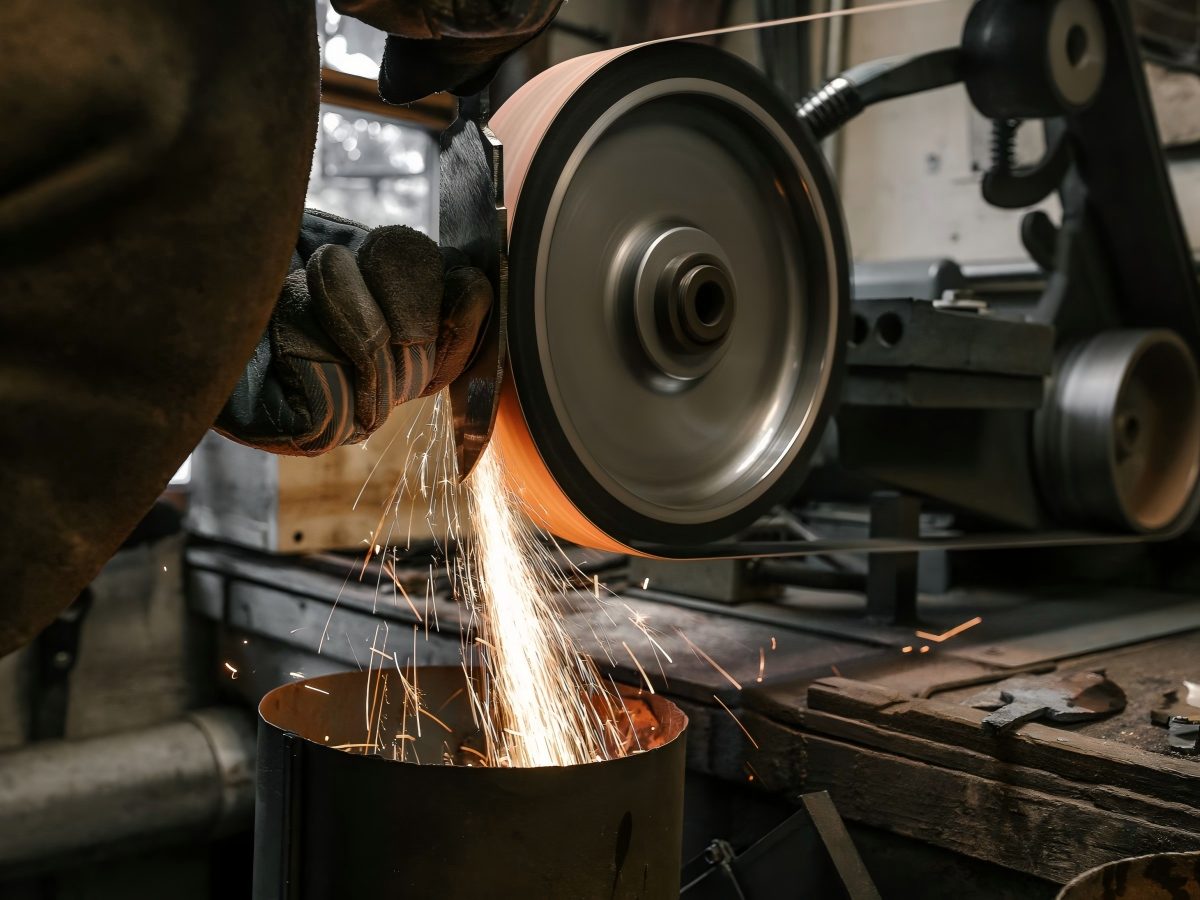
The same chemistry shapes finishing costs. 204P takes a superior mirror polish but wears grinding belts faster; MagnaCut grinds more efficiently and suits bead-blast or stonewash finishes. On large runs, that per-unit processing difference can matter as much as material price.
Hardness and Heat Treatment
The Carpenter datasheet lists 204P’s typical working hardness at 57–59 HRC, with 62–63 HRC available when wear resistance takes priority over toughness. Two details deserve attention on the factory floor:
- Annealed 204P machines easily at under 280 BHN, but the steel must never be tempered between 800–1100°F (427–593°C) — carbide precipitation in that window severely degrades toughness and corrosion resistance.
- MagnaCut delivers its full profile at 62–63 HRC with cryogenic treatment, a hardness range where 204P becomes noticeably more brittle.
One more point that experienced makers insist on: within the M390 family, heat treatment and edge geometry matter more than the label on the blade. A well-treated 204P blade at 62 HRC with a thin grind will outcut a poorly treated one every time. Lock your heat-treatment spec before you lock your steel spec.
Which Steel Fits Your Knife Line?
| Application | CTS-204P | CPM MagnaCut | Why |
|---|---|---|---|
| EDC folding knives | ⭐⭐⭐⭐⭐ | ⭐⭐⭐⭐ | 204P’s edge life suits daily slicing |
| Hard-use / tactical folders | ⭐⭐⭐ | ⭐⭐⭐⭐⭐ | MagnaCut resists chipping under abuse |
| Outdoor and hunting | ⭐⭐⭐⭐ | ⭐⭐⭐⭐⭐ | Bone contact and wet conditions favor toughness |
| Kitchen knives | ⭐⭐⭐⭐ | ⭐⭐⭐⭐ | 204P for edge life; MagnaCut for thin edges |
| Marine and saltwater | ⭐⭐⭐ | ⭐⭐⭐⭐⭐ | MagnaCut’s 9.5 corrosion score |
| Collectible / dress pieces | ⭐⭐⭐⭐⭐ | ⭐⭐⭐⭐ | 204P takes the better mirror polish |
Benchmarks your customers already know:
- CTS-204P: Spyderco Paramilitary 2 / Para 3 / Shaman sprint runs, Zero Tolerance 0562CF and 0456, Microtech Ultratech
- MagnaCut: Benchmade Bugout and Griptilian, Spyderco Salt series, Civivi Elementum, Kizer Mini Sheepdog, Leatherman Arc
What About M390 and CPM 20CV?
All three are metallurgical equivalents from different mills — Böhler (Austria), Crucible (USA), and Carpenter (USA). Zero Tolerance ran M390, 20CV, and 204P on the same 0562CF model over its production life, and customers could not tell them apart.
The practical differences are commercial: M390 has the widest global distribution and the strongest name recognition, while 204P comes in smaller, US-focused batches. Our sourcing advice: spec “M390 / 20CV / 204P equivalent” on the bill of materials and lock the exact mill at order time. It protects your schedule from single-mill supply gaps without changing anything your customer can detect.
Cost and Availability
| Factor | CTS-204P | CPM MagnaCut |
|---|---|---|
| Bar stock cost | ~$20 per cubic inch (small quantities) | Similar premium bracket |
| Typical knife MSRP | $150–$400 | $140–$350 |
| Material lead time | 4–8 weeks (batch-dependent) | 6–12 weeks (demand-driven) |
| Grinding cost per blade | Higher (carbides wear abrasives) | Lower (leaner carbide structure) |
| Recommended MOQ | 100+ units | 100+ units |
Both steels support healthy margins in the $150–$350 window, and both punish corner-cutting on heat treatment. The real cost difference is supply behavior: Carpenter produces 204P in smaller runs, so availability fluctuates, while MagnaCut demand keeps outpacing supply. An OEM knife manufacturer with established material channels removes most of that risk for either steel.
Final Verdict: Which Should You Choose?
There is no universal winner — only a better match for your brief.
Choose CTS-204P for:
- Premium EDC folders sold on edge retention
- Collectible and limited-edition pieces with mirror finishes
- Customers who already own diamond sharpening systems
Choose MagnaCut for:
- Hard-use, tactical, and outdoor lines
- Humid, coastal, and marine markets
- Volume production where grinding efficiency and fewer edge-chip returns protect your margins
Still weighing the two? Contact Keganico — we will help you match the steel to your price point and market.
Partner with Kegani
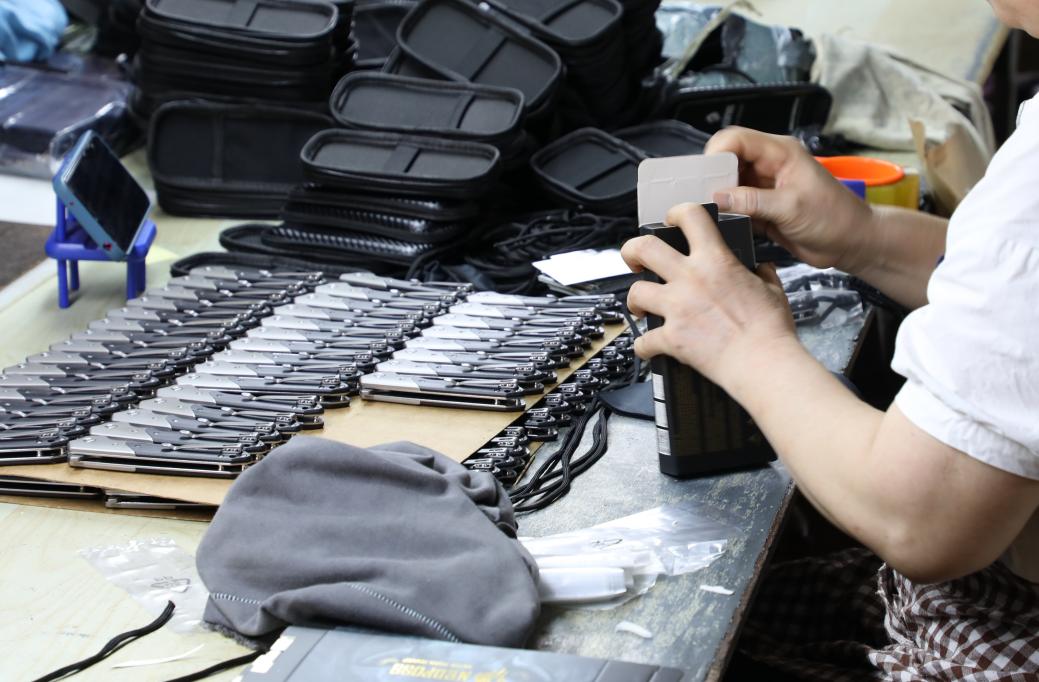
At Keganico, we optimize steel selection based on your target margin and brand positioning.
- For Custom Projects: Our OEM Service delivers the precision heat treatment both steels demand — including the cryogenic processing that unlocks their full performance.
- For Brand Expansion: Scale quickly with our Private Label Service or Wholesale Service.
Contact Keganico Today to request a quote and find out which steel should lead your next launch.
Frequently Asked Questions
Is CTS-204P the same as M390?
Functionally, yes — same alloy family, same performance class, with 204P adding a trace of tungsten (0.65%). Any difference a user feels comes from heat treatment and edge geometry, not the label. See our MagnaCut vs M390/20CV comparison for the full family analysis.
Which holds an edge longer: CTS-204P or MagnaCut?
CTS-204P, by roughly 30% in CATRA testing (180% vs 135% of 440C). Its higher carbide volume is the reason. If edge retention is your product’s headline feature, 204P is the right spec.
Is CTS-204P tougher than MagnaCut?
No. MagnaCut absorbs more than twice the impact energy (38 vs 15 ft-lbs in Charpy testing), because it contains no brittle chromium carbides. For thin edges, hard use, or batoning, MagnaCut is the safer choice.
Which steel is easier to sharpen?
MagnaCut, clearly. It takes a keen edge on standard whetstones; 204P calls for diamond or ceramic abrasives. For casual users, that difference decides how satisfied they are six months after purchase.
Is CTS-204P stainless?
Yes — 20% chromium puts it well past the stainless threshold, with a 9.0/10 corrosion rating, ahead of workhorses like S30V (7.5/10). Only dedicated saltwater use calls for something higher.
CTS-204P or MagnaCut for an EDC knife line?
Both work; they just sell differently. 204P suits a spec-driven audience that values edge life and collector heritage. MagnaCut suits a broader EDC market that values toughness, low maintenance, and the strongest steel branding of 2026. Many brands run both: MagnaCut for the hard-use flagship, 204P for the dress slicer.