
Two knives can leave the factory with the same black finish and sit at the same price point. Yet one coating is built to survive abrasion, while the other is built to block corrosion and carry color.
The core difference is thickness and hardness. PVD forms an extremely thin, hard ceramic film that resists scratches and preserves tight tolerances, making it ideal for hard-use EDC, OTF knives, and moving parts. Cerakote forms a thicker ceramic-polymer barrier that blocks moisture and chemicals and comes in hundreds of colors, making it ideal for coastal, kitchen, and custom knives.
For knife brands, distributors, and OEM buyers, this choice is not just cosmetic. The right coating reduces warranty claims. It defines your price tier. It shapes how customers perceive quality. This guide breaks down the differences so you can spec the right finish for your next knife line.
What Is PVD Coating on Knives?
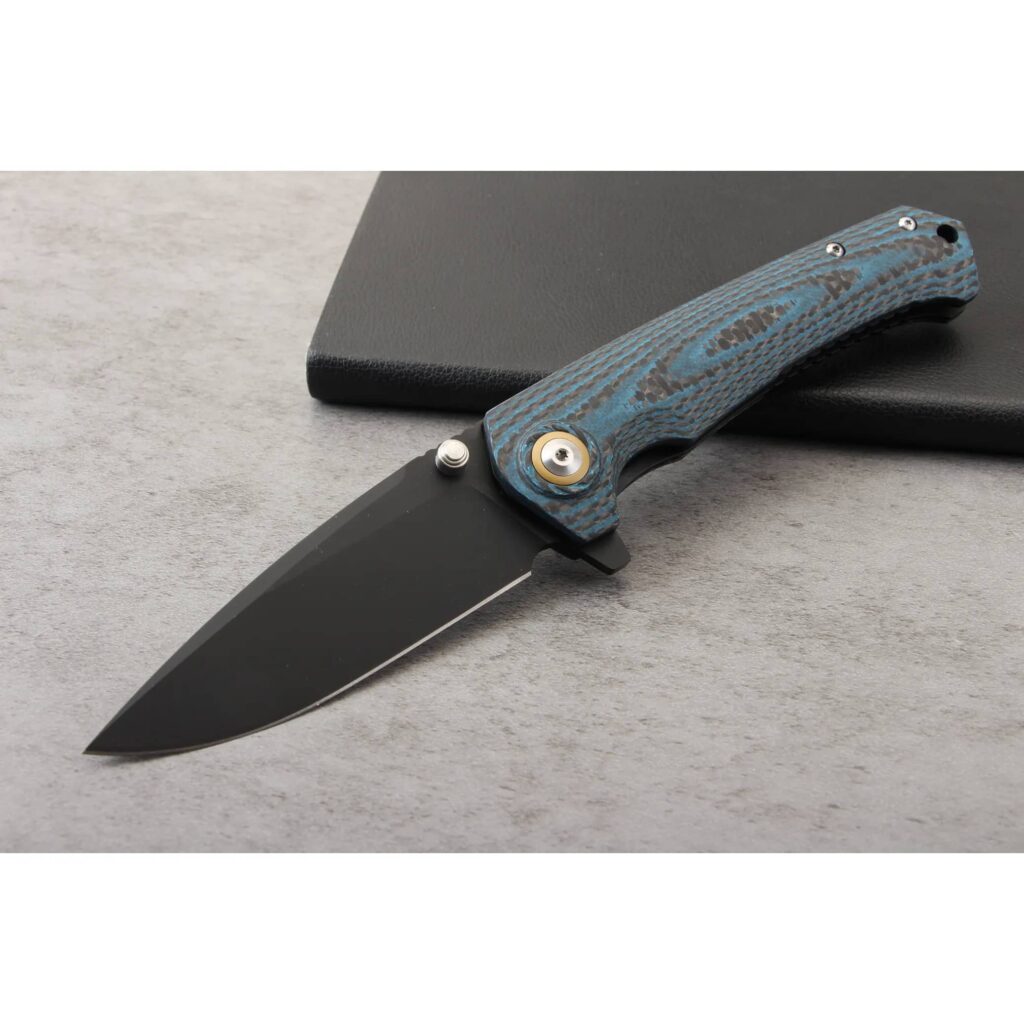
OEM Liner Lock Knife Fused Carbon Fiber + G10 Handle,Black PVD Coated (3.70 Inch 14C28N Blade)
PVD deposits a thin ceramic layer onto the blade in a vacuum chamber. The process vaporizes a solid metal target and condenses it atom by atom onto the steel.
Common PVD coatings for knives include:
- TiN (titanium nitride): gold-colored, decorative, moderate hardness.
- TiCN (titanium carbonitride): gray-blue, harder than TiN, good for EDC blades.
- CrN (chromium nitride): gray, excellent wear and corrosion resistance.
PVD film thickness typically falls between 1 and 5 microns. That is thin enough to preserve tight tolerances on OTF mechanisms, pivot bearings, and lock interfaces.
Note: DLC is often grouped with PVD because both use vacuum chambers, but it deposits carbon rather than metal nitrides. If you want a closer comparison of the two, read our PVD vs DLC guide.
Pros for Knives:
- Very thin, so it rarely affects blade geometry or action.
- High surface hardness resists scratches and abrasive wear.
- Low friction helps blades glide through material and makes carbon residue easier to wipe off.
- Color is locked into the chemistry, so it does not fade easily.
Cons for Knives:
- Color palette is limited to metallics, grays, golds, and black.
- Higher equipment cost per batch, especially for premium hard coatings like DLC.
- Once the edge is sharpened, the apex becomes bare steel again.
- If the film has pinholes or adhesion flaws, corrosion can start underneath.
What Is Cerakote on Knives?
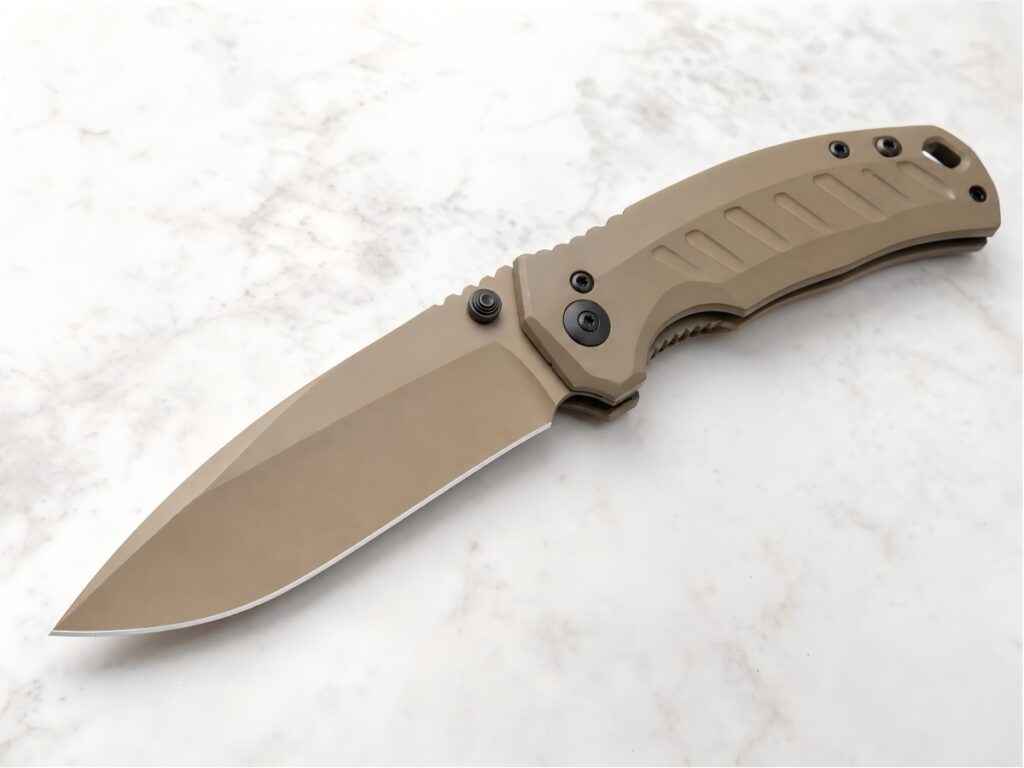
Cerakote is a ceramic-polymer composite. It is sprayed onto the blade and then cured in an oven. The most common series for knives are H-Series and Elite Series. Elite is thinner and harder than standard H-Series, but it is also more expensive.
Cerakote builds a film roughly 0.001″ to 0.002″ thick (about 25–50 microns). That is thicker than PVD, so applicators must control build-up on edges, pivot areas, and OTF windows.
Cerakote can be applied to many substrates: steel, titanium, aluminum, and even some handle materials. For knife brands, this means you can match blade color to handle color across the whole product.
Pros for Knives:
- Over 200 colors, including camo and custom patterns.
- Excellent corrosion and chemical resistance, especially in humid or coastal environments.
- Lower coating cost per part than most PVD options.
- Local applicators are widely available, so lead times are shorter.
- Worn areas can often be touched up without stripping the whole blade.
Cons for Knives:
- Thicker film can affect tolerances on precision folders and OTF knives.
- Surface hardness is lower than PVD, so high-wear areas can show marks faster.
- Performance depends heavily on surface prep and applicator skill.
- Once worn through to bare steel, the exposed area has no protection.
Users on BladeForums note that Cerakote works well as a protective barrier on knives that are not used aggressively. On hard-use folders, however, they report that Cerakote “wears off from use fairly quickly.” For those buyers, PVD or DLC is the safer spec.
PVD vs Cerakote for Knives: Head-to-Head Comparison
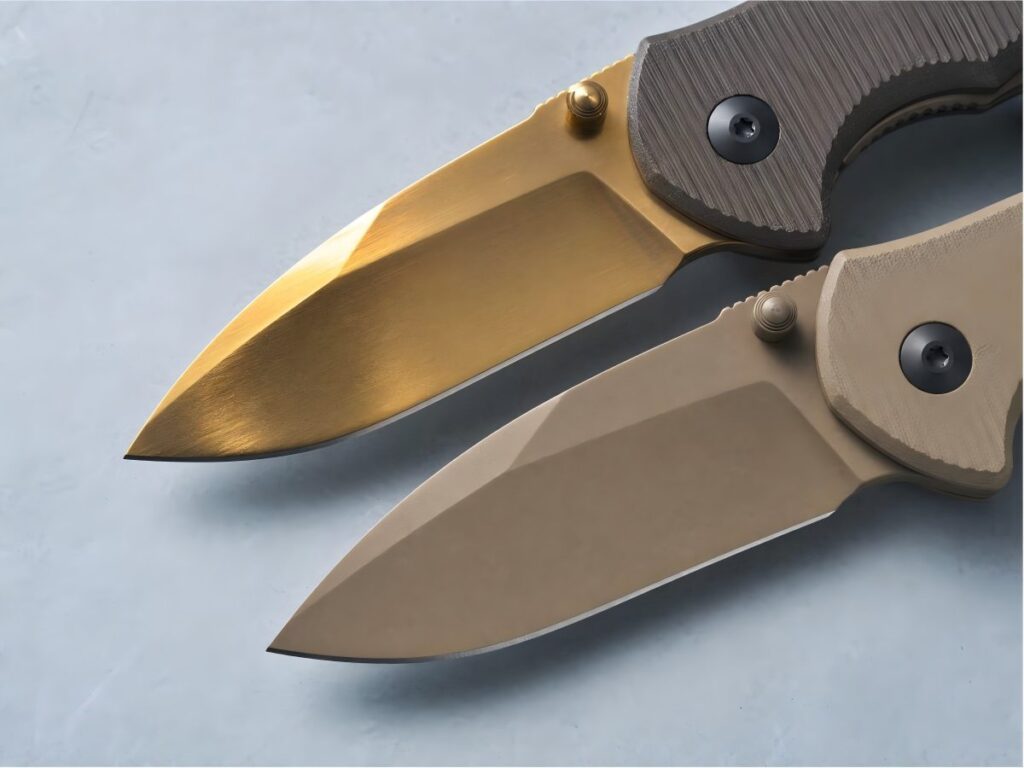
| Feature | PVD | Cerakote |
|---|---|---|
| Process | Vacuum deposition | Spray + oven cure |
| Typical thickness | 1–5 microns | 25–50 microns |
| Surface hardness | Very high | Moderate (Elite is harder) |
| Scratch resistance | Excellent | Good to moderate |
| Corrosion resistance | Good if film is intact | Excellent barrier protection |
| Chemical/food resistance | Moderate | Excellent |
| Color range | Limited (metallic, gray, black, gold) | 200+ colors and patterns |
| Tolerance impact | Minimal | Must be controlled on precision parts |
| Relative cost | Higher | Lower |
| Touch-up | Difficult; usually requires re-coating | Easier to patch |
This table is a snapshot, not a verdict. The best coating depends on how the knife will be used, where it will be sold, and what your target customer values most.
Thickness and Tolerance Impact
PVD wins on thinness. Its 1–5 micron film adds almost no measurable size to the blade. That matters for OTF knives, automatic folders, and any design with tight pivot or lock tolerances.
Cerakote is much thicker. On most fixed blades and standard folders the added size is fine. On precision mechanisms it can cause drag or affect lock-up if the applicator does not mask critical surfaces.
For knife brands, this means one practical rule: if the coating area includes moving parts or close clearances, PVD is the safer production choice.
Wear and Scratch Resistance
PVD is harder and more scratch-resistant. Its ceramic surface stands up to cardboard, rope, wood, and grit better than Cerakote. That is why hard-use EDC knives and outdoor blades often use TiCN or CrN.
Cerakote is softer. It will show marks faster on a working blade. It still protects the steel underneath, but the cosmetic life is shorter under abrasive use. For collectors, display pieces, or light-use knives, this trade-off is acceptable.
Corrosion and Chemical Protection
Cerakote wins as a barrier. Its thicker film blocks moisture, salt, and food acids longer than PVD. For kitchen knives, coastal carry, or any blade exposed to sweat and humidity, Cerakote is the stronger choice.
PVD resists corrosion well when the film is intact. However, pinholes, chips, or a sharpened edge can expose bare steel. The thin film is a great wear surface, but it is not a perfect seal.
Color and Brand Differentiation
Cerakote dominates color choice. With over 200 colors and patterns, it lets brands build signature looks, limited editions, and matching handle-and-blade themes. PVD cannot match that range. Its colors are limited by chemistry to gold, gray, bronze, blue, and black.
If your product strategy depends on visual customization, Cerakote is almost always the right tool.
Cost Comparison: Which Coating Adds More to Your Bill of Materials?
Coating cost matters for OEM and wholesale buyers. It affects MSRP, margin, and how the product competes in its price bracket.
| Cost Factor | PVD | Cerakote |
|---|---|---|
| Equipment / setup | High (vacuum chamber + targets) | Lower (spray booth + oven) |
| Batch size sensitivity | High; small runs raise unit cost | Lower; easier to handle small lots |
| Typical retail price add | $20–$80 | $10–$50 |
| Multi-color / pattern cost | Limited colors; custom targets expensive | Many colors; complex patterns add labor |
| Touch-up / rework | Expensive; usually requires re-coating | Easier and cheaper to patch |
| Typical lead time | Longer (vacuum batch cycles) | Shorter (more local applicators) |
| Local supplier availability | Fewer specialized shops | Widely available |
Why PVD Costs More
PVD requires a vacuum chamber and specialized targets. Setup and maintenance are expensive. Batch size also matters. Small runs have a high per-unit cost because chamber time is fixed.
Among PVD coatings, TiN is usually the most affordable. TiCN and CrN sit in the middle. Other hard coatings like DLC can be even more expensive due to longer cycle times and carbon target costs.
For a finished knife, PVD often adds $20–$80 to the retail price compared with an uncoated blade.
Why Cerakote Looks Cheaper
Cerakote equipment is less specialized. Many local shops offer the service. Single-color jobs are quick. That keeps the unit cost low.
For a finished knife, Cerakote often adds $10–$50 to retail, depending on color complexity and applicator location.
Long-Term Value
PVD can reduce returns on hard-use knives because it resists surface damage. Cerakote can reduce returns on kitchen, outdoor, and coastal knives because it resists corrosion. The “cheaper” option is the one that matches the use case.
For sourcing managers, it helps to test both finishes on the same model. Run a small production lot, track return reasons for 90 days, then lock the spec.
Knife Use Cases: When to Choose PVD or Cerakote
Quick Decision Matrix
| Your Priority | Recommended Coating | Reason |
|---|---|---|
| Maximum scratch and wear resistance | PVD (CrN/TiCN) | Harder film survives abrasive use |
| Corrosion and chemical resistance | Cerakote | Barrier protection outperforms PVD in wet environments |
| Tight tolerances / OTF / automatic | PVD | Thin film preserves clearance |
| Color variety and customization | Cerakote | 200+ colors and patterns |
| Lowest unit cost | Cerakote | Lower equipment and labor cost per part |
| Long-term durability on working blades | PVD | Fewer returns from surface wear |
Hard-Use EDC and Outdoor Knives → PVD
If the knife will cut cardboard, rope, packaging, or wood on a daily basis, the blade face will see abrasive wear. PVD handles this better.
For these knives, specify PVD hard coatings such as TiCN or CrN. They maintain appearance longer and reduce friction during cuts. This is a strong fit for EDC knives and fixed-blade knives sold to working users.
Humid, Coastal, or Kitchen Knives → Cerakote
Cerakote acts as a barrier. It keeps moisture and food acids away from the steel longer than bare metal. For knives used near water, in kitchens, or carried in sweaty pockets near the ocean, Cerakote is a practical choice.
The catch: Cerakote can still be scratched. Once the barrier is broken, the exposed steel can rust. Regular maintenance still matters.
OTF and Automatic Knives → PVD
OTF mechanisms have tight clearances. A thick coating can change how the blade deploys or retracts. PVD’s 1–5 micron film preserves those tolerances. As Uppercut Tactical explains in their OTF blade finishes guide, PVD offers durable color and abrasion resistance “without dimensional change that could hamper deployment.”
If you build OTF knives, PVD is usually the safer production spec.
Custom, Collector, and Display Knives → Cerakote
Color sells. Cerakote’s palette lets brands create limited editions, signature colors, and matching handle-and-blade themes. For knives that are carried lightly or displayed, Cerakote offers visual impact at a lower cost than most custom PVD colors.
Tactical and Low-Reflective Knives → Both Work
For matte black or gray tactical finishes, both coatings work. Choose based on expected use:
- PVD for blades that will see heavy field use.
- Matte Cerakote for handles, sheaths, or blades used in lower-abrasion roles.
Source Your Next Coated Knife Line with Keganico
PVD and Cerakote are not direct competitors. They solve different problems.
Choose PVD when the knife must survive abrasive use, maintain tight tolerances, or reduce friction. Choose Cerakote when color, corrosion protection, or cost efficiency matters most.
The right spec protects your margins and your reputation. Test both on your actual models, track return data, and match the coating to the customer’s real use case.
At Keganico, we help knife brands bring coated blades to market at scale. Whether you need PVD finishing for hard-use EDC knives or Cerakote color programs for custom and tactical lines, our OEM knife services cover both.
If you are building a private-label collection, explore our private label service. For distributors and retailers, our wholesale program offers competitive pricing on finished knives.
Not sure which coating fits your next SKU? Contact the Keganico team or request a free quote and we will recommend the right finish for your market.
Start Working with a Professional Now
Frequently Asked Questions
Is PVD more durable than Cerakote on knives?
For scratch and wear resistance, yes. PVD is harder and thinner, so it resists surface damage better on working blades. For corrosion resistance, Cerakote often wins because it forms a thicker barrier.
Does PVD coating scratch or wear off?
All coatings can scratch. PVD is more scratch-resistant than Cerakote, but it is not scratch-proof. Heavy contact with sand, grit, or metal can still mark it. Over time, high-friction areas will show wear.
How long does PVD last on a knife?
With normal EDC use, a quality PVD finish can last several years before cosmetic wear becomes visible. The exact life depends on the PVD type, substrate prep, and how the knife is used.
Can you recoat a PVD blade?
Yes, but it requires stripping the old film and running the blade through the vacuum chamber again. It is more expensive and less convenient than touching up Cerakote.
Does Cerakote add thickness to a blade?
Yes. Cerakote adds roughly 25–50 microns. For most fixed blades and standard folders this is fine. For OTF knives and tight pivots, the added thickness must be controlled during application.
Which coating offers more color options?
Cerakote offers far more colors and patterns. PVD colors are limited by chemistry, so you mostly see gold, gray, bronze, blue, and black.
Is Cerakote worth the money?
For knives that need color, corrosion protection, or lower unit cost, yes. For knives that will face heavy abrasive use, PVD is usually the better investment.