
D2 and 1095 are two of the most widely used steels in budget and mid-range knives, often appearing in the same product lines at similar prices.
The core difference is simple: D2 holds an edge longer and resists rust better, making it ideal for EDC folders and hunting knives, while 1095 is tougher, cheaper, and far easier to sharpen in the field — the classic choice for survival knives, machetes, and large fixed blades.
Neither steel is “better” in absolute terms — the right choice depends on blade size, environment, and how the knife will be used.
In this guide, we compare D2 vs 1095 side by side — composition, performance, cost, and best applications — so you can pick the right steel for your knife or your next OEM knife project.
What Is D2 Steel?
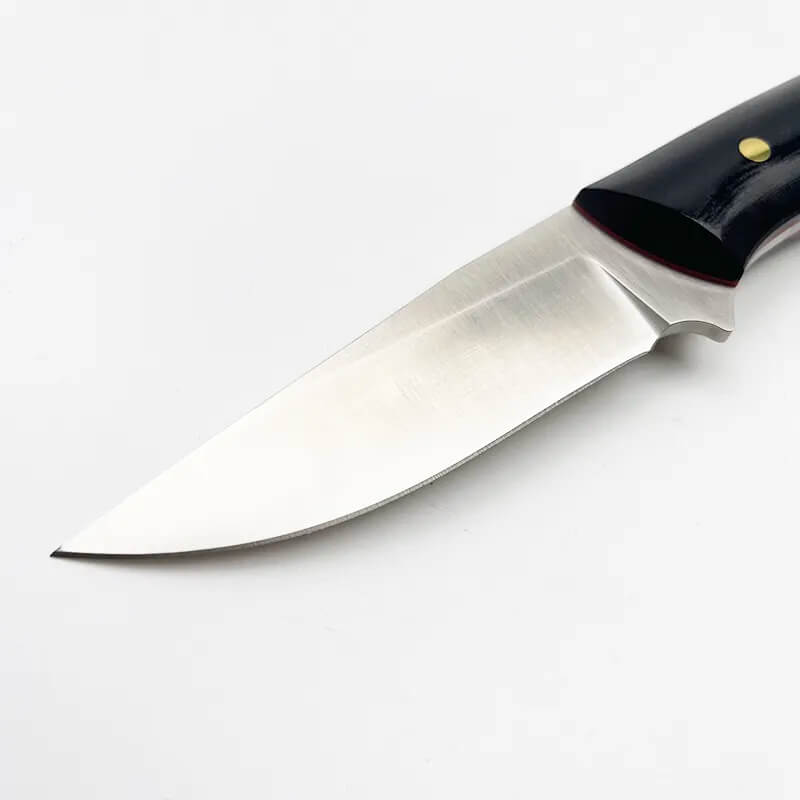
OEM Fixed Blade Knife G10 Handle (3.74 Inch D2 Blade)
D2 is a high-carbon, high-chromium cold-work tool steel. It was developed in the United States in the early 20th century, originally for industrial dies, punches, and cutting tools that needed long service life under abrasive conditions.
Its roughly 12% chromium content earned it the nickname “semi-stainless” — more rust-resistant than plain carbon steels, but not fully stainless.
Key Characteristics of D2:
- Type: High-carbon, high-chromium cold-work tool steel (air-hardening)
- Standard: AISI D2 (equivalents: DIN 1.2379, JIS SKD11)
- Hardness Range: 58-62 HRC
- Primary Application: EDC folders, hunting knives, small fixed blades, industrial cutting tools
Today, D2 sits in the mid-range category — a step up from budget steels like 8Cr13MoV, but below premium options like S35VN and MagnaCut.
What Is 1095 Steel?
1095 is a simple high-carbon steel and one of the oldest, most widely used blade steels in the world. It contains roughly 0.95% carbon and a small amount of manganese, with almost no other alloying elements.
That simplicity defines its character: almost no chromium means little rust resistance, but a clean structure that takes a very fine edge and sharpens easily. It is the classic choice for fixed blade knives and survival tools — the Ka-Bar USMC being the most famous example.
Key Characteristics of 1095:
- Type: Plain high-carbon steel
- Standard: AISI/SAE 1095
- Hardness Range: 56-60 HRC (up to ~65 HRC as-quenched)
- Primary Application: Survival knives, bushcraft blades, machetes, tactical fixed blades, springs
1095 is a budget-to-mid-range steel: inexpensive, easy to heat treat, and dominant in the entry-level and hard-use outdoor knife market.
Chemical Composition: D2 vs 1095
| Element | D2 | 1095 | Role |
|---|---|---|---|
| Carbon (C) | 1.40-1.60% | 0.90-1.03% | Base hardness contributor |
| Chromium (Cr) | 11.0-13.0% | ~0% | Corrosion resistance and carbide formation |
| Molybdenum (Mo) | 0.70-1.20% | — | Enhances toughness and hardenability |
| Vanadium (V) | ≤1.10% | — | Wear resistance and fine carbides |
| Manganese (Mn) | ~0.60% | 0.30-0.50% | Hardenability and tensile strength |
| Silicon (Si) | ≤0.60% | — | Strength and elasticity |
| Iron (Fe) | Balance (~82%) | 98.38-98.80% | Base metal |
Data sources: AZoM D2 Tool Steel datasheet (UNS T30402), AZoM AISI 1095 Carbon Steel datasheet (UNS G10950)
The composition gap explains almost every performance difference between these steels. D2 carries roughly 12% chromium and a large volume of hard chromium carbides (M7C3 type). These carbides deliver wear resistance and moderate rust protection, but they also make the steel more brittle and harder to grind.
1095 is essentially iron, carbon, and a trace of manganese. With no large alloy carbides, its microstructure is more uniform. That uniform structure is why 1095 takes such a keen edge and tolerates impact better than D2.
For buyers, the takeaway is simple: D2 trades toughness and workability for wear resistance. 1095 does the opposite.
Performance Scorecard: D2 vs 1095
| Performance Indicator | D2 | 1095 | Winner & Why |
|---|---|---|---|
| Edge Retention | 7.0/10 (Good) | 4.5/10 (Fair) | D2 – Hard chromium carbides resist abrasive wear |
| Toughness | 4.5/10 (Fair) | 7.0/10 (Good) | 1095 – Uniform, carbide-poor structure survives impact |
| Corrosion Resistance | 5.0/10 (Moderate) | 2.0/10 (Poor) | D2 – 12% chromium gives semi-stainless protection |
| Ease of Sharpening | 3.5/10 (Poor) | 8.5/10 (Excellent) | 1095 – Sharpens fast on basic stones, even in the field |
| Hardness Range | 58-62 HRC (High) | 56-60 HRC (Moderate) | D2 – Runs harder for better wear resistance |
| Cost (same model) | Higher (Mid-range) | Lower (Budget-friendly) | 1095 – Cheaper material, heat treatment, and grinding |
Scores are approximate based on industry data, CATRA-style testing references, and user consensus.
The scorecard shows a clean split. D2 wins every category tied to wear and corrosion. 1095 wins every category tied to toughness, sharpening, and cost. For sourcing managers, the question is not which steel is “better” — it is which trade-off fits your product line and target user.
Edge Retention
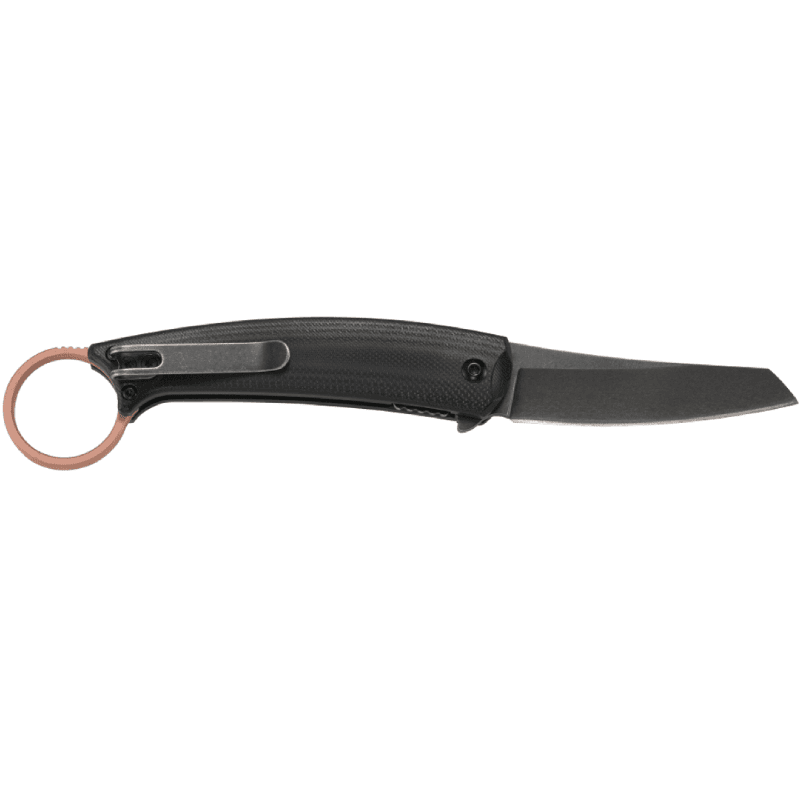
OEM Liner Lock Knife G10 Handle (2.70 Inch D2 Blade)
Edge retention is D2’s biggest advantage. Its high volume of hard chromium carbides resists abrasive wear far better than 1095’s simple iron-carbon structure.
A useful reference comes from a CATRA test shared in the knife community: at the same 40-degree edge angle, D2’s total cutting performance was roughly double that of 1095. In everyday terms, a D2 blade cutting cardboard, rope, or packaging may hold a working edge several times longer than a 1095 blade doing the same work.
The catch is what happens when the edge finally dulls. D2’s edge degrades slowly, but restoring it takes real effort. 1095 dulls faster, yet a few passes on a pocket stone bring it back. Users who sharpen often may never notice D2’s advantage; users who avoid maintenance will.
Toughness
Toughness measures a steel’s ability to absorb impact without chipping or cracking — and this is where 1095 wins. D2’s large chromium carbides create stress points in the microstructure, so the edge is more likely to chip under chopping, batoning, or lateral prying.
1095’s uniform, carbide-poor structure flexes slightly under load and resists chipping. That is why it dominates bushcraft, survival, and machete categories: knives in these roles rarely fail from wear — they fail from deformation and fracture. As one forum user put it: “If my knife gets dull, I can sharpen it. If it snaps in half, that’s a more difficult fix.”
One clarification: 1095’s “legendary toughness” is partly marketing. At high hardness its impact numbers are modest, and steels like 1075 or 5160 are tougher still. But relative to D2, 1095 is clearly the more impact-friendly choice — especially in blades over 4 inches.
Corrosion Resistance
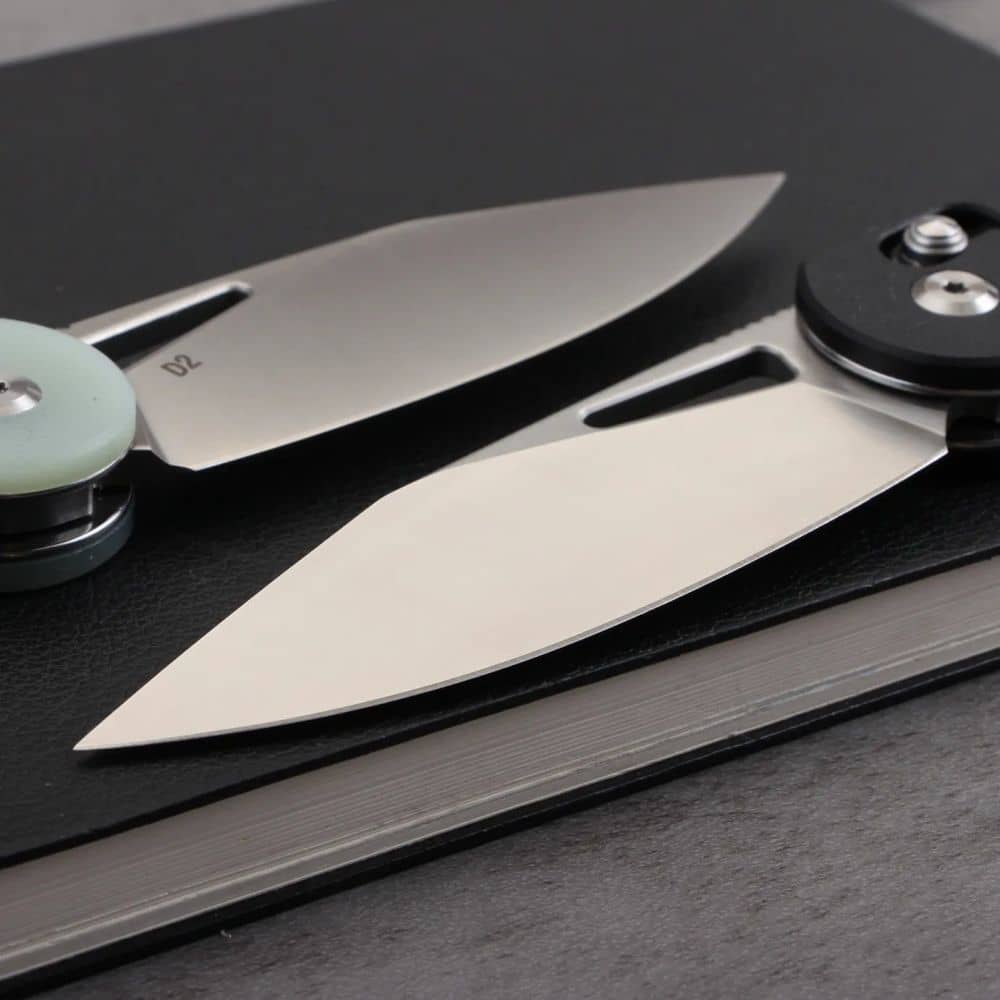
OEM Crossbar Lock Knife G10 Handle (3.11 Inch D2 Blade)
D2 wins on corrosion resistance, though neither steel is truly stainless. With about 12% chromium, D2 is “semi-stainless”: in normal dry use it needs only basic wiping and occasional oil, but humid or coastal environments still demand attention. It falls well short of true stainless steels like 14C28N.
1095 sits at the opposite extreme. With virtually no chromium, it can show surface rust within hours in damp conditions — fingerprints and humidity alone are enough. Owners must clean, dry, and oil the blade regularly.
The silver lining: over time, 1095 develops a patina, a stable dark oxidation layer that slows further rusting. Some users even force a patina with vinegar or mustard on purpose.
For product planning, if your customers are in humid climates or simply maintenance-averse, D2 is the safer spec.
Ease of Sharpening
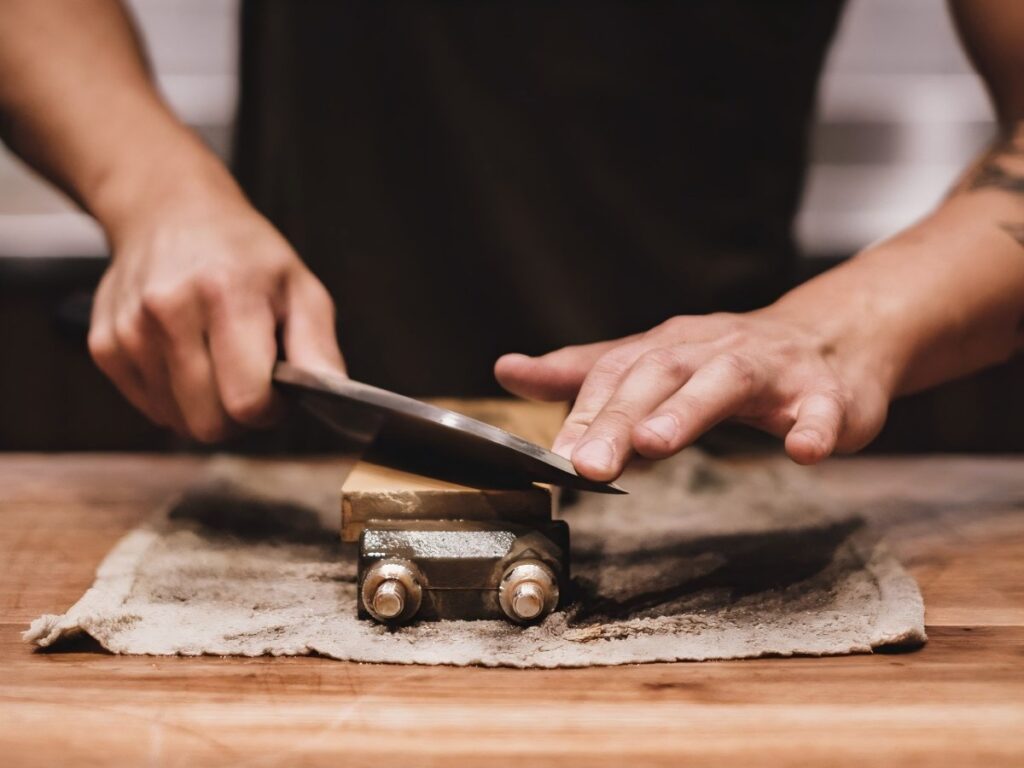
1095 is the clear winner here — it is one of the easiest knife steels to sharpen, period. A basic whetstone or Arkansas stone restores a working edge in minutes, even in the field. Its fine, carbide-poor structure also takes a keener, more polished edge than D2 typically achieves.
D2 is genuinely demanding. Its hard carbides resist common stones, so it wants diamond plates or quality ceramic abrasives, plus a strop for finishing. Many users report that D2 “never feels razor-sharp” on basic equipment.
This difference matters in real use. A bushcrafter with a dull 1095 knife is minutes away from a sharp one; a bushcrafter with a dull D2 knife and no diamond sharpener has a problem. For EDC users who maintain edges at a bench, D2’s longer edge life often outweighs the extra effort.
Hardness and Heat Treatment
D2 typically runs at 58-62 HRC. As an air-hardening steel, it is austenitized around 1010-1040°C, quenched in still air, and tempered multiple times. Air hardening gives excellent dimensional stability, but the process demands tight control.
1095 runs at 56-60 HRC in most production knives. A simple water or oil quench from 790-845°C plus tempering gets it there — a forgiving process every commercial heat treater knows well.
For OEM projects, 1095’s simple heat treatment supports consistent quality at high volume. D2 rewards experienced heat treaters: well-executed D2 (like the Bob Dozier knives praised in forums) performs noticeably better than average D2, so supplier capability directly shapes your product’s reputation.
Application Guide
The community rule of thumb is consistent across forums and reviews: large blades favor 1095, small blades favor D2.
1095 Steel: Best for Large, Hard-Use Blades
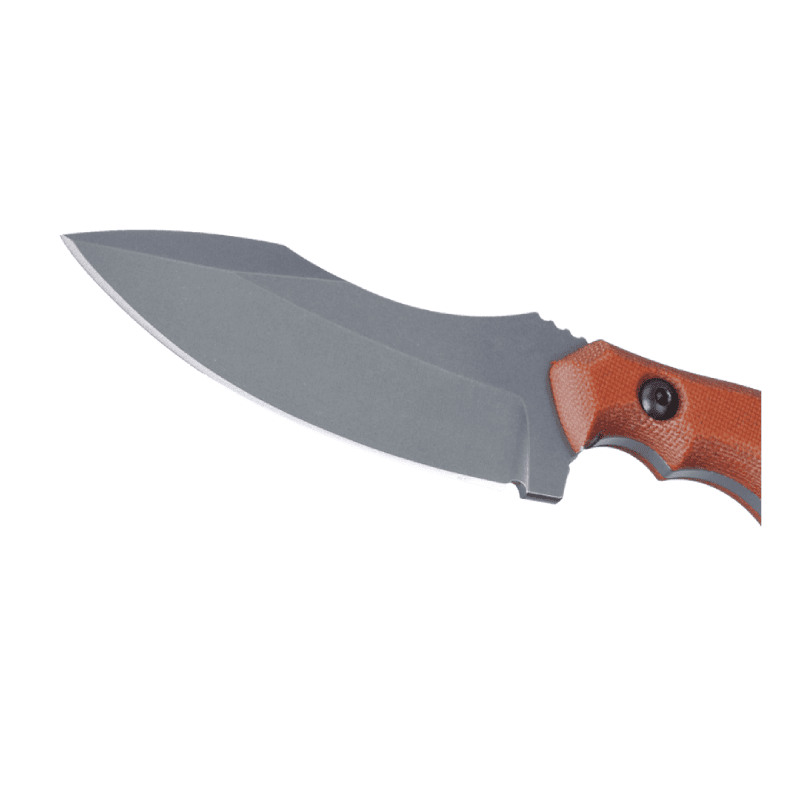
OEM Fixed Blade Knife Micarta Handle (3.78 Inch 1095 Blade)
1095’s toughness, field-friendly sharpening, and low cost make it the default choice for big blades that see real abuse. These are the knife types where it performs best.
Survival and Bushcraft Knives
Survival knives live or die by toughness, and this is 1095’s home ground. Its uniform, carbide-poor structure absorbs chopping, batoning, and prying without chipping, and a dull edge comes back in minutes on any basic stone — critical when you are miles from a workbench. This is why blades like the ESEE-4 and Ontario RAT series trust 1095.
Machetes and Large Choppers
Large blades fail from deformation and fracture, not wear — exactly the failure mode 1095 resists best. Its ability to flex slightly under heavy impact keeps long, thin edges intact through repeated chopping of brush and wood. D2’s brittleness makes it a poor fit here, which is why machetes over 10 inches are almost always carbon steel.
Military-Style Fixed Blades
Combat and utility fixed blades demand reliability above all else. 1095’s proven track record — most famously the Ka-Bar USMC fighting knife — comes from its balance of toughness, easy maintenance, and low cost. Soldiers can restore the edge with improvised tools and trust the blade not to snap under stress.
Budget Hunting and Camp Knives
For entry-level outdoor product lines, 1095 keeps unit costs low without sacrificing real-world performance. It grinds fast in production, heat-treats easily, and lets end users maintain the knife with a $20 stone. For brands competing in the budget segment, 1095 delivers the best value-to-performance ratio available.
D2 Steel: Best for EDC and Precision Cutting
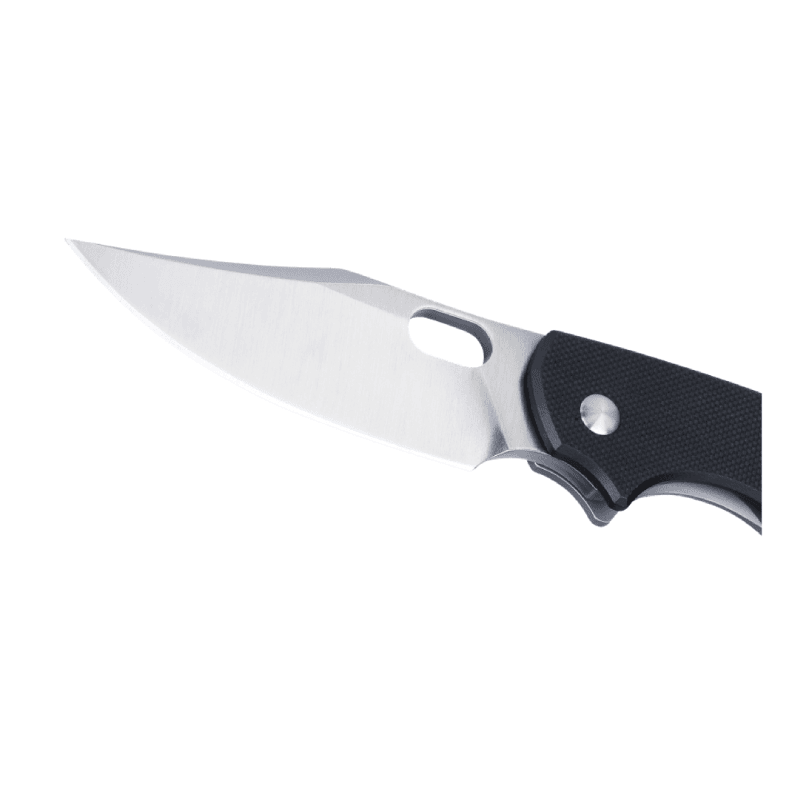
OEM Frame Lock Knife G10 + Stainless Steel Handle (3.09 Inch D2 Blade)
D2’s edge retention, wear resistance, and semi-stainless nature shine in smaller blades used for sustained cutting rather than impact. These are the knife types where it earns its place.
EDC Folding Knives
EDC folders spend their lives cutting cardboard, rope, and packaging — abrasive work where D2’s carbide-rich structure outlasts 1095 by a wide margin. Users who dislike frequent sharpening get weeks of cutting between touch-ups. Models like the SOG Terminus XR and Ontario RAT D2 editions are built on exactly this logic.
Hunting and Skinning Knives
Field dressing an animal means long, continuous slicing through hide and tissue — wear, not impact, is what dulls the blade. D2’s edge retention lets a hunter finish the job on one edge, and its semi-stainless nature tolerates blood and moisture better than 1095. The Buck Skinner and Bob Dozier’s D2 folders are classic examples.
Small Fixed Blades
In blades under 4 inches, chipping risk drops because the tasks are slicing-focused, so D2’s toughness limitation matters less. What remains is its advantage: long edge life in a compact package. Ka-Bar’s D2 models show how well the steel works in small utility and tactical fixed blades.
Package- and Rope-Cutting Work Knives
Warehouse, trade, and utility work involves hours of abrasive cutting every day — the exact scenario D2 was designed for as an industrial tool steel. Its wear resistance translates directly into fewer sharpening breaks and longer service life. For professional users, that durability justifies the extra sharpening effort when the edge finally dulls.
Cost and Market Pricing
The cost gap between the two steels shows up at every production stage.
1095 is one of the cheapest knife steels available: inexpensive raw material, simple quench-and-temper heat treatment, and fast grinding on a soft, carbide-free structure. D2 costs more throughout — a pricier alloy, tighter heat-treatment control, and carbides that eat grinding belts and slow production.
| Cost Factor | D2 | 1095 |
|---|---|---|
| Raw material | Higher | Low |
| Heat treatment | Air hardening, multiple tempers | Simple quench and temper |
| Grinding/machining | Slow, high abrasive cost | Fast, low abrasive cost |
| Typical retail positioning | Mid-range | Budget to mid-range |
The market reflects this gap directly: Ontario charges more for the D2 versions of its RAT and TAK knives than for the 1095 versions of the same models.
For OEM projects, 1095 lowers unit cost in volume production, while D2 supports a higher price point and a “better edge retention” marketing claim.
Let Keganico Help You Choose the Right Steel
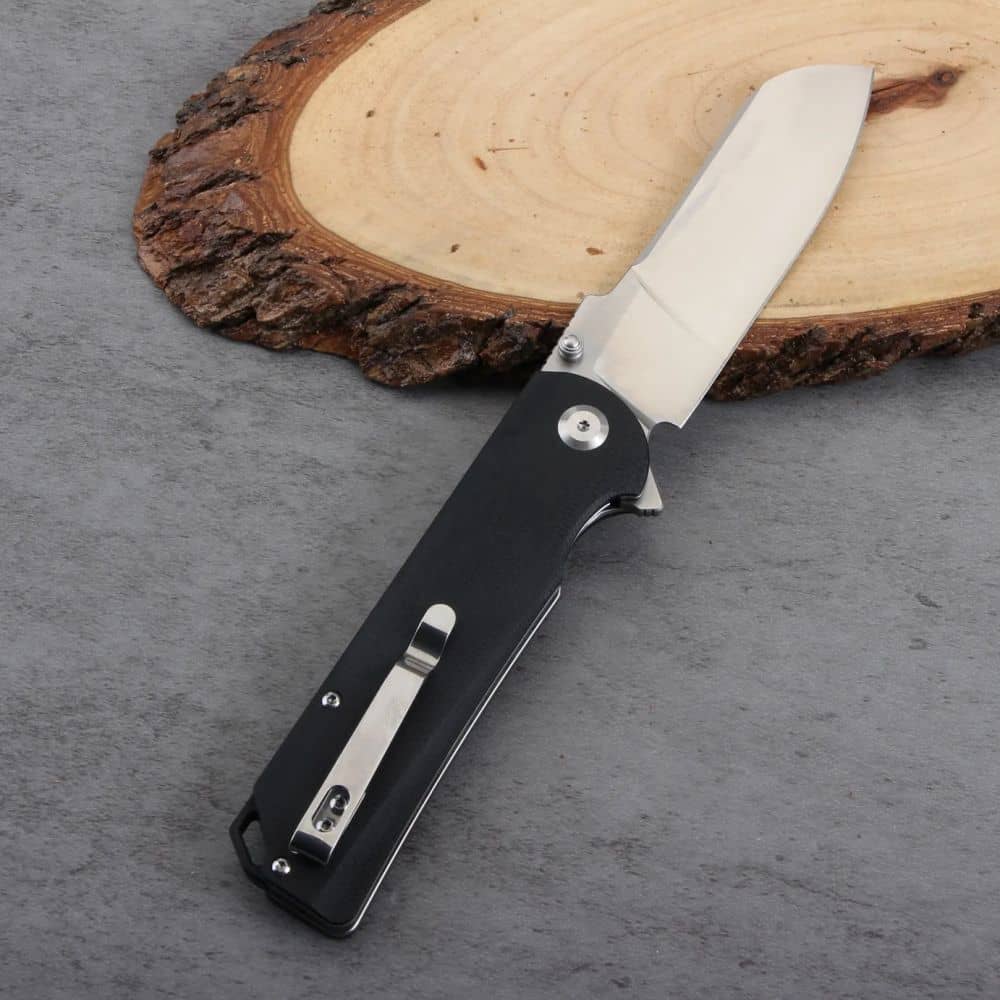
OEM Liner Lock Knife G10 Handle (3.82 Inch D2 Blade)
D2 and 1095 are not competitors for the same job — they are two different answers to two different requirements.
1095 delivers toughness, easy sharpening, and low cost for large outdoor blades. D2 delivers edge retention and semi-stainless convenience for EDC and precision cutting.
For brand owners and sourcing managers, the decision usually comes down to positioning. Use 1095 to compete on rugged value. Use D2 to compete on edge life and spec-sheet appeal. Many successful brands offer both steels across different product tiers.
At Keganico, we support OEM knife manufacturing, private label programs, and wholesale knife supply. Our team can help you select the right steel, optimize heat treatment, and control grinding costs for your product line.
Ready to source your next knife line? Request a free quote or contact Keganico to discuss D2, 1095, and other blade steels for your market.
Frequently Asked Questions
Is D2 steel the same as carbon steel?
Not exactly. When knife people say “carbon steel,” they usually mean simple steels like 1095 — iron, carbon, and little else. D2 is technically a high-carbon tool steel, but its 12% chromium content puts it in a separate “semi-stainless” category. Both will rust without care, but 1095 rusts much faster.
What is the equivalent of D2 steel?
D2’s international equivalents are DIN 1.2379 (Europe), JIS SKD11 (Japan), and GB Cr12Mo1V1 (China). You may also see it listed simply as AISI D2. These grades share nearly identical chemistry, so sourcing any of them delivers the same base performance — heat treatment quality makes the real difference.
Is D2 a high end steel?
D2 is a solid mid-range steel, not a high-end one. It sits above budget steels like 8Cr13MoV and 440A, but below premium options like S35VN, M390, and MagnaCut. Its long track record and low cost keep it popular in the $50-$150 knife segment.
What knife brands use D2 steel?
Many major brands offer D2 models, including Ontario (RAT series D2 editions), Ka-Bar (D2 Extreme), Benchmade (select models), SOG (Terminus XR), Buck (Skinner), and custom makers like Bob Dozier, whose heat-treated D2 has a strong following. D2 is also common in budget-friendly Chinese brands because it offers strong specs at low cost.
What steel is better than D2?
It depends on what you want to improve. For better toughness and rust resistance with easy sharpening, 14C28N is a popular upgrade. For a premium all-rounder, S35VN and MagnaCut beat D2 in nearly every category at a higher price. For pure wear resistance, steels like S90V or M4 hold an edge even longer.
What grit should I use to sharpen D2 — and can I use a whetstone?
Start with a coarse diamond plate (around 400 grit) to shape the edge, refine at 1000 grit, then finish on a strop. You can use a whetstone, but standard aluminum oxide stones cut D2 slowly — diamond or CBN abrasives save significant time. The key technique: do the heavy work on a coarse stone first, and only move to fine stones once the edge is fully formed.