M390 and N690 are two popular stainless steels from Böhler-Uddeholm, but they serve different knife markets.
M390 outperforms N690 in edge retention and wear resistance, while N690 offers better value, easier sharpening, and sufficient toughness for most outdoor and EDC knives. Both steels are stainless, yet their manufacturing methods and target users differ significantly.
This guide compares M390 and N690 side by side — with composition data, performance benchmarks, and sourcing implications — so you can specify the right steel for your OEM knife projects, wholesale lines, and custom production runs.
What Is M390 Steel?
M390 is a martensitic stainless steel from Böhler-Uddeholm, produced via third-generation powder metallurgy.
It was developed in the late 1980s from K190, a powder metallurgy cold-work tool steel, with the goal of creating a stainless steel with very high wear resistance and good corrosion resistance for plastic injection molds.
The powder metallurgy process makes the carbides very fine and evenly distributed. This gives knife makers excellent edge retention, high hardness, and a clean, polished look. M390 quickly became popular for high-end folding knives, limited editions, and premium kitchen knives.
Key Characteristics of M390:
- Type: Powder metallurgy stainless steel
- Producer: Böhler-Uddeholm (Austria/Sweden)
- Known Aliases: M390 MicroClean, M390 Isomatrix, CTS-204P, CPM 20CV
- Hardness Range: 60-62 HRC
- Primary Application: Premium EDC folders, tactical knives, collector pieces, kitchen knives
What Is N690 Steel?
N690 is a martensitic stainless steel from Böhler-Uddeholm, made through conventional ingot casting, often refined with electro-slag remelting (ESR).
It was introduced in the late 1990s as an evolution of the company’s surgical-grade 440B alloy, designed to harden past 60 HRC, hold an edge longer than 440C, and still grind and polish easily.
Cobalt and molybdenum are the key additions. Cobalt improves tempering resistance and helps carbides distribute more evenly. Molybdenum boosts pitting resistance in salty or humid environments. The result is a balanced, mid-to-high-range stainless steel that performs above its price point.
Key Characteristics of N690:
- Type: Conventional ingot stainless steel (often ESR-refined)
- Producer: Böhler-Uddeholm (Austria)
- Known Aliases: N690Co (the “Co” simply highlights cobalt content)
- Hardness Range: 58-60 HRC
- Primary Application: Outdoor knives, tactical fixed blades, budget-to-mid-range EDC folders, kitchen knives
Chemical Composition: M390 vs N690
| Element | M390 | N690 | Role |
|---|---|---|---|
| Carbon (C) | 1.90% | 1.08% | Base hardness and carbide formation |
| Chromium (Cr) | 20.00% | 17.30% | Corrosion resistance; exceeds 13% stainless threshold |
| Vanadium (V) | 4.00% | 0.10% | Wear resistance and hard carbide formation |
| Molybdenum (Mo) | 1.00% | 1.10% | Pitting resistance and strength |
| Tungsten (W) | 0.60% | — | Carbide stabilization and hardness |
| Cobalt (Co) | — | 1.50% | Secondary hardening and tempering resistance |
| Manganese (Mn) | 0.30% | 0.40% | Hardenability and deoxidation |
| Silicon (Si) | 0.70% | 0.40% | Strength and scaling resistance |
Data sources: Böhler M390 MicroClean datasheet, Böhler N690 datasheet
The composition table explains why these steels behave differently:
- M390 carries nearly twice the carbon and forty times the vanadium of N690. This creates more hard carbides, giving M390 better edge retention and wear resistance.
- N690 uses cobalt instead of vanadium for hardness and tempering resistance. It has less carbide load, so it is easier to sharpen, machine, and polish.
- Both steels exceed the 13% chromium threshold for stainless classification. M390 has more chromium, but real-world corrosion resistance also depends on heat treatment and edge geometry.
Performance Scorecard: M390 vs N690
| Performance Indicator | M390 | N690 | Winner |
|---|---|---|---|
| Edge Retention (CATRA) | Excellent (959 mm) | Good (635 mm) | M390 |
| Toughness (Charpy V-notch, 61 HRC) | Moderate (~5 ft-lbs) | Moderate-Good (~14.7 ft-lbs (20 J)) | N690 |
| Corrosion Resistance | Excellent | Very Good | M390 |
| Ease of Sharpening | Moderate-Difficult | Easy-Moderate | N690 |
| Hardness (HRC) | 60-62 | 58-60 | M390 |
| Cost | Premium | Mid-range | N690 |
Data sources: Knife Steel Nerds M390 analysis, Böhler-Uddeholm CATRA Edge Retention Test, Noblie N690 guide, Böhler datasheets
This scorecard shows the classic trade-off in knife steel design. M390 wins on edge retention, hardness, and corrosion resistance. N690 wins on toughness, ease of sharpening, and cost.
Neither steel is universally better; the right choice depends on the knife’s intended use, target price, and the end user’s maintenance habits.
Edge Retention

OEM Frame Lock Knife Titanium Alloy Handle (2.56 Inch M390 Blade)
M390 wins on edge retention. In CATRA testing, Böhler-Uddeholm’s data shows M390 MicroClean cutting 959 mm of silica-impregnated cardstock at 61+ HRC. N690 scores 635 mm under the same test conditions.
The gap comes from M390’s 4% vanadium content, which forms harder carbides that resist wear better than N690’s chromium carbides. M390 also runs harder (60-62 HRC vs 58-60 HRC), which further improves edge stability.
For OEM buyers, M390 is the better choice when customers value long intervals between sharpening. N690 is the pragmatic choice when easy maintenance matters more than maximum cutting endurance.
Toughness
N690 tolerates rougher use better than M390. M390’s high carbide volume limits its toughness. Charpy V-notch testing at 61 HRC shows M390 at approximately 5 ft-lbs. N690 scores around 20 J (~14.7 ft-lbs) at 20°C — roughly three times higher.
N690’s lower carbide volume and more ductile matrix make it less likely to chip under lateral stress. For outdoor, survival, and tactical fixed blades, N690 is the safer choice. M390 performs best in controlled cutting tasks where the edge does not take heavy impact.
Corrosion Resistance
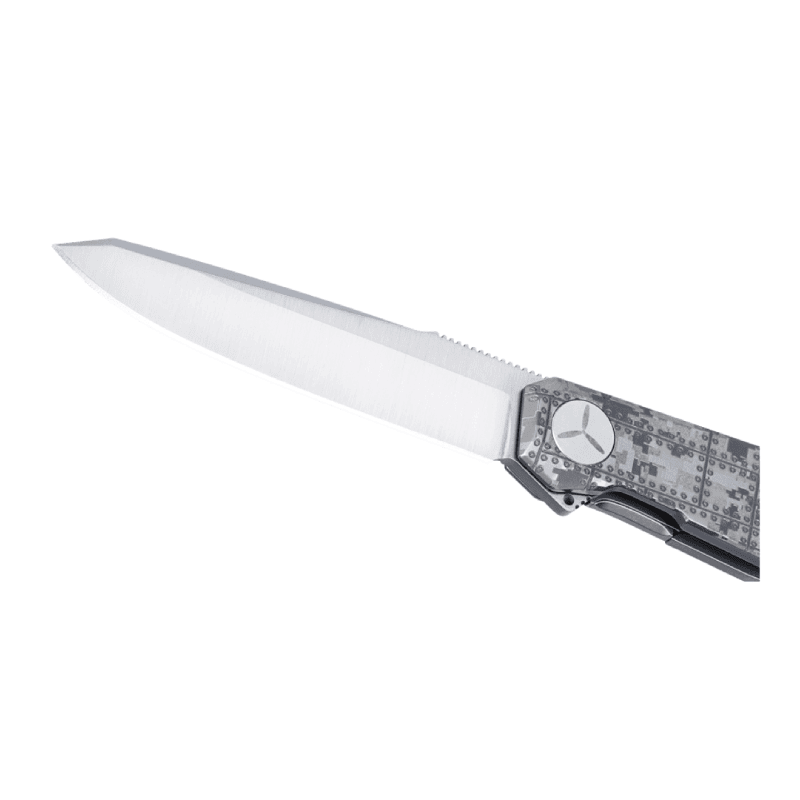
OEM Frame Lock Knife Titanium Handle (3.50 Inch M390 Blade)
M390 has a slight edge, but both steels resist rust well in normal use. M390 contains 20% chromium, one of the highest levels among mainstream knife steels. N690 contains 17.3% chromium plus 1.1% molybdenum, which improves pitting resistance in salty environments.
Salt-spray testing (ASTM B117) shows N690 resisting red rust for about 300 hours — better than 154CM (~240 hours) and close to S30V (~360 hours).
For most EDC, outdoor, and kitchen knives, N690 is “stainless enough.” M390 is the better choice for humid climates, marine use, or kitchen knives that stay wet for long periods.
Ease of Sharpening
N690 is easier to sharpen than M390. N690’s chromium carbides are softer than M390’s vanadium carbides, so standard whetstones and ceramic rods cut N690 efficiently. Most users can restore a working edge in minutes.
M390’s high carbide volume dulls abrasives faster and needs more passes. Diamond or CBN plates work best.
For OEM buyers, N690 is the safer choice for customers who sharpen at home without specialized equipment. M390 suits customers who use diamond/CBN systems or send knives out for professional sharpening.
Hardness and Heat Treatment
M390 runs harder but needs more precise heat treatment. Most production M390 knives run at 60-62 HRC. The recommended process uses austenitizing at 1130°C (2066°F) for 30 minutes, followed by rapid quenching and cryogenic treatment.
Higher temperatures up to 1180°C (2155°F) maximize wear resistance but require careful management of retained austenite.
N690 has a wider, more forgiving heat-treat window. Most makers aim for 58-60 HRC using austenitizing at 1050–1060°C and tempering at 150–200°C for 2 hours × 2 cycles. Its simpler alloy structure makes it more consistent across large production runs.
For OEM manufacturers, M390 demands tighter process control and more specialized equipment. N690 is easier to scale, especially if your production partner has limited experience with powder metallurgy steels.
Cost Analysis & Market Pricing
| Steel | Typical Knife Price Impact | Market Positioning |
|---|---|---|
| M390 | +$30 to +$80 vs N690 in same model | Premium/super-steel flagship lines |
| N690 | Baseline for mid-range European steel | Value-premium EDC, outdoor, tactical |
Factors Affecting Price
- Material Cost: M390 powder steel is significantly more expensive per kilogram than conventionally produced N690.
- Manufacturing Complexity: M390 requires PM-specific processing, more expensive heat treatment, and diamond/CBN grinding equipment. N690 can be produced with conventional tooling.
- Heat Treatment Cost: M390 needs cryogenic processing and precise temperature control. N690’s wider heat-treat window lowers both cost and scrap rate.
- Brand Premium: M390 carries stronger collector and enthusiast appeal, allowing higher retail margins. N690 competes on value and reliability.
- Supply Chain Maturity: M390 is widely available but concentrated among premium suppliers. N690 is common in European supply chains and often easier to source in smaller quantities.
Value Assessment
For a brand building a flagship line, M390 justifies its premium through measurable performance advantages. For a brand targeting price-sensitive EDC or outdoor buyers, N690 offers a compelling balance of corrosion resistance, edge retention, and manufacturability.
From a sourcing perspective, the total landed cost difference often exceeds the raw material gap. M390 requires more skilled labor, longer grinding cycles, and stricter QC. N690 lets factories move faster and maintain higher yields.
Application Guide: Which Steel for Which Knife?
Best Uses for M390
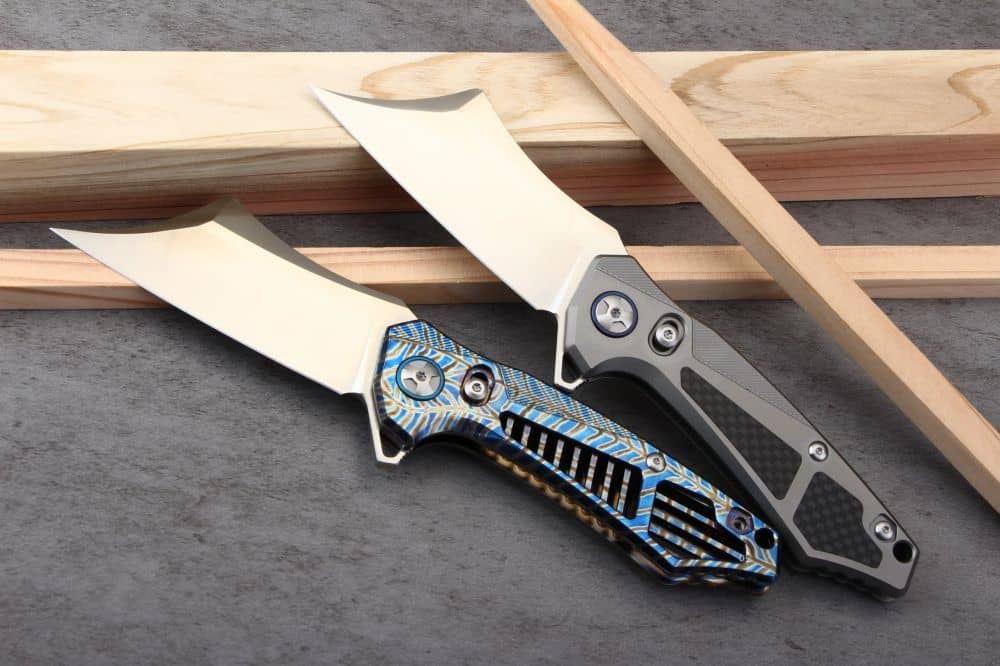
OEM Crossbar Lock Knife TC4 Titanium with Carbon Fiber Inlay Handle (M390 Blade)
M390 excels where edge retention and corrosion resistance matter most.
Premium EDC Folders
Flagship folding knives in the $150-$400 range often use M390 to justify their premium positioning. These knives typically feature titanium or carbon fiber handles, ceramic bearings, and flipper or thumb-stud deployment.
For users who cut cardboard, tape, and packaging daily, M390’s edge life means fewer sharpening sessions. Brands like Benchmade, Zero Tolerance, and LionSteel have used M390 in core EDC models.
Collector and Limited-Edition Knives
M390 carries strong enthusiast appeal. Limited runs, collaboration pieces, and blade-show exclusives often specify M390 because the “super steel” label supports higher retail prices and stronger resale value. Collectors frequently prioritize steel identity as part of the knife’s story.
Kitchen Knives
Chef’s knives, gyutos, and petty knives benefit from M390’s wear resistance during high-volume prep work. A cook slicing vegetables, proteins, and herbs for hours will notice that an M390 edge holds longer between honing sessions.
This makes it attractive for professional kitchens and serious home cooks who want performance over easy maintenance.
Marine and Humid-Environment Knives
M390’s 20% chromium content makes it a strong candidate for diving knives, fishing knives, and coastal EDC blades.
While no stainless steel is truly rust-proof, M390 resists salt spray and humidity better than most mainstream stainless steels. Users in tropical or marine climates gain a measurable maintenance advantage.
Light-Duty Slicing Tools
M390 performs best in controlled cutting tasks such as opening packages, slicing rope, cutting fibrous materials, and preparing food. These applications reward edge retention without putting the blade under impact or twisting loads.
M390 is less ideal for heavy-impact tasks like batoning, prying, or chopping through bone. Its high carbide volume can chip under shock loading if the edge geometry is too thin.
Best Uses for N690
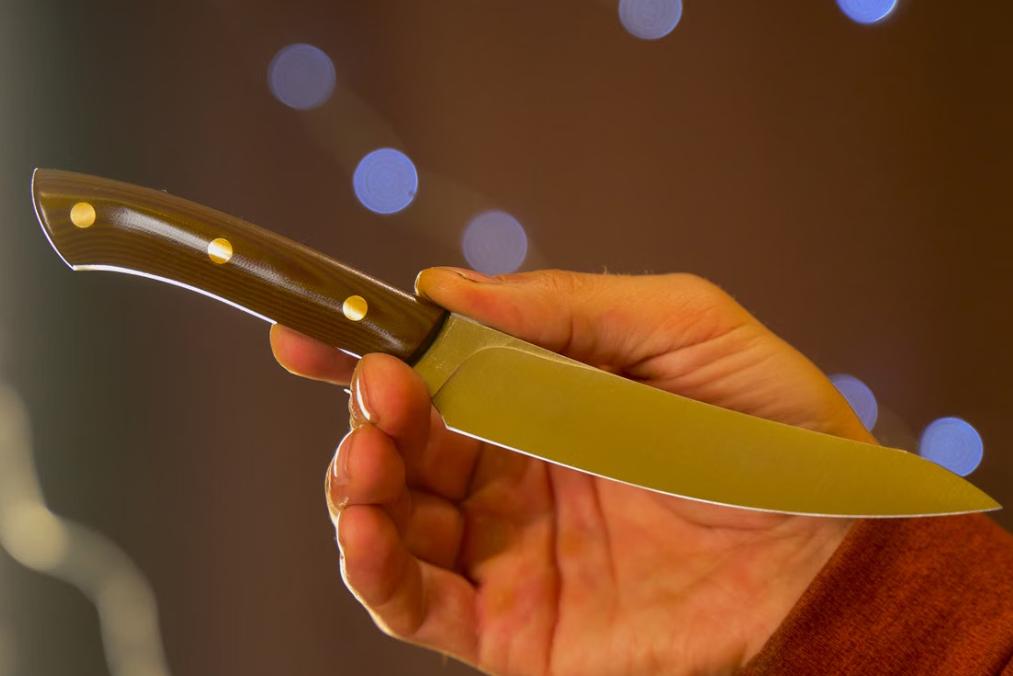
N690 is the practical choice when toughness, ease of maintenance, and cost control are priorities.
Outdoor and Survival Fixed Blades
Bushcraft knives, hunting knives, and camping fixed blades often use N690 because it handles impact better than M390. Tasks like batoning wood, cutting rope, cleaning game, and carving feather sticks put lateral stress on the edge.
N690’s lower carbide volume and more ductile matrix reduce the risk of chipping. Field sharpening with a small ceramic rod or river stone is also straightforward.
Tactical and Military Knives
European makers have a long history of using N690 for military-issue knives. Extrema Ratio’s Col Moschin and Fulcrum series, along with models from Fox Knives and LionSteel, demonstrate the steel’s reliability in harsh field conditions.
The combination of corrosion resistance, easy maintenance, and solid toughness fits soldiers, police, and security professionals who cannot baby their blades.
Budget-to-Mid-Range EDC Folders
Brands like Kizer, Civivi, Vosteed, and Kershaw use N690 in folders priced between $40 and $120.
At this price point, buyers want a steel that resists rust, takes a sharp edge, and does not require diamond stones to maintain. N690 delivers that balance without pushing the knife into premium pricing territory.
First Responder and Work Knives
Rescue knives, EMS folders, and construction work knives benefit from N690’s forgiving nature. Professionals often need to touch up an edge quickly between calls or jobs.
A few passes on a ceramic rod or leather strop can restore N690 to working sharpness in seconds.
Kitchen Knives for Low-Maintenance Users
Home cooks who want good performance without learning advanced sharpening will find N690 easier to live with than M390.
A simple honing rod and occasional pass on a basic whetstone keep the edge in shape. N690 also resists staining from acidic foods better than many budget stainless steels.
N690 does not match M390 in abrasive edge retention, so it is less suited for premium collector pieces or knives marketed primarily on “never needs sharpening” claims.
OEM Sourcing Recommendation
Choose M390 if your product line targets enthusiasts, collectors, or professional users who prioritize edge retention and are willing to pay a premium. It works best for knives with controlled edge geometry and clear premium positioning.
Choose N690 if your product line targets practical users, outdoor buyers, or budget-conscious EDC customers. It offers lower manufacturing risk, easier field maintenance, and strong corrosion resistance at a mid-range price point.
For many brands, the best strategy is not to choose one steel for every model. A dual-steel lineup — M390 for flagship models and N690 for workhorse models — lets you capture both premium and value segments.
Partner with Keganico for Your Knife Steel Sourcing

OEM Frame Lock Knife Titanium Alloy Handle (3.15 Inch M390 Blade)
Choosing between M390 and N690 is only the first step. At Keganico, we help knife brands, retailers, and distributors turn that choice into a profitable product line.
Our expertise includes:
- Precision heat treatment optimized for M390, N690, and other premium steels
- OEM manufacturing with consistent quality control and hardness verification
- Private-label programs that let you launch branded knife lines quickly
- Wholesale sourcing for EDC folders, fixed blades, kitchen knives, and outdoor tools
- Access to Yangjiang’s mature knife manufacturing supply chain
Whether you need a flagship M390 folder, a workhorse N690 outdoor knife, or a mixed steel lineup, we deliver the right balance of performance, cost, and reliability.
Explore our services:
- OEM Knife Manufacturing — Custom designs and steel specifications
- Private Label Knives — Your brand on production-ready blades
- Wholesale Knives — Competitive pricing for bulk orders
Get Your Free Quote from Keganico today and let our team help you select the best steel for your next knife project.
Frequently Asked Questions
Is N690 a high-end steel?
Yes, N690 qualifies as a high-end or upper-mid-range stainless steel. It offers better corrosion resistance than 440C, comparable edge retention to VG-10 and 154CM, and easier sharpening than many powder metallurgy steels.
While it is not a “super steel” like M390 or S90V, it performs well above its price point for EDC, outdoor, and tactical knives.
What is N690 knife steel equivalent to?
N690 is most similar to VG-10 and 154CM. All three are high-carbon stainless steels with around 1% carbon and good corrosion resistance.
N690’s cobalt content gives it slightly better tempering resistance than 154CM, while its higher chromium content improves rust resistance compared to VG-10. Side-by-side rope-cut tests show N690 lasting about as long as VG-10 and noticeably longer than 440C.
Is Böhler N690 steel any good?
Yes, N690 is a proven knife steel with a strong track record. It is the backbone of Extrema Ratio’s military-issued knife lineup and is widely used by LionSteel, Fox Knives, and many custom European makers.
Forum users generally report that N690 takes a fine edge, resists rust in humid environments, and sharpens easily with standard stones. The main limitation is that it does not match the edge retention of premium PM steels.
Is M390 considered a premium steel?
Yes, M390 is firmly in the premium/super-steel category. Its powder metallurgy construction, 20% chromium content, and 4% vanadium content give it outstanding edge retention, wear resistance, and corrosion resistance.
It is commonly found in knives priced above $150 and is often used for flagship models, limited editions, and high-end kitchen knives.
Why is M390 so expensive?
M390 costs more because of its powder metallurgy manufacturing process, higher alloy content, and demanding heat treatment. PM steel production requires atomizing, compacting, and sintering equipment that conventional steel mills do not need.
The high vanadium and chromium content also increases raw material cost. In production, M390 requires diamond or CBN abrasives, longer grinding cycles, and precise heat treatment — all of which add to the final price.