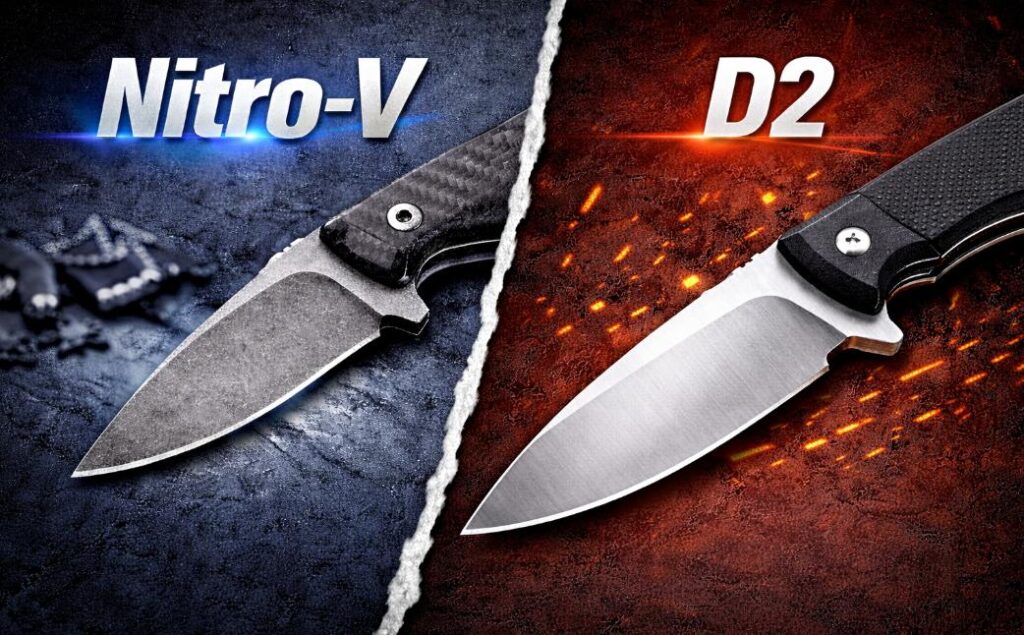
Nitro-V and D2 are popular blade steels, each with distinct strengths. Nitro-V is a modern stainless steel with balanced performance, while D2 is a proven tool steel known for durability.
This guide compares them across five key metrics—corrosion resistance, hardness, toughness, edge retention, and ease of sharpening—to help you choose the right steel.
Steel overview
Nitro-V
A modern stainless steel, Nitro-V is an enhanced version of AEB-L, developed by New Jersey Steel Baron and Buderus Steel. With 13% chromium and 0.11% nitrogen, it delivers excellent corrosion resistance and toughness.
D2
D2 is a high-carbon, high-chromium tool steel, often called “semi-stainless” due to its 12% chromium content. Popular in knife making since the 1960s, it’s prized for its high hardness and wear resistance.
Chemical composition comparison: Nitro-V vs D2
| Element | Nitro-V | D2 Steel | Role and Impact |
| C (Carbon) | 0.68% | 1.5% | Increases hardness and edge retention; |
| Cr (Chromium) | 13.0% | 12% (50% forms carbides) | Enhances corrosion resistance; |
| N (Nitrogen) | 0.11% | Negligible | Strengthens corrosion resistance and refines carbide structure |
| Mo (Molybdenum) | Negligible | 0.70-1.20% | Improves red hardness and corrosion resistance |
| V (Vanadium) | 0.05-0.10% | 0.50-1.1% | Enhances wear resistance by forming hard carbides |
| Mn / Si / Ni, etc. | Mn: 0.60-0.70%, Si: 0.30-0.50% | Mn: 0.1%-0.6%, Si: 0.1%-0.6% | Improves hardenability and overall heat treatment performance |
Nitro-V alloy chemistry sourced from the official Nitro-V Heat Treating Specification Sheet — New Jersey Steel Baron, 2024.
D2 alloy chemistry sourced from Crucible Industries D2 Tool Steel Data Sheet.
The key differences between these two steels are:
- With higher chromium and added nitrogen, Nitro-V offers superior corrosion resistance compared to D2. Its enhanced toughness allows for thinner, more durable blades.
- D2’s high carbon and vanadium content create hard carbides, providing excellent wear resistance. It generally surpasses Nitro-V in edge retention.
Detailed performance comparison
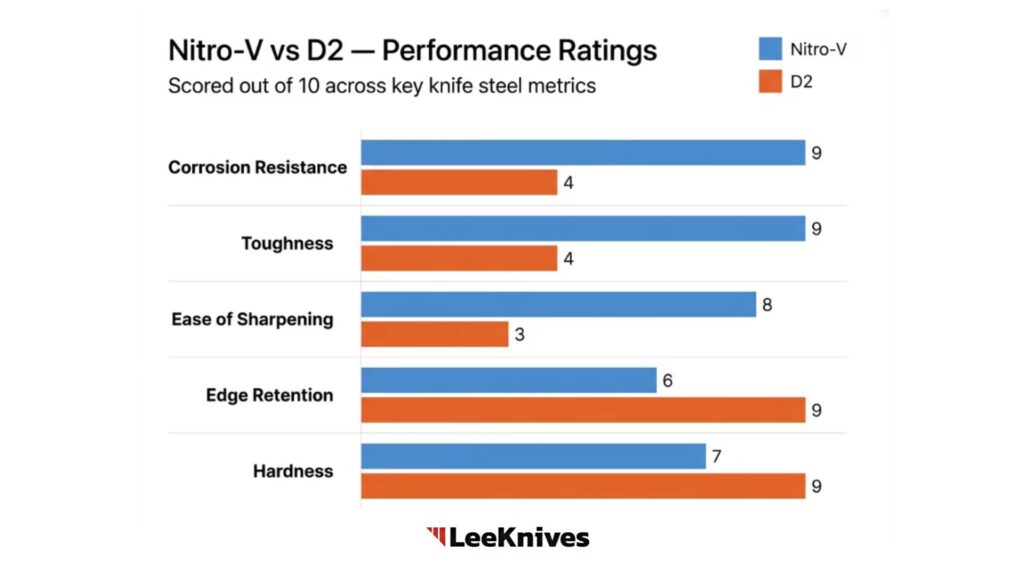
1. Corrosion resistance: Nitro-V is more reliable
Nitro-V:
- Contains 13% chromium, mostly in free form, providing excellent corrosion resistance.
- Includes 0.11% nitrogen, which enhances pitting resistance 16 times more effectively than chromium, making it ideal for humid or saltwater environments.
- Requires minimal maintenance and resists rust and staining.
D2:
- Contains 12% chromium, but about half is tied up in carbides, resulting in weaker corrosion resistance, similar to high-carbon steel.
- Prone to rust in harsh conditions, requiring coating or regular maintenance.
In humid environments (e.g., coastal areas, rainforests) or kitchen settings, Nitro-V knives remain rust-free for longer, reducing maintenance. D2 knives require regular oiling or coating to prevent rust.
2. Hardness: D2 has a slight edge
Nitro-V:
- Hardness ranges from 58-62 HRC (depending on heat treatment), offering good wear resistance.
- Can achieve high hardness with proper heat treatment but slightly less wear-resistant than D2.
D2:
- Hardness ranges from 58-62 HRC (commonly hardened to 60–61 HRC), with high chromium and vanadium carbides providing superior wear resistance.
- Excels in heavy-duty cutting tasks.
Although both steels offer similar hardness on paper, D2 maintains a sharp edge longer thanks to its abundant vanadium carbides.
For heavy-duty cutting (e.g., chopping wood, industrial processing), D2 knives stay sharp longer. Nitro-V is better for everyday tasks like opening boxes or slicing fruit.
Start Working with a Professional Now
3. Toughness: Nitro-V is more chip-resistant
Nitro-V:
- Toughness is approximately 25 ft-lbs (10.7 Nm), offering strong resistance to chipping.
- Suitable for thin blade designs, able to withstand impact without breaking.
D2:
- Toughness is 15-17 ft-lbs (5.7 Nm), making it more prone to chipping.
- Requires thicker blades to prevent breakage, not ideal for high-impact tasks.
During outdoor activities (e.g., camping adverbial hiking), Nitro-V knives can handle accidental impacts or bending without chipping. D2 knives need careful handling in high-impact tasks to avoid blade damage.
4. Edge retention: D2 lasts longer
Nitro-V:
- Moderate edge retention, similar to AEB-L steel, suitable for everyday cutting.
- Loses sharpness faster during extended use.
D2:
- Excellent edge retention, surpassing 440C and ATS-34, with outstanding wear resistance.
- Ideal for tasks requiring long-lasting sharpness, such as hunting or industrial cutting.
For extended cutting sessions (e.g., skinning game, continuous processing), D2 knives maintain sharpness, reducing the need for frequent sharpening. Nitro-V is better for daily tasks like office or household chores.
5. Ease of sharpening: Nitro-V is more user-friendly
Nitro-V:
- Fine carbide structure makes sharpening easier and allows for a finer edge. Ideal for batch processing in knife factories.
- Suitable for DIY users or mass production.
D2:
- Larger carbides make sharpening more difficult and limit edge fineness.
- Requires professional tools and expertise.
For DIY sharpening or mass production, Nitro-V knives are easier to sharpen, making them suitable for beginners or efficient factory processing. D2 knives require professional tools and skills, better for experienced users.
| Parameter | Nitro-V | D2 Steel |
| Corrosion Resistance | Excellent (higher rust resistance) | Moderate (prone to rust, requires coating) |
| Hardness Range | 58-62 HRC (depending on heat treatment) | 60-62 HRC |
| Toughness | Better, resists chipping | Weaker, prone to chipping |
| Edge Retention | Moderate | Strong (outperforms 440C and ATS-34) |
| Ease of Sharpening | Easier – Finer carbides | More Difficult – Larger carbides |
| Recommended Uses | EDC, kitchen knives, outdoor knives | Tool knives, industrial knives, hunting, large tactical knives |
Nitro-V vs D2: Usage scenario recommendations
Nitro-V:
- Advantages: High toughness, excellent corrosion resistance, easy to sharpen.
- Recommended Uses: EDC knives, outdoor knives (e.g., camping, fishing), kitchen knives.
- Ideal Scenarios: Humid environments or daily use with low maintenance needs.
D2:
- Advantages: High hardness, superior edge retention, strong wear resistance.
- Recommended Uses: Industrial knives, hunting knives, large tactical knives.
- Ideal Scenarios: Tasks requiring long-lasting sharpness or heavy-duty cutting.
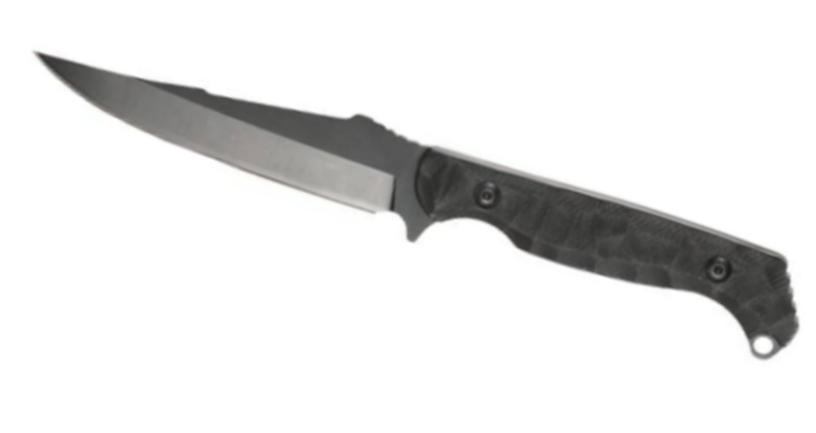
Choosing between Nitro-V and D2 for your knife brand
Selecting blade steel isn’t just a technical decision — it directly affects your product margins, customer complaint rate, and target market fit. Here’s what matters most from a sourcing and brand-building perspective.
Production & manufacturing
| Factor | Nitro-V | D2 |
|---|---|---|
| Heat treat consistency | Performs well across a wide HRC window (58–62); forgiving in batch production | Narrow optimal window; more sensitive to process variation |
| Grinding difficulty | Fine carbide structure — easier to grind, lower tooling wear | Large vanadium and chromium carbides — harder to grind, higher abrasive cost |
| Thin blade suitability | Yes — high toughness (~25 ft-lbs) supports thin grinds | Less suitable — lower toughness (~15–17 ft-lbs) requires thicker stock |
| Sharpening at factory | Easier; achieves finer edge finish with standard CBN abrasives | Requires more steps; limits edge fineness |
Toughness data sourced from Knife Steel Nerds metallurgist testing.
Market fit & customer risk
Nitro-V is better for:
- Consumer EDC, kitchen, and outdoor knife lines — high corrosion resistance (13% free chromium + nitrogen) means low post-sale maintenance complaints
- Humid-market distribution (Southeast Asia, coastal US, Europe) — nitrogen addition provides ~16× more pitting resistance than chromium alone
- Sellers who rely on reviews — D2’s rust risk under neglect is a known source of 1-star reviews; Nitro-V eliminates this variable
D2 is better for:
- Working and industrial knife lines — superior edge retention and abrasion resistance justify the tradeoff for users who cut cardboard, rope, or abrasive materials all day
- Value-positioned tactical/hunting SKUs — D2’s cost efficiency and “semi-stainless” positioning still resonates in this segment
- Markets where buyers actively maintain their blades — enthusiast communities (BladeForums, Reddit r/knives) view D2’s sharpening ritual as acceptable
Corrosion risk: A real business risk
In salt-fog testing, D2 shows visible oxidation within 24–48 hours of exposure, compared to stainless steels that hold for 72+ hours under identical conditions (per fcssteel.com salt spray data). For brands selling to general consumers — especially through Amazon where post-delivery rust triggers returns — this is a measurable financial risk, not just a performance metric.
Quick decision guide
Choose Nitro-V if your buyers are general consumers, your distribution includes humid regions, or your brand competes on low-maintenance positioning.
Choose D2 if your product targets heavy-use professionals, outdoor/hunting segments, or price-sensitive buyers who prioritize edge longevity over corrosion resistance.
Both steels are cost-effective at OEM scale. The right choice depends on where your products end up — and who will be responsible when they don’t perform as expected.
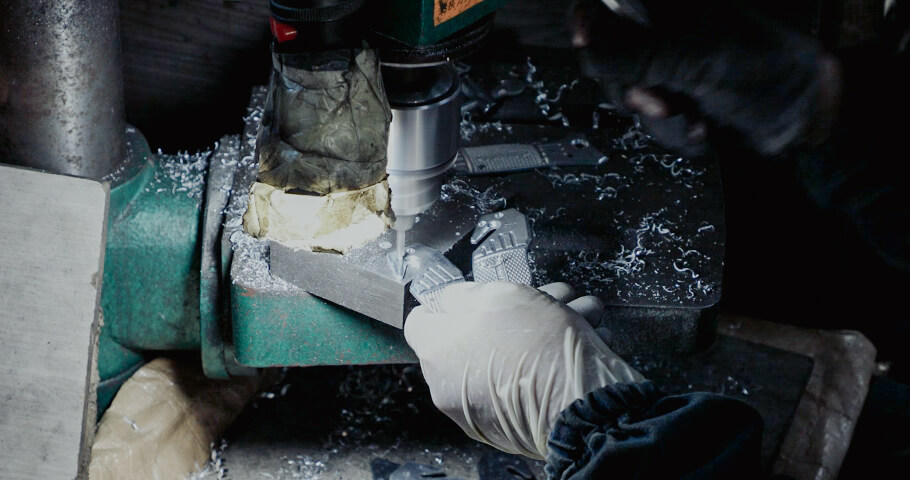
Looking to source high-quality steel knives?
We are a professional knife OEM/ODM supplier in China, providing one-stop customization services for global brands, distributors, and Amazon sellers. Our services include:
- Knife design suggestions
- Multiple steel options (Nitro-V, D2, VG10, 440C, etc.)
- Surface treatments and laser engraving
- International logistics and compliant export support
Click the button below to tell us your needs, and we will respond with a detailed quote within 24 hours. Get a Quote Tailored to Your Needs.
Frequently asked questions
Is Nitro-V better than D2 for everyday carry?
For most EDC users, yes. Nitro-V’s superior corrosion resistance and toughness make it more forgiving in daily use — easier to maintain and less prone to chipping. D2 wins on edge retention, making it better suited for heavy cutting tasks where you’d rather sharpen less frequently.
What are the disadvantages of D2 steel?
D2’s main drawbacks:
- Corrosion — semi-stainless only; requires regular oiling in humid or coastal conditions
- Brittleness — lower toughness (15–17 ft-lbs) means chips are possible under lateral stress or hard impacts
- Difficult to sharpen — large carbides demand diamond abrasives; not beginner-friendly
- Heat treat sensitivity — a narrow optimal window means inconsistent results without precise process control
For brands selling to general consumers, the corrosion and sharpening issues are the most common sources of post-sale complaints.
How does 14C28N compare to Nitro-V and D2?
14C28N (Sandvik) sits between the two in most practical metrics. Like Nitro-V, it offers excellent corrosion resistance and is very easy to sharpen — in fact, it’s often considered the easiest of the three to bring to a razor edge.
Compared to Nitro-V, it has slightly lower edge retention due to the absence of vanadium. Against D2, it’s significantly tougher and more corrosion-resistant, but trails in wear resistance and long-term edge holding.
A rough positioning: D2 > Nitro-V > 14C28N on edge retention; 14C28N ≈ Nitro-V > D2 on corrosion resistance and ease of sharpening; Nitro-V > 14C28N > D2 on toughness.
For a full breakdown, see our dedicated comparisons: Nitro-V vs 14C28N and 14C28N vs D2.
What steel is closest to Nitro-V?
The closest alternatives are 14C28N (Sandvik) and AEB-L — all three share fine carbide structure, high corrosion resistance, and easy sharpenability. If edge retention is the priority, VG10 is a step up from Nitro-V while remaining in the stainless category. For a non-stainless comparison, Nitro-V’s toughness profile is closest to N690.