VG-10 and D2 are two of the most common blade steels in the $30-150 knife market. The core difference is simple: D2 holds an edge longer in abrasive cutting, while VG-10 resists rust better, sharpens on almost any stone, and asks for nearly zero maintenance.
Neither steel wins in absolute terms — the right choice depends on where the knife will be used, who will maintain it, and which market your product line serves.
In this guide, we compare VG-10 vs D2 side by side — composition, performance, cost, and best applications — so you can pick the right steel for your knife or your next OEM knife project.
What Is VG-10 Steel?
VG-10 is a martensitic stainless steel made exclusively by Takefu Special Steel in Echizen, Japan — the name stands for “V Gold 10.” With ~1.0% carbon and 15% chromium, it is a true stainless steel running at 59-61 HRC, known for taking a keen edge, sharpening easily, and shrugging off rust.
It is the standard steel of Spyderco‘s Japanese folders (Delica, Endura), the core of Fällkniven’s laminated blades, and the heart of many Japanese kitchen knives — most often supplied as a san-mai laminate or Damascus-clad core.
For the full history, chemistry, and performance breakdown, see our dedicated VG-10 steel review.
What Is D2 Steel?
D2 is a high-carbon (1.4-1.6%), high-chromium (~12%) cold-work tool steel — an American industrial die steel that became the budget knife market’s favorite workhorse.
Its large volume of hard chromium carbides delivers excellent wear resistance at 58-62 HRC, but the same chemistry leaves it only “semi-stainless” and slow to sharpen. Today it powers proven budget folders from Civivi, CJRB, and Kershaw to Ontario’s RAT D2 editions.
We cover D2's background and international equivalents (1.2379, SKD11, Cr12Mo1V1) in detail in our 12C27 vs D2 comparison.
Chemical Composition: VG-10 vs D2
| Element | VG-10 | D2 | Role |
|---|---|---|---|
| Carbon (C) | 1.00% | 1.50% | Base hardness contributor |
| Chromium (Cr) | 15.00% | 12.00% | Corrosion resistance and carbide formation |
| Molybdenum (Mo) | 1.00% | 0.75% | Enhances toughness and hardenability |
| Vanadium (V) | 0.25% | 0.90% | Grain refinement and wear resistance |
| Cobalt (Co) | 1.55% | — | Strengthens the matrix; tempering resistance |
| Manganese (Mn) | — | 0.30% | Hardenability and tensile strength |
| Silicon (Si) | — | 0.30% | Strength and elasticity |
Data sources: Takefu Special Steel official VG-10 datasheet (representative values; Takefu does not publish Mn/Si figures), Hudson Tool Steel D2 technical data
Two numbers tell the whole story. D2’s 50% higher carbon forms a large volume of chromium carbides — great for wear resistance, costly for toughness and grindability — and, as Knife Steel Nerds explains, locks so much chromium away that too little stays in solution for true stainless behavior.
VG-10 keeps its 15% chromium mostly in solution, which is what makes it genuinely stainless; its cobalt simply strengthens the matrix.
Performance Scorecard: VG-10 vs D2
| Performance Indicator | VG-10 | D2 | Winner & Why |
|---|---|---|---|
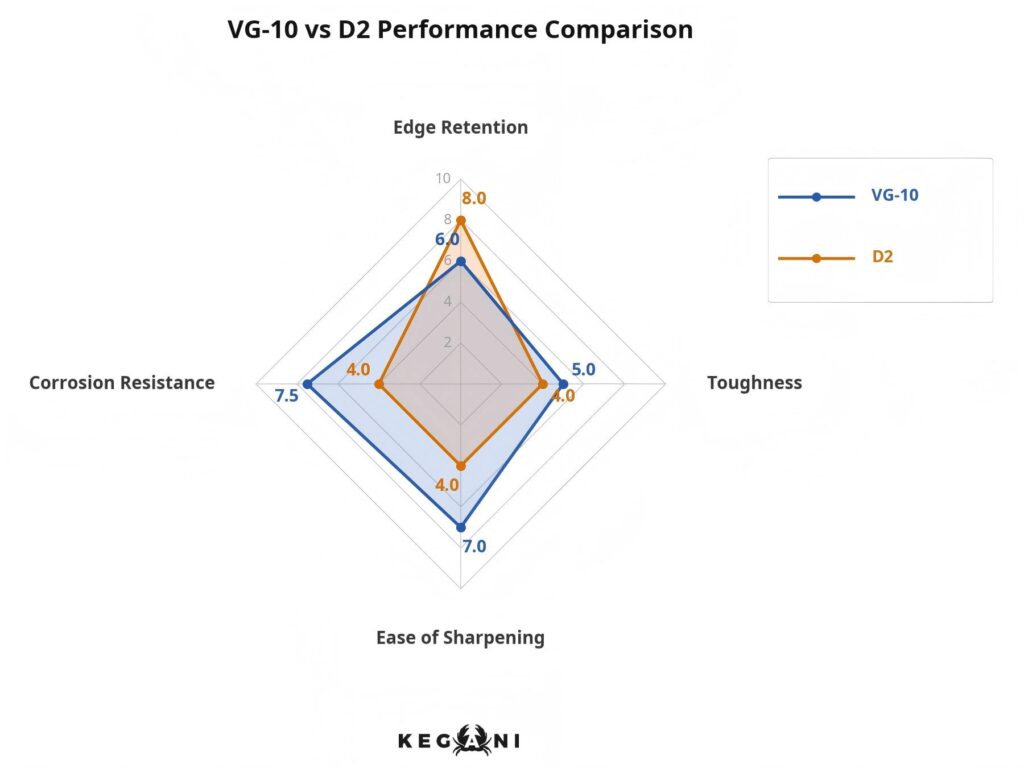
| Edge Retention | 6.0/10 (Good) | 8.0/10 (Very Good) | D2 – High carbide volume resists abrasive wear |
| Toughness | 5.0/10 (Good) | 4.0/10 (Fair) | VG-10 – Fine carbides resist micro-chipping better than D2’s large chromium carbides |
| Corrosion Resistance | 7.5/10 (Very Good) | 4.0/10 (Fair) | VG-10 – True stainless (15% Cr) vs semi-stainless |
| Ease of Sharpening | 7.0/10 (Good) | 4.0/10 (Fair) | VG-10 – No significant vanadium carbides; works on basic stones and ceramic rods |
| Hardness Range | 59–61 HRC (High) | 58–61 HRC (High) | Tie – Comparable working hardness |
| Cost (same model) | Higher (Mid-range) | Lower (Budget-friendly) | D2 – Cheaper alloy, widely available |
Scoring note: Normalized to a 10-point scale from Knife Steel Nerds test data, Bohler CATRA benchmarks, manufacturer datasheets, and user feedback. KSN ratings referenced where applicable; other categories scored independently.
The scorecard shows a clean split. D2 wins every category tied to wear and cost. VG-10 wins every category tied to corrosion and maintenance. Toughness is a genuine tie — a point most comparison articles get wrong, and one we break down below.
For sourcing managers, the question is not which steel is “better” — it is which trade-off fits your product line and target market.
Edge Retention
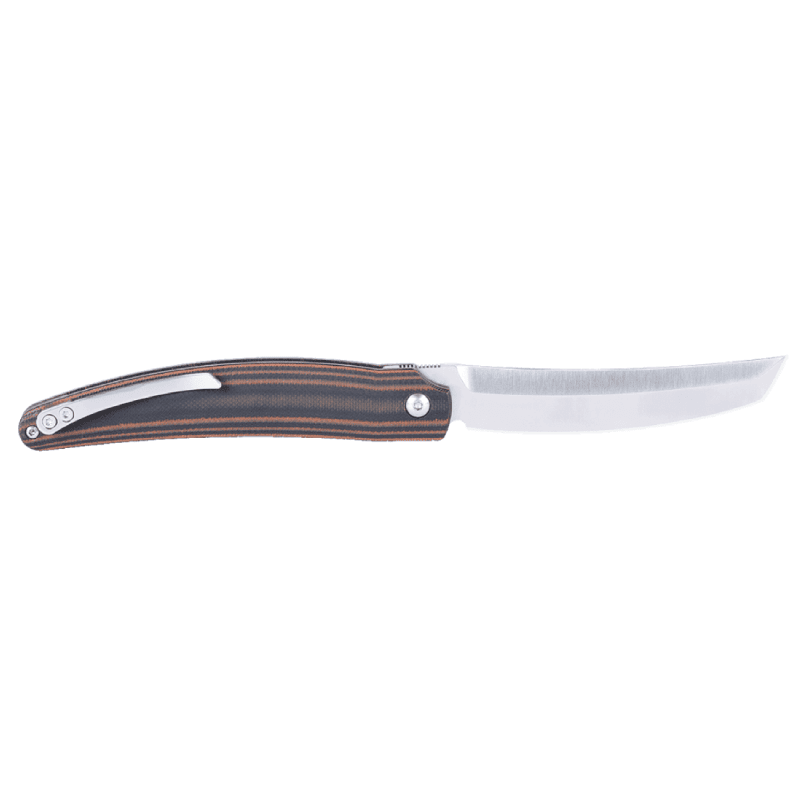
OEM Liner Lock Knife G10 Handle (3.60 Inch D2 Blade)
D2 wins on abrasive cutting — and real-world testing backs the spec sheet. In a BladeForums rope-cutting test at identical 15° edge angles, D2 made 30 cuts before losing its working edge; VG-10 managed 20. That 50% gap is what D2’s carbide volume buys in cardboard, rope, and webbing.
Two qualifications matter. VG-10’s fine edge excels at clean slicing, where “sticky sharp” beats raw cut count.
And heat treatment narrows the gap: Knife Steel Nerds rates VG-10 at 4.5/10 for edge retention, placing it in the same tier as 440C and 154CM. D2 scores 5.0/10 — a clear step above — though poorly treated budget D2 can fall below VG-10. The steel name sets the ceiling; the heat treat sets the floor.
Toughness
VG-10 wins on edge stability, even though the lab numbers are close. Knife Steel Nerds measured VG-10 at ~5.8 ft-lbs in subsize unnotched Charpy (60.7 HRC). D2 tested at ~5.0 ft-lbs (~61 HRC) — a gap that sits inside normal heat-treat variance.
The difference is in how they fail. VG-10’s fine, evenly dispersed carbides let the edge roll under stress. D2’s large chromium carbides (some >20 μm) act as crack initiators, so the edge micro-chips instead — especially on thin geometries.
That makes VG-10 the safer pick for hard-use folders and thin kitchen blades, while D2 needs a thicker, more conservative edge angle to match it in the field.
Corrosion Resistance
VG-10 wins on corrosion resistance, and it is not close. It is a true stainless steel rated 7.5/10 in Knife Steel Nerds testing; D2 scores only 4.5/10 — semi-stainless at best.
In the most dramatic user report, a year-round cyclist on the Spyderco forums carried a VG-10 Delica through daily rain and sweat, never wiped it down, and “never saw even a hint of rust” — while his S30V knife picked up spots.
D2’s rust behavior depends on climate and care: dry-region users report years of rust-free carry, while humid-climate users call it a rust magnet.
For product planning, the safe read is this: if your customers are in humid or coastal markets, or simply maintenance-averse, VG-10 dramatically reduces rust complaints and warranty noise.
Ease of Sharpening
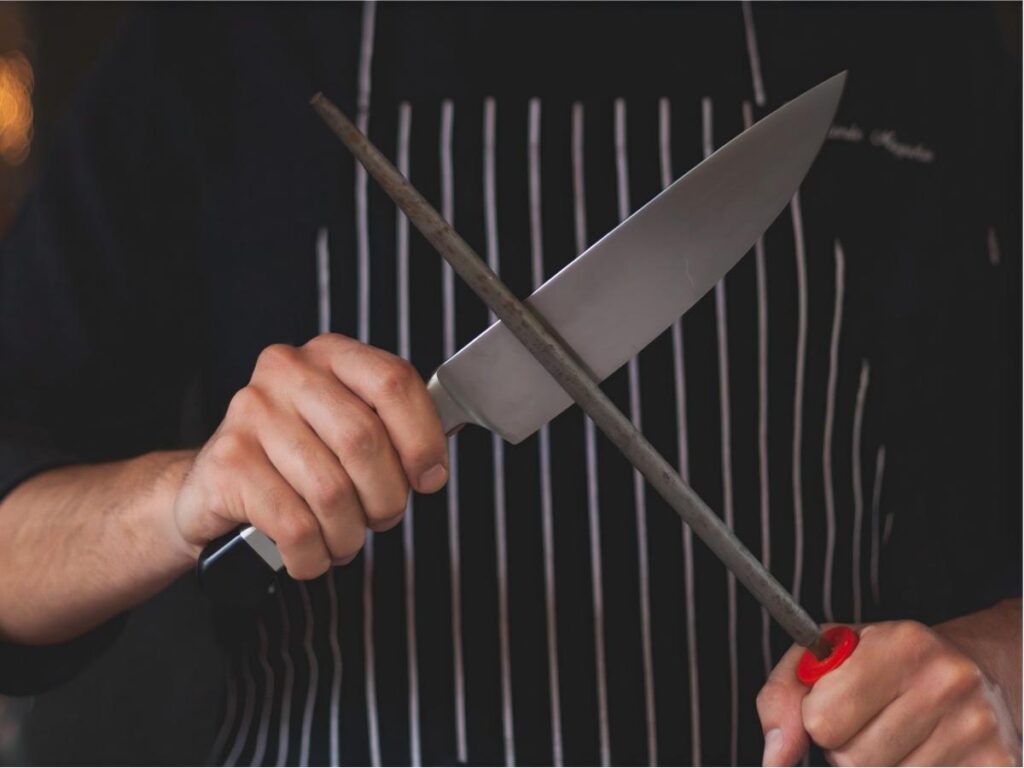
VG-10 sharpens on almost anything; D2 demands diamond or ceramic abrasives. VG-10 contains no vanadium carbides, so ordinary stones, ceramic rods, and even a Spyderco Sharpmaker bring it back to razor sharp.
D2 is the opposite experience. Its large chromium carbides resist common abrasives, and one BladeForums user summed up the frustration: “D2 can be a bear to sharpen… I don’t want to wrestle with my knives.” Field sharpening is a particular weakness — a real consideration for bushcraft and camping lines.
For brands, this shapes customer reviews: a steel end users can maintain with a $20 stone generates fewer complaints, though D2’s longer edge life often outweighs the effort in professional segments.
Start Working with a Professional Now
Application Guide
The community consensus is consistent across forums and reviews: kitchen use and humid environments favor VG-10; abrasive work and dry conditions favor D2.
VG-10 Steel: Best for Kitchen, Wet-Environment, and Premium Laminated Lines
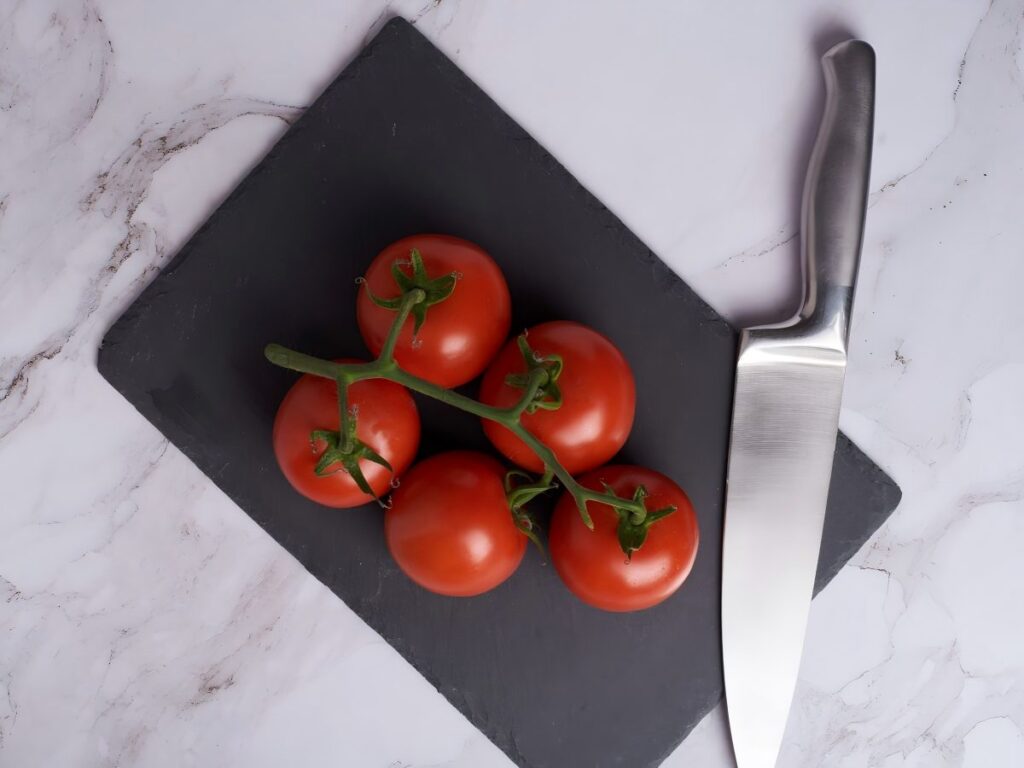
VG-10’s stainless nature, fine edge, and sharpening friendliness make it the default for knives that live around water, food, and casual users.
Kitchen and Food-Prep Knives
Food acids, wet sinks, and daily washing attack semi-stainless blades immediately, while VG-10 shrugs them off. Its fine structure takes a keen, polished edge that glides through tomatoes, herbs, and boneless meat, and a few strokes on a honing rod keep it aligned between tasks.
Tojiro built its reputation on exactly this formula — VG-10 performance at restaurant-friendly prices. For cutlery lines, that also means fewer corrosion complaints and returns.
EDC Folders for Humid and Coastal Markets
Pocket carry means daily exposure to sweat and humidity — a corrosion test D2 often fails and VG-10 passes without effort, as the cycling Delica story above shows.
Everyday tasks are short, clean cuts where its fine edge excels, and owners can restore sharpness on basic equipment. Spyderco has sold the Delica and Endura on this logic for three decades.
Laminated and Damascus-Clad Product Lines
VG-10’s signature supply form is the san-mai laminate or Damascus-clad blank: a hard VG-10 core between softer stainless or patterned outer layers. This delivers the cutting performance of VG-10 with premium shelf appeal — the visual signature of Japanese kitchen knives.
One caveat from experienced users: heavily used laminated blades are harder to re-profile, so laminate lines should target kitchen and light-duty use, not hard-use tools.
D2 Steel: Best for Abrasive, Hard-Use Cutting in the Budget Segment
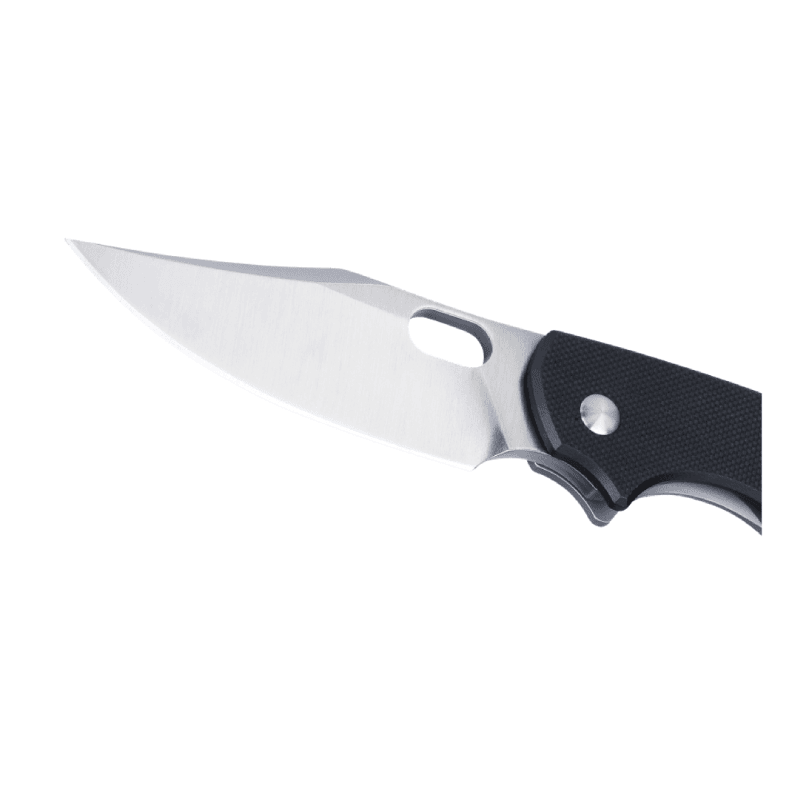
OEM Frame Lock Knife G10 + Stainless Steel Handle (3.09 Inch D2 Blade)
D2’s wear resistance shines where edges dull from abrasion, not corrosion — and where users accept a little maintenance for longer edge life.
Cardboard, Rope, and Utility Work Knives
Breaking down boxes, slicing webbing, and trimming carpet is a pure wear problem — exactly what D2 was designed for as an industrial tool steel.
Its carbides keep cutting long after a simpler steel’s apex has worn away, which means fewer sharpening breaks per shift. The thicker edge geometry D2 prefers is no drawback here — utility blades are not asked to shave.
Budget Workhorse EDC Folders
“D2 steel” on the box signals serious edge retention at a budget price — the formula behind proven sellers like the Civivi and CJRB folders ($30-60).
Daily tasks like opening packages and cutting zip ties reward D2’s carbides without demanding much corrosion care. Pair it with a black coating or stonewashed finish to hide the spotting.
Dry-Climate Outdoor Knives
In arid regions, D2’s corrosion weakness largely disappears, leaving a nearly pure edge-retention advantage. An occasional wipe-down and a light oil film is all the maintenance the outdoor and survival knives needs.
For brands selling into the American Southwest, Australia, or the Middle East, D2 offers premium-feeling edge life at a mid-range cost.
Cost and Market Pricing
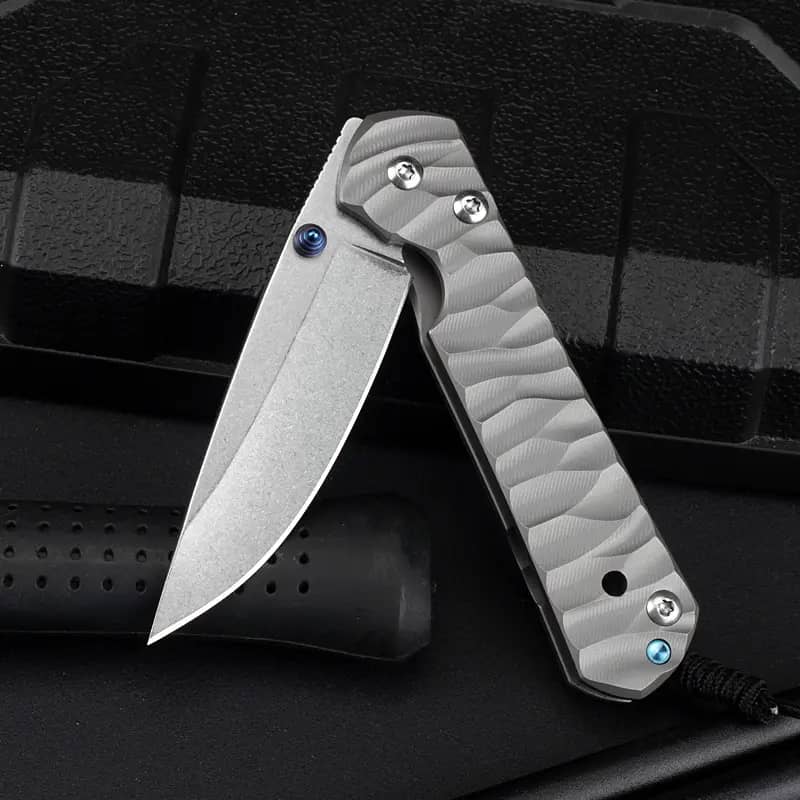
OEM Frame Lock Knife Titanium Alloy Handle (2.83 Inch D2/Damascus Blade)
The cost gap between the two steels shows up at every production stage — but in opposite directions.
VG-10 is the pricier alloy: as a single-mill Japanese proprietary steel, raw material runs roughly 2-3x the cost of D2 (market quotes put VG-10 around $10-14/kg versus $4-6/kg for D2, though prices fluctuate).
D2 offsets its cheap material with expensive processing — its carbides eat grinding belts and slow production, and tight heat-treatment control adds cost.
| Cost Factor | VG-10 | D2 |
|---|---|---|
| Raw material | Higher (~2-3x D2) | Low |
| Heat treatment | Standard vacuum hardening, tempering | Air hardening, multiple tempers, cryo optional |
| Grinding/machining | Moderate (no vanadium carbides) | Slow, high abrasive cost |
| Available supply forms | Solid, san-mai laminate, Damascus-clad | Solid only, coated or uncoated |
| End-user maintenance cost | Low (basic stones) | Higher (diamond/ceramic tools) |
| Typical retail positioning | Mid-range to premium | Budget to mid-range (spec-led) |
The market reflects this clearly: D2 powers proven budget folders like the Civivi and CJRB lines ($30-60), while VG-10 anchors Spyderco’s Japanese folders ($90-150) and laminated kitchen knives from Tojiro (~$50) to premium Damascus-clad lines ($150-200+).
For OEM projects, the strategic difference is this: D2 supports an “edge retention per dollar” claim in the budget EDC segment, while VG-10’s laminate and Damascus-clad forms support premium shelf pricing in kitchen and gift markets.
Start Working with a Professional Now
Partner with Kegani on Your Next VG-10 or D2 Knife Line
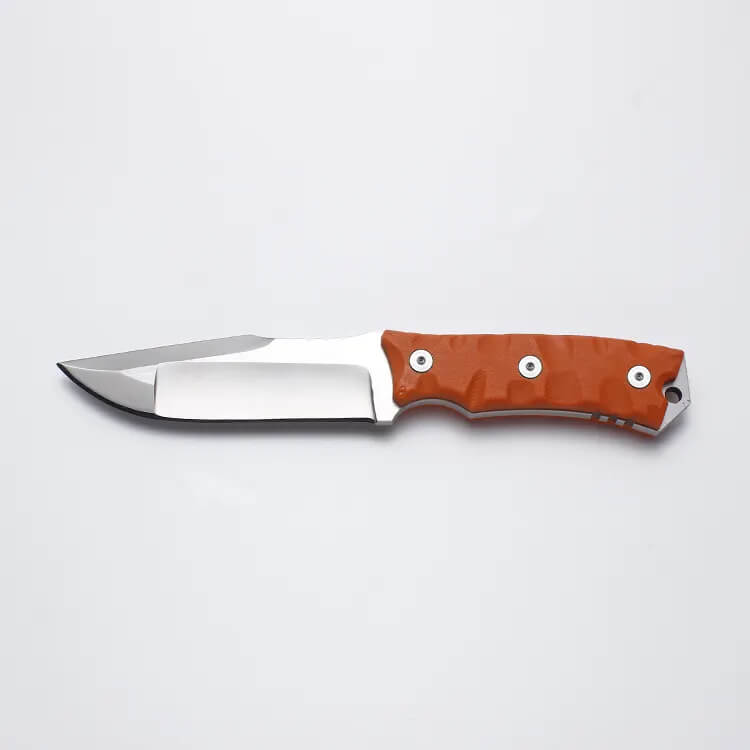
OEM Fixed Blade Knife G10 Handle (3.74 Inch D2 Blade)
Choosing between VG-10 and D2 is a positioning decision — and you don’t have to make it alone. Tell us your target market, price point, and sales channel, and our engineers will recommend the steel, hardness target, and edge geometry that fit your product line.
What you get when you work with Kegani:
- Steel selection consulting — VG-10, D2, 14C28N, and beyond, matched to your market and price tier
- Controlled heat treatment — documented process records and batch-by-batch hardness verification, because the steel name sets the ceiling but the heat treat sets the floor
- Laminated and clad options — VG-10 san-mai and Damascus-clad blades for premium kitchen and gift lines
- Flexible supply options — OEM manufacturing, private label, and wholesale programs
Whether your next line calls for stainless, low-maintenance VG-10 or long-wearing D2, we can build it — and prove the quality with samples before you commit.
Request a free quote or contact our team today to get started.