
154CM and 14C28N are two of the most widely used stainless steels in production knives — one an American classic, the other a Swedish steel built purely for blades.
The difference comes down to performance and use case. 154CM holds an edge longer, suiting mid-range EDC, tactical, and hunting knives. 14C28N is far tougher, more corrosion-resistant, easier to sharpen, and cheaper — ideal for budget EDC, kitchen, and outdoor knives.
This guide compares composition, test data, and cost so you can pick the right steel for your product line.
What Is 154CM Steel?
154CM is an American martensitic stainless steel developed by Crucible Materials Corporation. It was originally engineered for jet engine turbine components and high-speed bearings, where heat and wear resistance are critical. The same properties made it attractive for knife blades.
154CM is essentially an improved version of 440C with added molybdenum. The molybdenum increases hardenability, strength, and corrosion resistance. For decades, 154CM was considered a premium knife steel. It built its reputation through custom makers and production brands like Benchmade, Emerson, and Pro-Tech.
Key Characteristics of 154CM:
- Type: Conventional ingot stainless steel
- Developer: Crucible Industries (USA)
- Origin: Aerospace bearing and turbine steel
- Hardness Range: 58-61 HRC (up to 63 HRC with cryogenic treatment)
- Primary Application: Mid-range EDC folders, tactical knives, hunting knives
What Is 14C28N Steel?
14C28N is a martensitic stainless steel developed by Sandvik of Sweden (now Alleima) specifically for knife blades. Unlike 154CM, which was adapted from an industrial application, 14C28N was designed from the ground up for cutting tools.
It is an upgraded version of Sandvik’s 12C27 and 13C26 steels. The key change is added nitrogen. Nitrogen allows the steel to reach higher hardness while improving corrosion resistance. The lower carbon content also means fewer and finer carbides, which translates to excellent toughness and a very clean, fine edge.
Key Characteristics of 14C28N:
- Type: Conventional ingot stainless steel (fine-grained)
- Developer: Sandvik / Alleima (Sweden)
- Origin: Purpose-built knife steel; upgrade of 12C27/13C26
- Hardness Range: 55-62 HRC (Alleima recommended window)
- Primary Application: Budget and mid-range EDC folders, kitchen knives, outdoor fixed blades
Chemical Composition: 154CM vs 14C28N
| Element | 154CM | 14C28N | Role |
|---|---|---|---|
| Carbon (C) | 1.05% | 0.62% | Base hardness contributor |
| Chromium (Cr) | 14.00% | 14.00% | Primary corrosion resistance |
| Molybdenum (Mo) | 4.00% | — | Strength, hardenability, pitting resistance |
| Nitrogen (N) | — | 0.11% | Hardness and corrosion resistance boost |
| Manganese (Mn) | 0.50% | 0.60% | Hardenability and wear resistance |
| Silicon (Si) | 0.30% | 0.20% | Deoxidizer; minor strength gain |
Data sources: SB Specialty Metals 154CM datasheet, Alleima 14C28N technical datasheet
The composition table explains almost every performance difference between these steels. 154CM gets its wear resistance from carbide volume. With 1.05% carbon, it forms roughly 17% carbides by volume. More carbides mean better edge retention but lower toughness.
14C28N takes the opposite approach. It cuts carbon to 0.62% and adds 0.11% nitrogen. This produces only about 12% carbide volume, with a much finer carbide size. Less chromium is trapped in carbides, so more stays in solution to fight rust. The result is a steel that trades some wear resistance for large gains in toughness, corrosion resistance, and sharpenability.
For buyers comparing datasheets, one caution: some websites list vanadium in 154CM’s composition. The standard Crucible grade contains no vanadium. Accurate composition data matters when you specify steel for production, so always verify against the mill datasheet.
Performance Scorecard: 154CM vs 14C28N
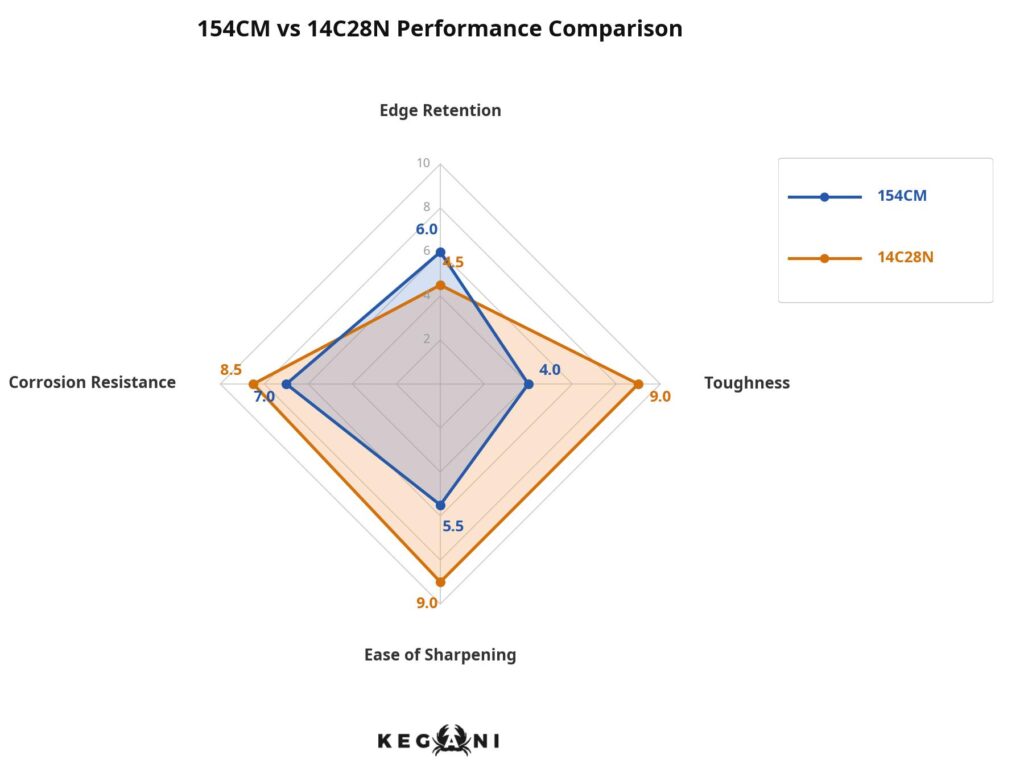
| Performance Indicator | 154CM | 14C28N | Winner and Why |
|---|---|---|---|
| Edge Retention | 6.0/10 (Good) | 4.5/10 (Average) | 154CM – ~20% longer edge life in CATRA testing |
| Toughness | 4.0/10 (Below Average) | 9.0/10 (Excellent) | 14C28N – ~4x higher Charpy impact values |
| Corrosion Resistance | 7.0/10 (Good) | 8.5/10 (Excellent) | 14C28N – lasts 2-3x longer in salt spray tests |
| Ease of Sharpening | 5.5/10 (Average) | 9.0/10 (Excellent) | 14C28N – finer carbides, faster touch-ups |
| Hardness Range | 58-61 HRC | 55-62 HRC | Tie – 14C28N offers a wider production window |
| Price Range (typical knife) | $80-$180 | $30-$60 | 14C28N – roughly half the retail price |
Scores are approximate, based on Knife Steel Nerds CATRA and Charpy testing, mill datasheets, and industry consensus.
The scorecard shows a clear split. 154CM wins exactly one category: edge retention. 14C28N wins everything else, including cost. For sourcing managers, the question is whether that extra wear resistance justifies a higher price and more maintenance for the end user.
Edge Retention
Edge retention is 154CM’s home turf. Its 1.05% carbon produces a high volume of wear-resistant carbides. In CATRA testing tracked by Knife Steel Nerds, 154CM holds a working edge roughly 20% longer than 14C28N, which lands between AUS-8 and VG-10 in practical edge life.
User experience matches the data, though the perceived gap depends on cutting intensity. Heavy users on BladeForums say the difference is clear in long cutting tasks. Another member, citing Ankerson’s rope-cut tests, found 14C28N “comparable in edge retention to 154CM… considerably better than 420HC.”
The takeaway: for light daily cutting, most users will not feel the difference. For abrasive work like cardboard, rope, and carpet, 154CM’s advantage becomes clear.
Toughness
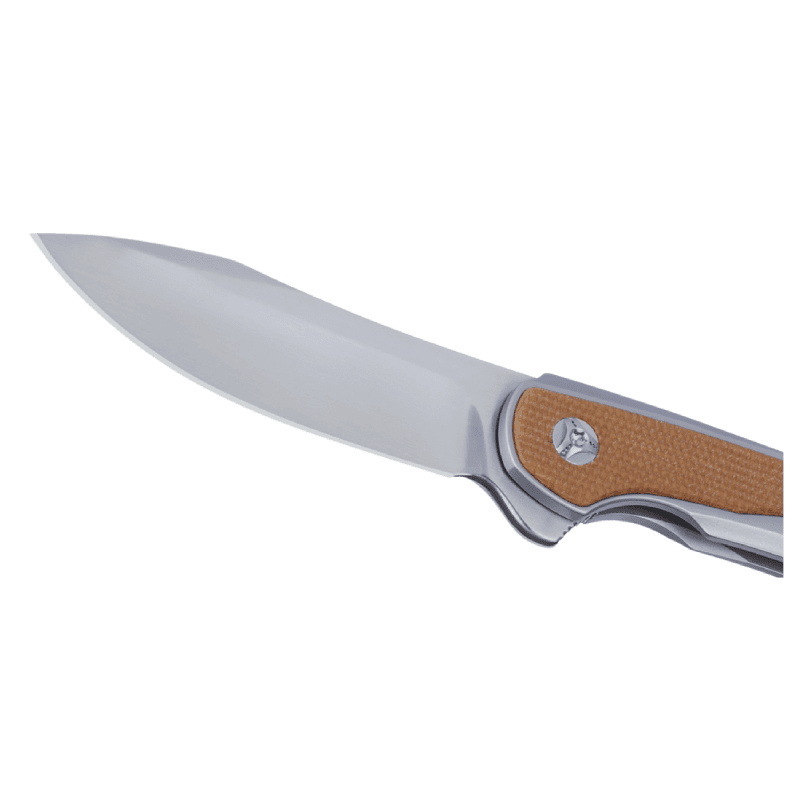
OEM Frame Lock Knife Stainless Steel Handle (3.01 Inch 14C28N Blade)
Toughness is where 14C28N dominates. According to Charpy impact data cited by Knife Steel Nerds, 14C28N reaches approximately 30 ft-lbs at 60-62 HRC, while 154CM manages only 6-8 ft-lbs — roughly a 4x difference.
This gap has real consequences at the edge. 154CM is more likely to chip on bone, staples, or hard knots. 14C28N tends to roll instead, and a rolled edge fixes easily in the field.
Dr. Larrin Thomas of Knife Steel Nerds compares its toughness to AEB-L, “a rather tough steel.” Users confirm it: one BladeForums member chopped branches, batoned, and pierced the ground with 14C28N — “No issues so far.” Another found his S30V knives chip more readily.
For outdoor and rough-use product lines, 14C28N’s toughness supports thinner blade geometry and more aggressive edge angles without chipping complaints.
Corrosion Resistance
Both steels contain 14% chromium, yet 14C28N resists rust noticeably better, lasting 2-3 times longer in salt spray testing. Two factors explain the gap: 154CM locks more chromium inside carbides, leaving less free chromium to form the protective oxide layer, while 14C28N’s 0.11% nitrogen directly improves pitting resistance.
The market agrees — Kershaw famously switched from 13C26 to 14C28N partly for its corrosion resistance. For your product line, the rule is simple:
- Marine, fishing, kitchen, and tropical-market knives: choose 14C28N.
- Normal EDC and dry-climate use: both steels perform well with basic care.
Ease of Sharpening
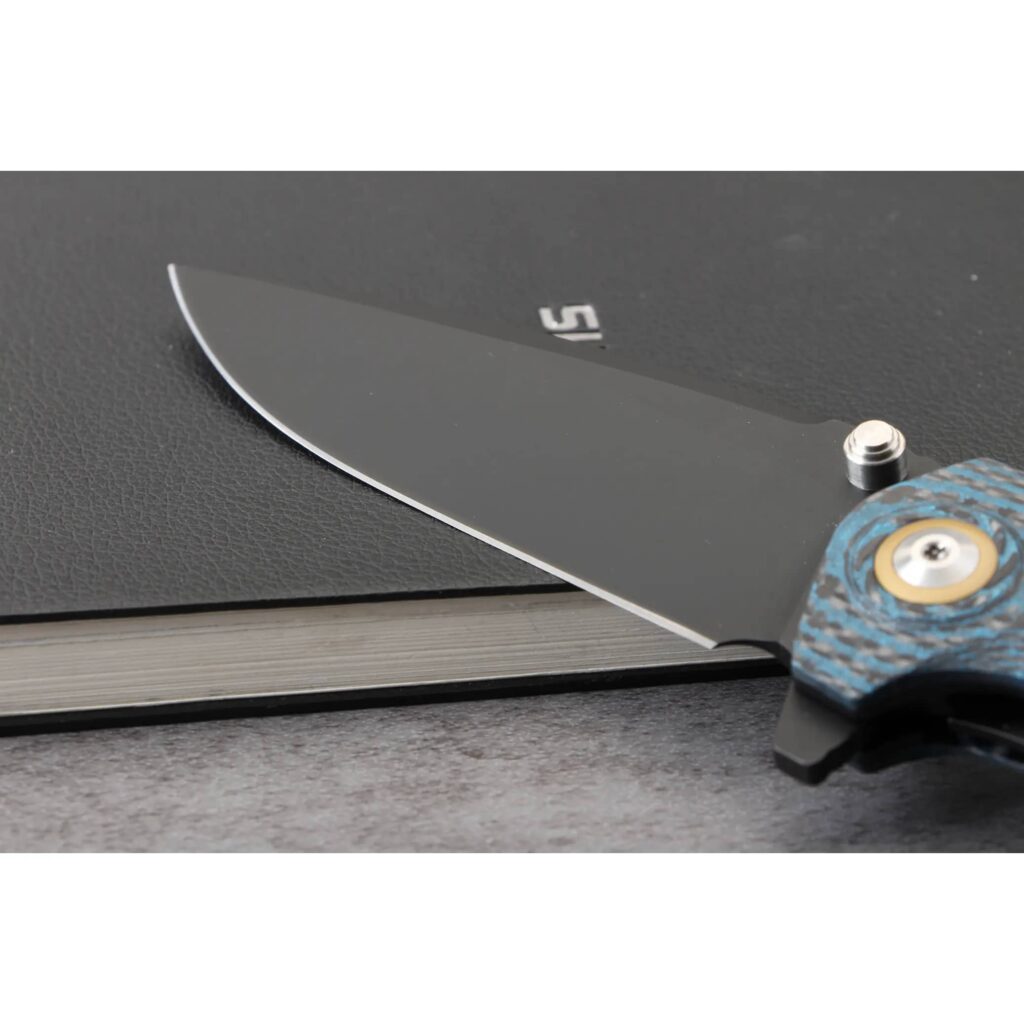
OEM Liner Lock Knife Fused Carbon Fiber + G10 Handle (3.70 Inch 14C28N Blade)
14C28N is one of the easiest stainless steels to sharpen. Its fine grain and small carbides take a razor edge quickly, even on basic stones — users report touching it up on the bottom of a coffee cup. One BladeForums member summed it up: “Fast and easy… you can polish it all the way up on waterstones for push cuts.”
154CM is not difficult to sharpen, but its larger chromium carbides abrade unevenly, making the process slower and the finished edge less refined.
For B2B buyers, this shapes the ownership experience: a steel end users can maintain themselves generates fewer complaints and better reviews — a real advantage for lines sold through e-commerce.
Hardness and Heat Treatment
154CM performs best at 58-61 HRC. Heat treatment protocols are mature, and most commercial heat treaters handle it reliably. The window is narrow but well understood.
14C28N offers a wider recommended window of 55-62 HRC according to Alleima. This flexibility is valuable in production. Makers can target 57-59 HRC for maximum toughness in outdoor knives, or 60-62 HRC for better edge retention in EDC folders.
14C28N also has a reputation for being nearly impossible to ruin in heat treatment. Reddit users often call it the “perfect budget steel” for exactly this reason.
Combined with its fineblankability, this makes 14C28N one of the most production-friendly knife steels available. For high-volume OEM runs, that translates to consistent quality and fewer rejected blades.
Cost and Market Pricing
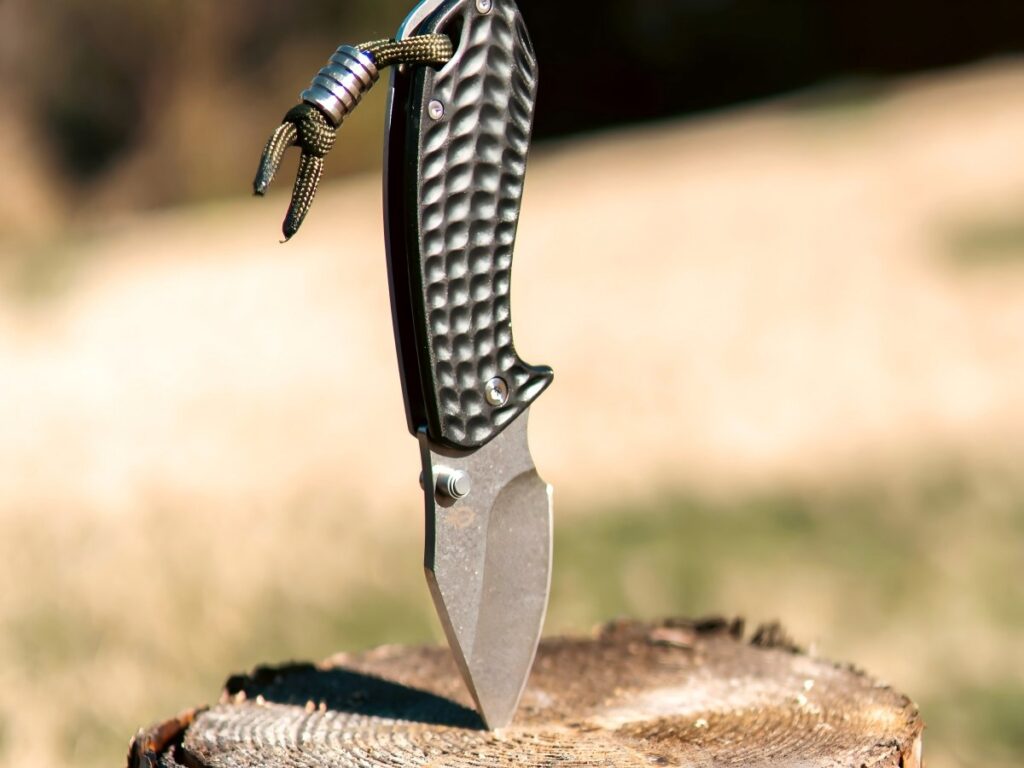
The price gap between these steels is significant and shapes product positioning.
| Price Tier | Typical Steel | Retail Range | Best For |
|---|---|---|---|
| Budget/Entry | 14C28N, 8Cr13MoV, AUS-8 | $30-$60 | Value EDC, kitchen, first-time buyers |
| Mid-Range | 154CM, D2, VG-10, N690 | $80-$180 | General EDC, tactical, hunting |
| Premium | S35VN, MagnaCut, M390 | $150-$300+ | Enthusiasts, hard use, collectors |
14C28N dominates the $30-$60 segment. Kershaw built dozens of models on it, and Chinese brands like Civivi, Sencut, and Kansept use it to anchor their value lines. 154CM appears in knives like the Benchmade Griptilian at $150-$180, where brand heritage and edge retention justify the premium.
At the material level, 14C28N also costs less per kilogram and processes more efficiently. Fineblanking reduces machining time, and the forgiving heat treatment lowers scrap rates. For mass production, these factors compound into a meaningful unit-cost advantage.
For brands that want 154CM’s character with better consistency, CPM 154 — the powder metallurgy version — offers finer carbides and 20-30% better toughness at a modest price increase. It is a credible upgrade path for mid-range lines, as we covered in our 154CM vs MagnaCut comparison.
Application Guide
The right steel depends on the knife’s tasks, environment, and price point. Here is how each alloy maps to real product types.
Where 154CM Works Best
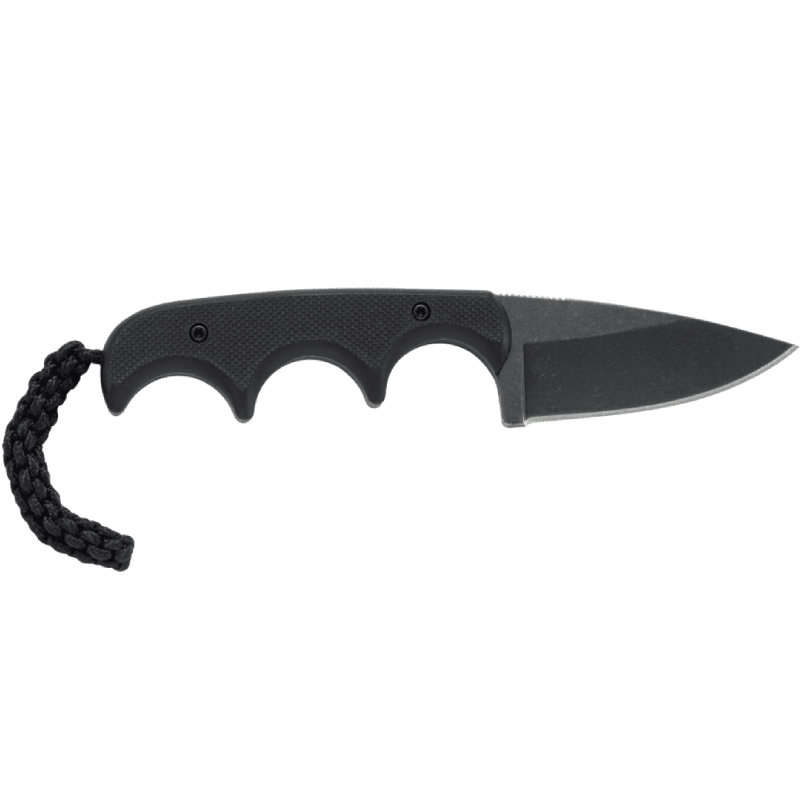
OEM Fixed Blade Neck Knife Micarta/G10 Handle (2.16 Inch 154CM/5Cr15MoV Blade)
Tactical and Hard-Use Folders
Tactical knives cut abrasive materials like rope, webbing, and cardboard — exactly where 154CM’s high carbide volume pays off. Its ~20% edge retention advantage means fewer touch-ups in the field, and its 58-61 HRC hardness resists edge deformation under lateral stress. This is why brands like Benchmade and Emerson built their tactical lines on it.
Hunting Knives
Field dressing and skinning are long, continuous cutting jobs. 154CM holds a working edge through an entire processing session without stopping to resharpen.
Its corrosion resistance handles blood and moisture during normal use, as long as the blade is cleaned afterward. For inland and dry-climate hunting, it is a proven fit.
Mid-Range and Heritage EDC Lines
For knives retailing at $80-$180, 154CM offers something budget steels cannot: a story. Decades of use by American makers give it credibility with enthusiast customers.
These buyers expect longer edge life and accept scheduled maintenance — a good match for 154CM’s strengths.
Where 14C28N Works Best
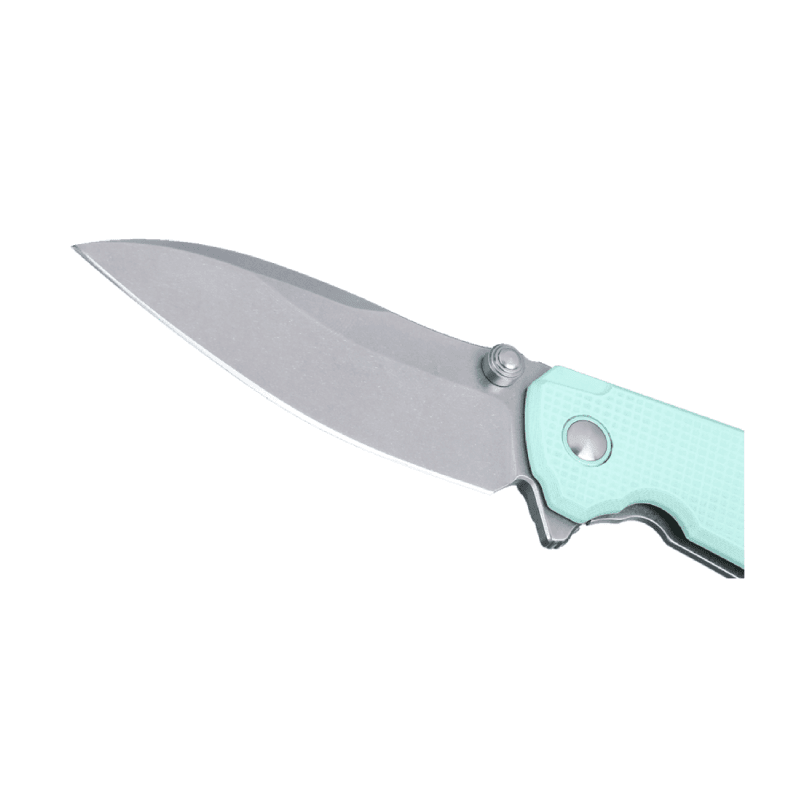
OEM Frame Lock Knife G10 + Stainless Steel Handle (3.09 Inch 14C28N Blade)
Budget and High-Volume EDC Folders
At $30-$60 retail, margins depend on production efficiency. 14C28N’s fineblankability and forgiving heat treatment keep unit costs and defect rates low.
Its toughness survives the drops and prying that budget buyers put knives through, and easy sharpening keeps complaint rates down.
Kitchen Knives
Kitchen work demands thin, slicey geometry — and 14C28N’s fine-grained toughness supports thin edges that resist chipping on bones and cutting boards.
Its corrosion resistance handles acidic foods and constant moisture, while home cooks can restore the edge on basic sharpeners. Brands like Cangshan already build kitchen lines on it.
Fishing and Marine Knives
Saltwater is where 14C28N’s 2-3x salt spray advantage matters most. Around hooks, scales, and bait, the edge rolls rather than chips — and a rolled edge fixes in seconds on a small stone. For coastal and tropical markets, it is the safer specification.
Outdoor and Bushcraft Fixed Blades
Chopping, batoning, and carving punish a blade’s edge. 14C28N’s roughly 4x toughness advantage over 154CM means fixed blades survive impacts that would chip harder steels. The Mora Garberg’s reputation in the bushcraft community rests on exactly this property.
For a deeper look at how 14C28N stacks up against another value-segment favorite, see our 14C28N vs D2 breakdown.
Put 154CM or 14C28N into Production with Kegani
Both steels can anchor a successful product line — the difference is in execution. Consistent heat treatment, the right hardness target for your market, and tight unit costs determine whether the steel performs on paper or in your customers’ hands.
That is where Kegani comes in. Based in Yangjiang — the hub of China’s knife industry — we help brands turn steel selection into finished products:
- Precision heat treatment – 154CM dialed to 58-61 HRC, 14C28N tuned anywhere in its 55-62 HRC window for your target use case
- High-volume efficiency – fineblanking-friendly 14C28N production with low scrap rates and consistent quality across batches
- Flexible programs – from small custom runs to full-scale wholesale supply
We offer three ways to work together:
- OEM Manufacturing – bring your custom design to life in 154CM, 14C28N, or any steel in this guide
- Private Label Service – put your brand on our proven blade platforms
- Wholesale Supply – stock market-ready knives at competitive prices
Tell us your target price point and volume. Get a free quote today, or reach out to our team — we will recommend the steel and spec that fits your margins.
Frequently Asked Questions
Is 154CM a good blade steel?
Yes. 154CM is a proven, well-rounded stainless steel with good edge retention and decent corrosion resistance. It has served production and custom knives for decades. Its main weakness is modest toughness compared to modern fine-grained steels like 14C28N.
What is 154CM comparable to?
154CM is most often compared to ATS-34 (its Japanese near-equivalent), 440C (the steel it improved upon), and VG-10. All are high-carbon stainless steels with similar edge retention. Its powder metallurgy version, CPM 154, offers the closest performance with slightly better toughness.
What is 14C28N comparable to?
14C28N is comparable to AEB-L, Nitro-V, and its predecessor 12C27. These steels share a fine-grained, low-carbide structure that favors toughness and easy sharpening over raw edge retention. Among them, 14C28N generally offers the best corrosion resistance.
Is 154CM a budget steel?
No. 154CM sits in the mid-range. Knives made from it typically retail between $80 and $180. True budget steels include 8Cr13MoV, AUS-8, and 420HC. 14C28N offers budget-tier pricing with performance that approaches mid-range steels, which is why it dominates the value segment.
Is 14C28N steel worth the money?
Absolutely. 14C28N delivers toughness, corrosion resistance, and ease of sharpening that rival steels costing far more. Knife Steel Nerds ranked it the best budget knife steel for its balance of properties. At $30-$60 per knife, it is one of the strongest value propositions in the market.
Is 12C27 better than 14C28N?
No. 14C28N is the direct upgrade of 12C27 from the same Swedish mill. The added nitrogen gives 14C28N higher attainable hardness and better corrosion resistance. Edge retention and toughness are similar. If both are available at the same price, choose 14C28N.
Is 420HC better than 154CM?
No. 154CM outperforms 420HC in edge retention and hardness by a wide margin. 420HC is a true budget steel with low carbon content. It resists corrosion well and sharpens easily, but it cannot hold an edge like 154CM. Rope-cut testing consistently places 154CM well above 420HC.
What is the absolute best steel for a knife?
There is no single best steel. The right choice depends on use case, budget, and maintenance habits. For premium all-around performance, MagnaCut leads the stainless category. For budget knives, 14C28N is hard to beat. For pure edge retention, high-vanadium steels like S90V win.