
Two of the most common blade geometries on modern knives are the full flat grind and the sabre grind.
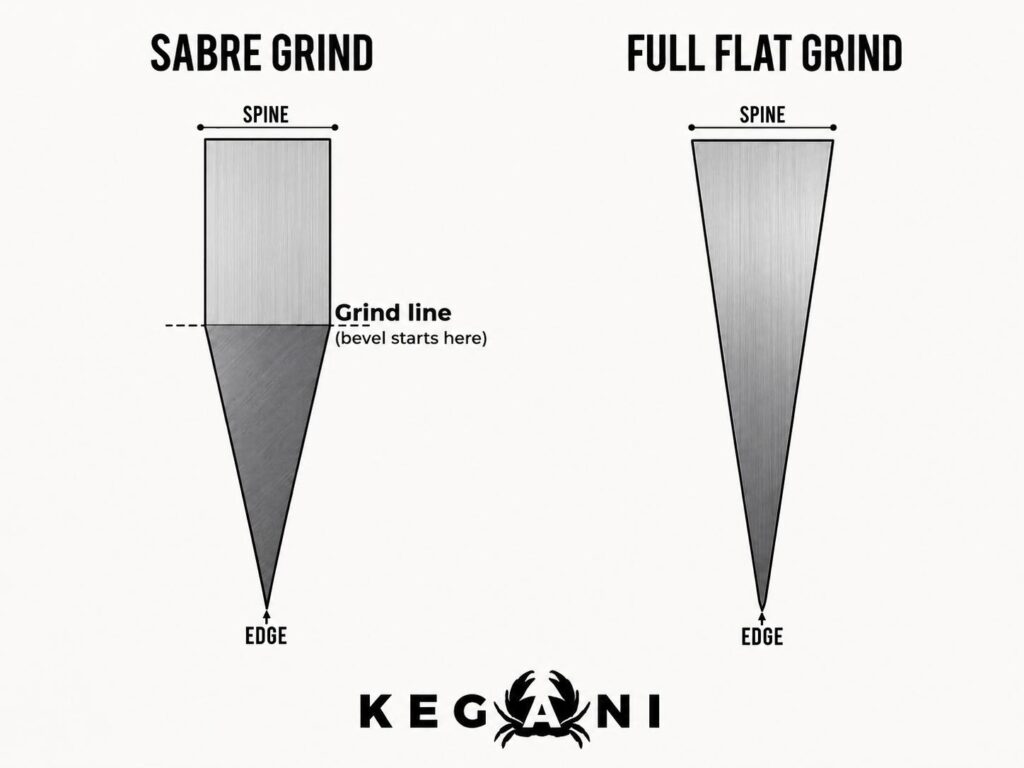
A full flat grind tapers evenly from spine to edge, removing steel across the entire blade face. A sabre grind starts its bevel partway down, leaving the upper section at full thickness.
The first slices better through cardboard, rope, and food. The second withstands batoning, prying, and impact without folding. The best choice depends on your target market—EDC users opening packages or tactical buyers chopping wood.
This guide compares both grinds head-to-head, explains how to match geometry with steel selection, and helps you choose the right grind for your next OEM knife project.
What Is a Full Flat Grind?
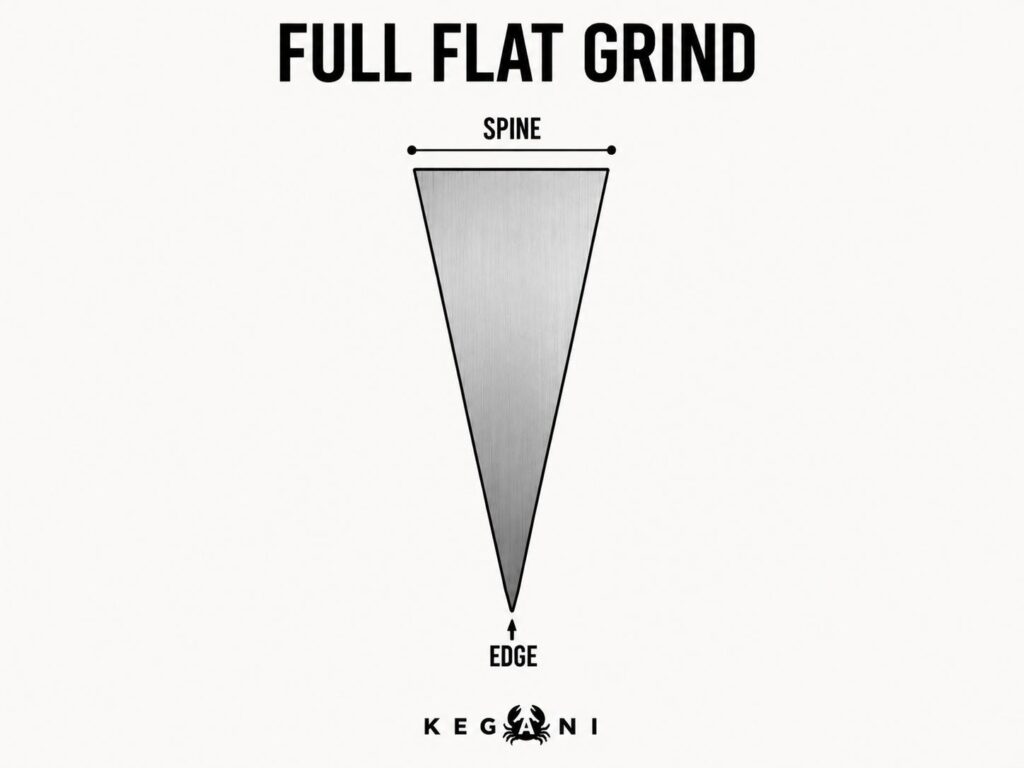
Full flat grind tapers evenly from the spine all the way to the edge bevel in a straight, flat line. The blade’s cross-section forms a simple wedge, thick at the spine and thin at the edge.
This is the most common grind on modern EDC knives, chef knives, and general-purpose fixed blades. Because the taper is linear and continuous, the blade passes through material with minimal resistance and reduces sticking.
Full Flat Grind Characteristics
- Continuous taper: bevels run from spine to edge with no interruption.
- Excellent slicing: low cutting drag makes it ideal for food, cardboard, rope, and game processing.
- Versatile: works across knife categories from kitchen to camp.
- Easy to sharpen: the flat bevel rests naturally on whetstones and guided systems.
Common Full Flat Grind Variants
| Variant | Description | Best For |
|---|---|---|
| True full flat grind | Taper runs continuously from spine to the cutting edge with no secondary bevel (zero grind) | Fine slicers, chef knives, EDC folders |
| Full flat with secondary bevel | Primary grind reaches near the edge, then a small secondary bevel forms the apex | Most production knives; balances sharpness and durability |
| Thin full flat grind | Very aggressive taper with thin spine stock for maximum slicing ability | Kitchen slicers and lightweight EDC |
What Is a Sabre Grind?
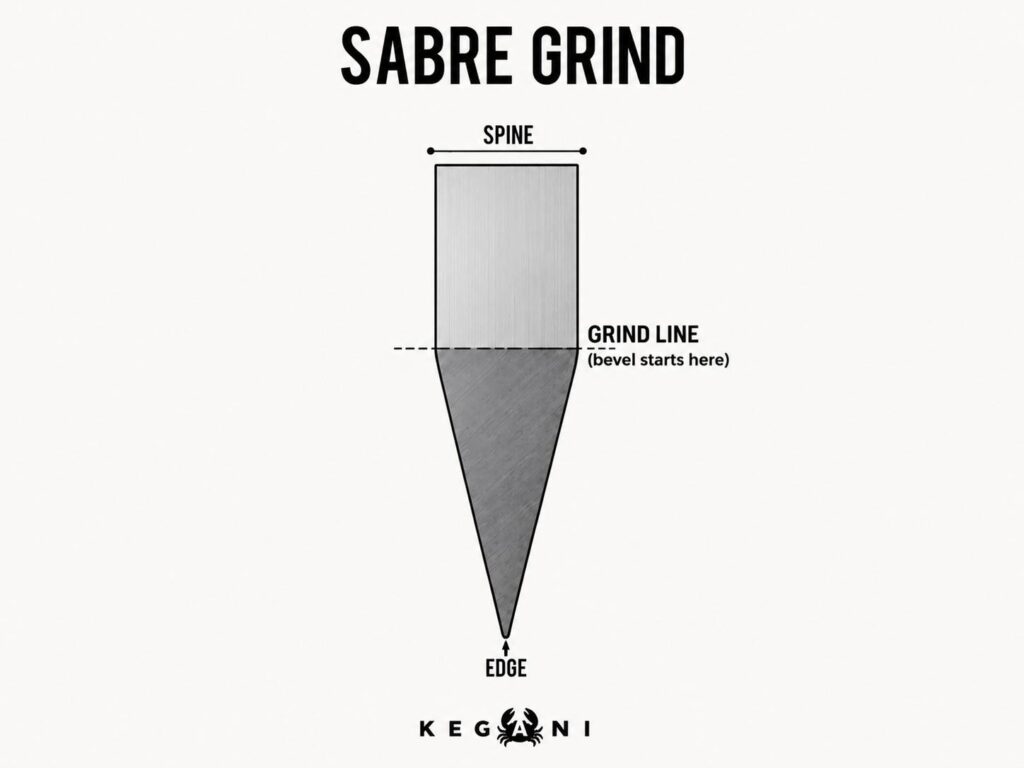
Sabre grind starts the primary bevel partway down the blade rather than at the spine. The upper portion of the blade remains at full stock thickness, creating a visible “sabre line” where the grind begins.
Tactical knives, military designs like the Ka-bar, survival knives, and heavy camp blades commonly use this geometry. By leaving more steel behind the edge and near the spine, the sabre grind produces a stronger, more impact-resistant blade.
Sabre Grind Characteristics
- Partial-height grind: the primary bevel covers roughly the lower 40–60% of the blade width.
- Stronger edge: more steel behind the edge resists chipping, rolling, and lateral forces.
- Thicker tip: less distal taper means a more robust point for piercing and prying.
- Reduced slicing efficiency: the thicker geometry creates more wedging in dense material.
Common Sabre Grind Variants
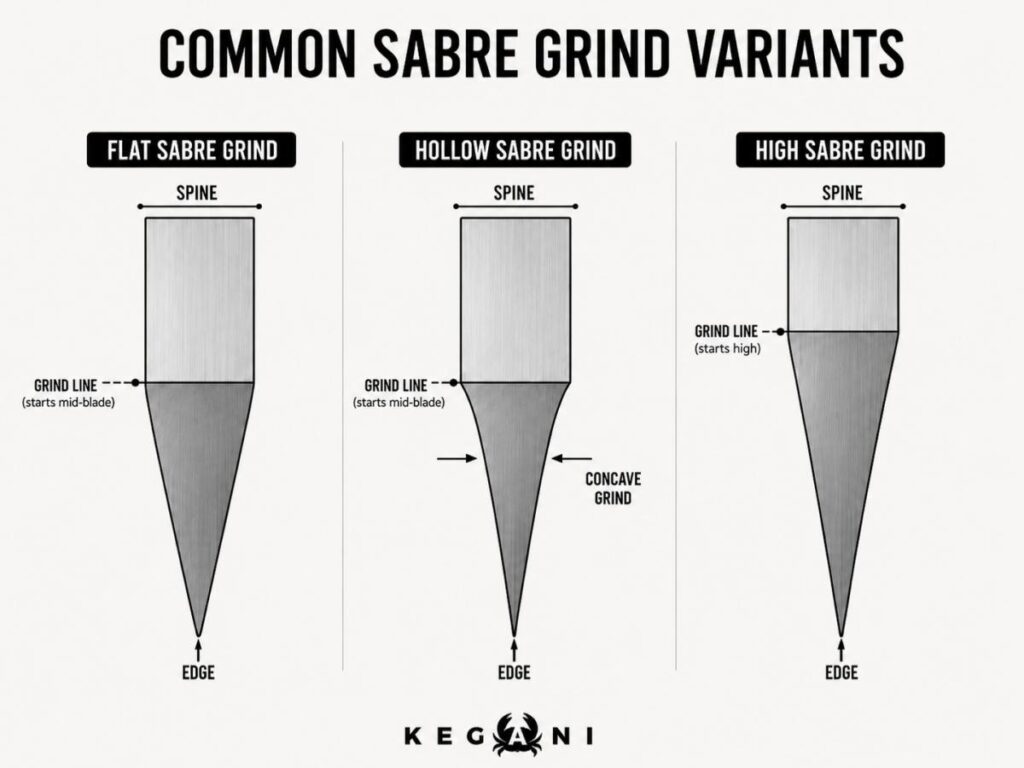
| Variant | Description | Best For |
|---|---|---|
| Flat sabre grind | Flat primary bevel starting mid-blade | Tactical knives, camp knives, military blades |
| Hollow sabre grind | Concave primary bevel starting mid-blade | Slicing-oriented folders with extra spine strength |
| High sabre grind | Bevel starts high, closer to the spine | A middle ground between full flat and sabre |
Sabre Grind vs Full Flat Grind: Quick Comparison
| Feature | Sabre Grind | Full Flat Grind | Winner & Why |
|---|---|---|---|
| Slicing efficiency | Good | Excellent | Full flat — thin edge, less drag |
| Edge durability | Excellent | Good | Sabre — more steel behind edge |
| Tip strength | Excellent | Moderate | Sabre — thick spine supports point |
| Chopping / batoning | Excellent | Moderate | Sabre — mass absorbs impact |
| Food release / sticking | Moderate | Excellent | Full flat — thin geometry separates material |
| Ease of sharpening | Easy | Easy | Tie — both use flat stones |
| Versatility | Tactical / hard-use | Broad all-rounder | Full flat — geometry trade-off |
| Material removal | ~40-60% less | ~90-100% blade face | Sabre — skips upper section |
| CNC cycle time | ~30-50% faster | More passes required | Sabre — smaller contact area |
| Heat treatment warp | Low (~95% pass) | Higher (~85-90% pass) | Sabre — thick edge cools evenly |
| Best for | Tactical, survival, camp | EDC, kitchen, hunting | Depends — use case match |
Detailed Performance Comparison
Slicing and Cutting Efficiency
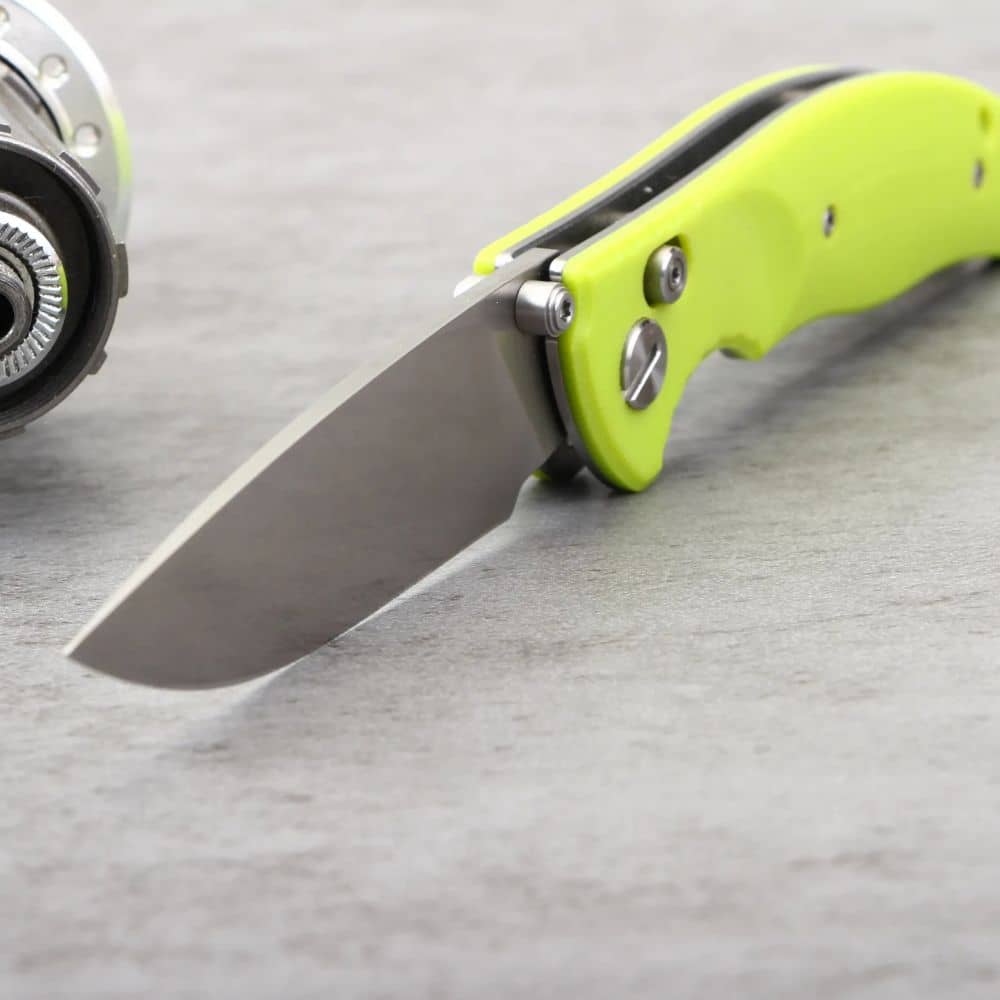
OEM Crossbar Lock Knife G10 Handle (3.39 Inch 5Cr15MoV Blade)
Full flat grinds slice better. The continuous taper from spine to edge creates a thin geometry behind the edge, so the blade encounters less material resistance. This is why most chef knives and EDC folders use full flat grinds: they pass through food, cardboard, and rope with less wedging.
Sabre grinds still cut well, but the thicker section behind the edge creates more drag in dense material. The difference is most noticeable when cutting thick vegetables, soft fruit, or fibrous rope. A sabre-ground knife will still do the job, but it requires more force and produces rougher cuts.
Edge Durability and Toughness
Sabre grinds win on durability. The partial-height grind leaves more steel behind the edge and along the spine, giving the blade greater resistance to chipping, rolling, and lateral loads. This makes sabre grinds the preferred choice for chopping, batoning, prying, and hard-use tactical knives.
Full flat grinds are not fragile, but they remove more steel to achieve their thin edge. A thin full flat grind can chip if it hits bone, knots, or metal. A thicker full flat grind can partly close the gap, but it will still have less steel directly behind the edge than a sabre grind of similar stock thickness.
Tip Strength
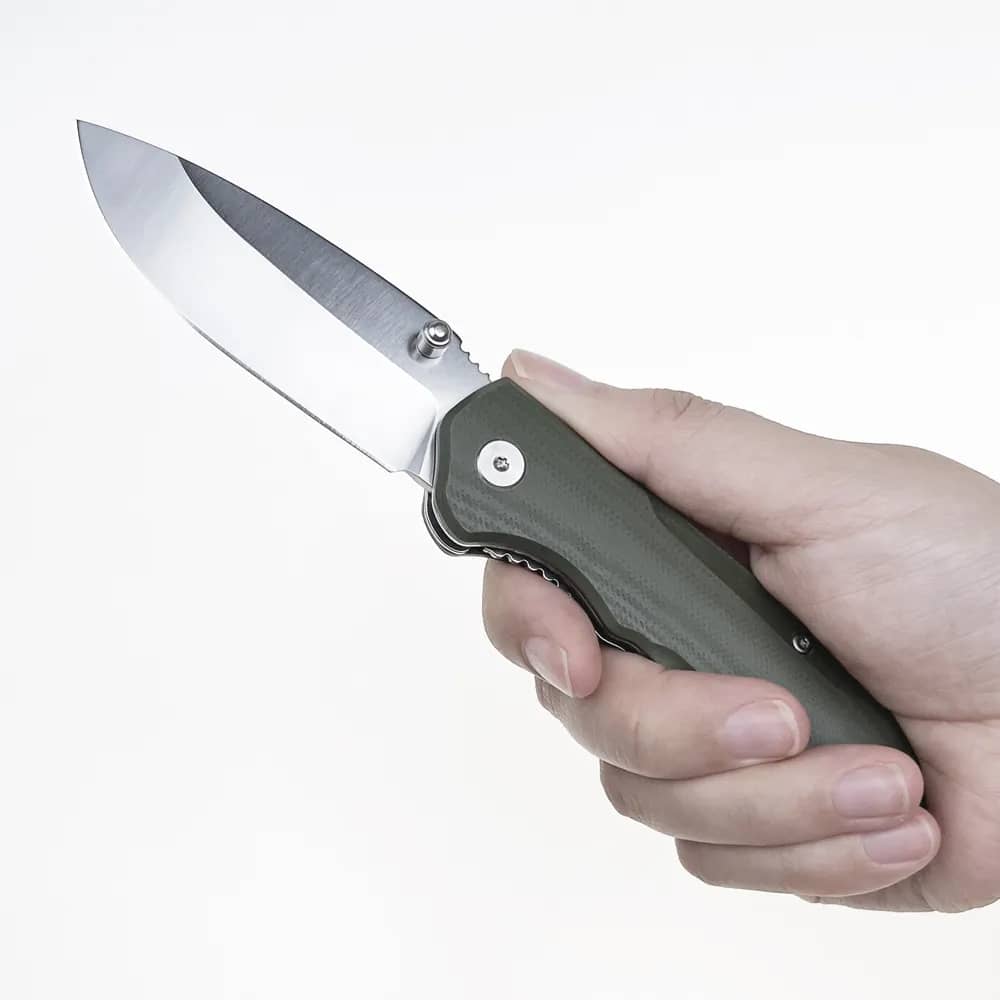
OEM Liner Lock Knife G10 Handle (3.15 Inch S90V Blade)
Sabre grinds typically produce a stronger tip. Because less steel is removed from the upper blade, the point remains thicker and less prone to breakage during piercing or prying. This is one reason tactical and survival knives often use sabre or high sabre grinds.
Full flat grinds can have thinner, more acute tips. That acute tip is excellent for detail work and precise piercing, but it is more vulnerable under side loads or when prying.
Ease of Sharpening
Both grinds are relatively easy to sharpen on flat stones or guided systems. The primary bevel of a sabre grind is shorter, so there is less surface area to work. The primary bevel of a full flat grind is longer, but it rests evenly on a whetstone.
The real difference appears when reprofiling or repairing damage. A sabre grind has more steel behind the edge, so small chips and rolls are easier to clean up without changing the geometry dramatically. A thin full flat grind requires more care to avoid overheating the edge or removing too much steel.
Manufacturing and Cost Analysis
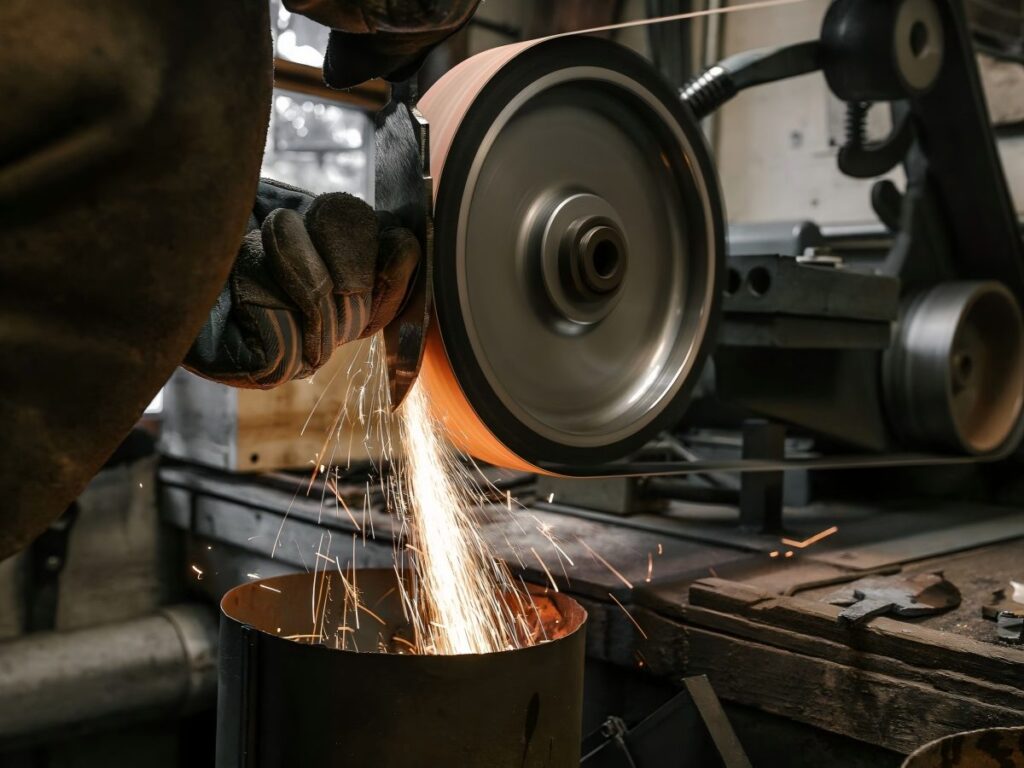
Grind choice directly impacts three things on the production floor: cycle time, material waste, and heat treatment risk.
Cycle Time
Sabre grinds run faster because the belt only contacts the lower 40–60% of the blade. Full flat grinds need the belt to traverse the entire face, increasing cycle time by 40–80% on a 6-axis CNC grinder.
| Grind | Rough Grind Passes | Finish Grind Passes | Total Cycle |
|---|---|---|---|
| Sabre | 1 | 1 | Baseline |
| Full Flat | 2–3 | 2 | +40–80% |
Material Waste
Full flat grinds remove 15–20% more stock from a 3/16″ blank. On a 1,000-blade batch, that difference adds up to measurable raw material cost.
Heat Treatment Risk
Thin full flat edges cool faster than the spine during quench, creating warp. Sabre grinds avoid this because the thick spine and edge cool more evenly.
| Grind | Typical Warp Rate | Fix |
|---|---|---|
| Sabre | ~5% | Standard oil quench |
| Full Flat (thin) | ~10–15% | Vacuum heat treatment or press quench |
Bottom Line
Sabre grinds cost less to produce. The belt touches only the lower half of the blade, so grinding finishes in fewer passes and abrasive belts last longer.
Full flat grinds need the belt to cover the entire face, adding 40–80% to cycle time and 30–50% to consumable costs. Material waste also jumps 15–20% because more stock comes off the blank.
Heat treatment widens the gap. Thin full flat edges warp more easily during quench, pushing some batches to vacuum processing. Sabre grinds tolerate standard oil quench with minimal scrap.
For a 1,000-blade run in 3/16″ stock, full flat typically adds 25–40% to unit cost over sabre. The gap narrows on thin stock where both grinds remove similar amounts of steel, but sabre still wins on cycle time.
Start Working with a Professional Now
Best Uses and Limitations
When to Choose a Full Flat Grind
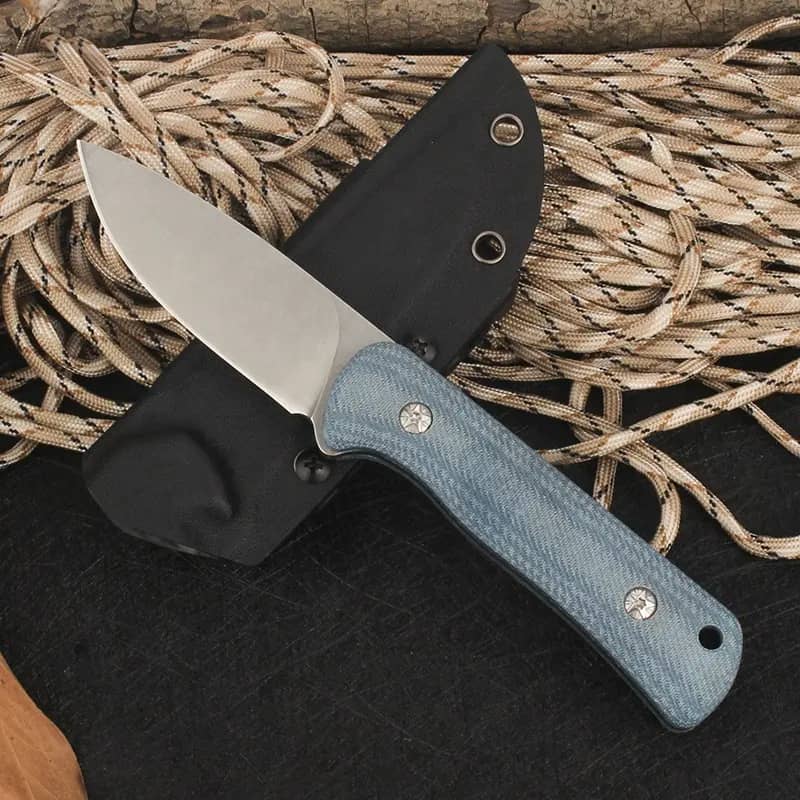
OEM Fixed Blade Knife Micarta Handle (2.95 Inch 8Cr14MoV Blade)
Full flat grinds perform best in applications where slicing, food release, and versatility matter most.
EDC Folders
Urban users open packages, cut rope, and slice fruit daily. Full flat grinds excel here because the continuous taper creates minimal drag—the blade slips through material instead of pushing it.
A thin full flat folder in 14C28N stays sharp for weeks of light use and restores quickly on a ceramic rod during a commute.
Kitchen Knives
Chefs need clean separation, not brute force. The full flat grind’s thin geometry behind the edge acts like a wedge splitting air: food falls away instead of sticking.
This matters more in a professional kitchen than edge retention, because a 30-second touch-up between prep stations beats a blade that holds an edge but glues cucumber slices to the face.
Hunting Knives
Skinning requires following curves without tearing hide. A full flat grind’s thin edge flexes slightly against bone contours, where a sabre grind’s thick geometry would skip or chatter.
The trade-off is vulnerability—hit a shoulder blade wrong and you chip—but hunters typically carry a backup sharpener and accept the risk for precision.
General Outdoor Fixed Blades
Camp chores vary: feather sticks, food prep, rope work. Full flat grinds handle all of them adequately because the geometry is neutral—no single task is optimized, but nothing is excluded. This versatility matters when you carry one blade for a weekend, not a quiver.
Limitations: Very thin full flat grinds chip on bone and metal. Thick full flat grinds wedge in pumpkins or squash. The grind works only if the steel and heat treatment match the thickness—14C28N at 61 HRC supports a thinner edge than 1095 at the same hardness.
When to Choose a Sabre Grind
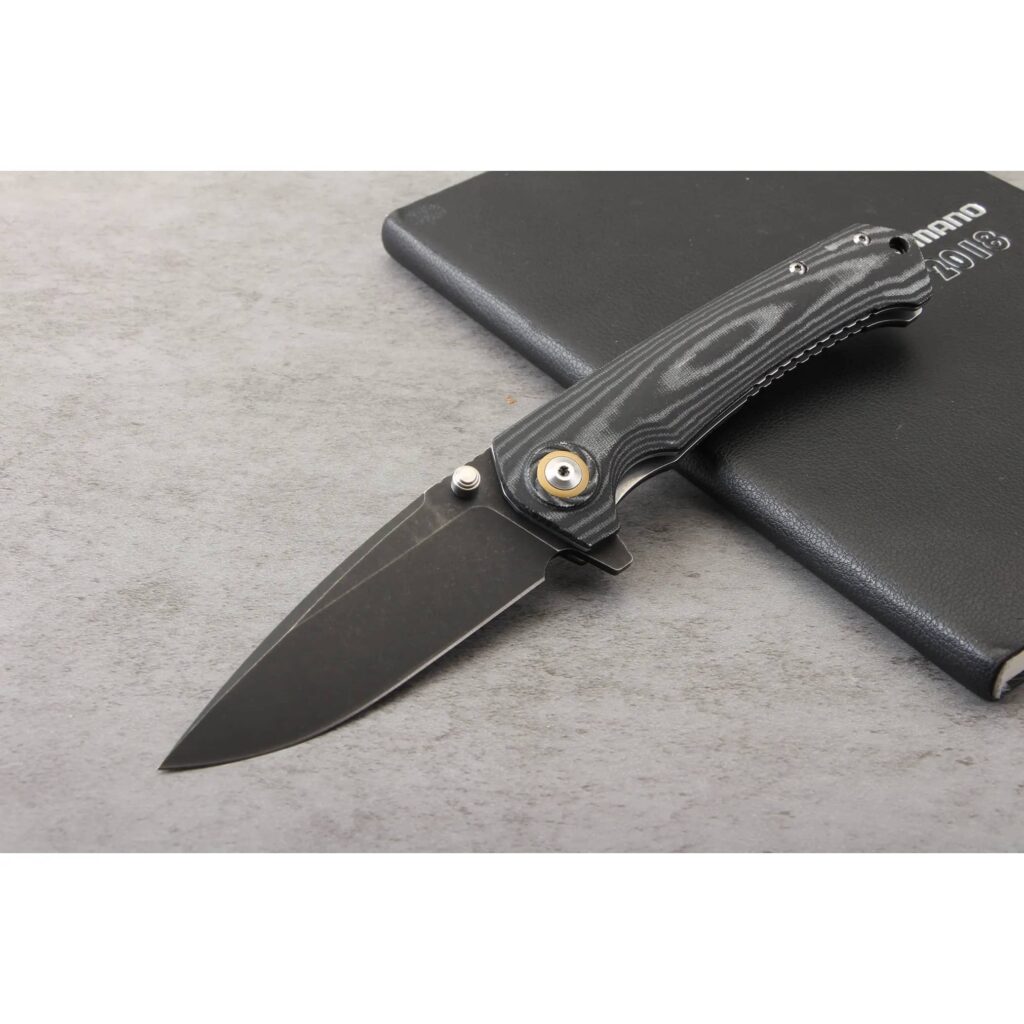
OEM Liner Lock Knife Micarta Handle (3.70 Inch D2 Blade)
Sabre grinds suit applications where strength, durability, and impact resistance matter more than pure slicing.
Tactical Fixed Blades
Tactical use is unpredictable: prying a door, chopping through drywall, hammering a window. The sabre grind’s thick edge and spine absorb impacts that would fold a full flat blade.
The geometry sacrifices slicing efficiency for survival—you cannot optimize for batoning and cardboard cutting simultaneously, and tactical users prioritize the former.
Survival Knives
Bushcraft knives spend more time on wood than flesh. The sabre grind’s partial-height bevel leaves mass in the blade’s upper half, creating forward momentum for chopping.
The thick edge also tolerates user error: a survivor sharpening on a river stone will not ruin the geometry because there is enough steel to absorb uneven angles.
Heavy Camp Knives
Fire prep means splitting kindling and batoning logs. The sabre line—the visible step where the grind begins—acts as a natural fulcrum when levering wood apart.
A full flat grind would bind because the taper starts at the spine, offering no flat surface to press against. The sabre grind’s geometry is essentially a built-in splitting wedge.
Military Designs
Ka-bar and similar designs use sabre grinds because they were specified for trench warfare and utility abuse in the 1940s. Modern military buyers expect this geometry even if their actual use is lighter, because the silhouette signals durability.
Changing to a full flat grind on a military-style knife would alienate the target market regardless of performance metrics.
Limitations: Sabre grinds wedge in dense food and fibrous rope. The thick geometry requires more force to push through material, fatiguing the user during extended cutting. For EDC buyers who open five Amazon boxes a day, a sabre grind is overbuilt and annoying.
Steel Pairing Recommendations
Grind and steel work together. The wrong combination can waste the advantages of both.
| Grind | Recommended Steels | Manufacturing Logic |
|---|---|---|
| Full flat grind (thin) | 14C28N, AEB-L, VG-10 | Predictable heat treatment, low warp risk, easy to grind |
| Full flat grind (thick) | D2, S30V, 1095 | Harder steels benefit from extra steel behind the edge; HT window manageable with thick geometry |
| Sabre grind | D2, S30V, 3V, 1095, 14C28N | Thick edge supports harder steels; wider HT tolerance |
Cost note: S35VN costs approximately 2-3x more than D2 per kg. For cost-sensitive lines, D2 with sabre grind offers better value than S35VN with full flat.
Avoid pairing very thin sabre grinds with extremely brittle steels. Even though the sabre grind adds strength, a steep, thick edge on a brittle steel can still chip if the heat treatment is not optimized.
Partner with Keganico for Your Knife Line
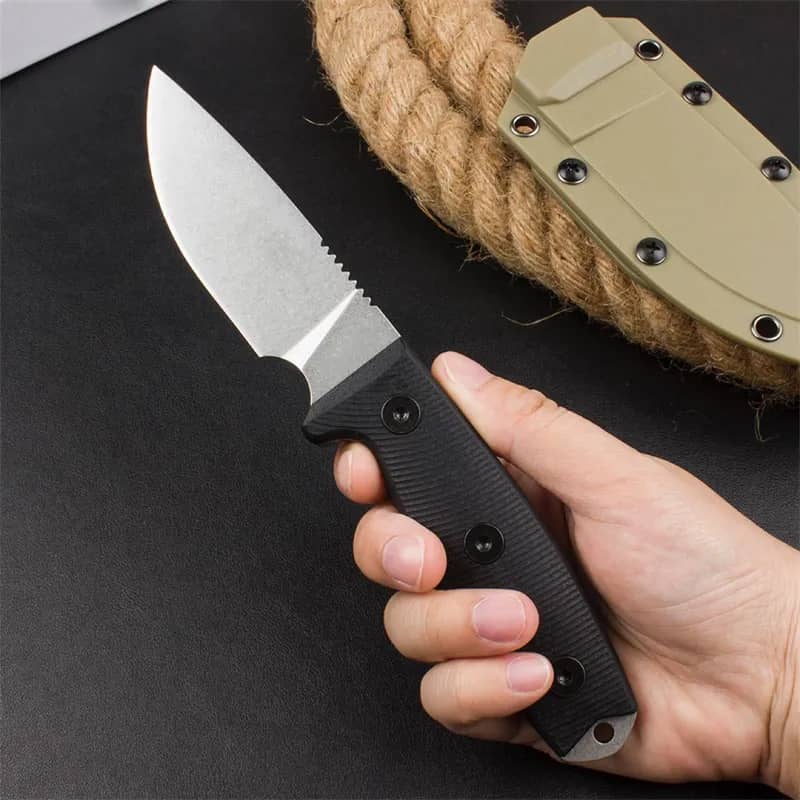
OEM Fixed Blade Knife G10 Handle (3.54 Inch 9Cr18MoV Blade)
At Keganico, we help brands specify the right grind, steel, and heat treatment for every price tier and use case. Whether you need a slicey full-flat EDC folder or a robust sabre-ground survival blade, our team can deliver consistent geometry at scale.
Our services include:
- Precision grinding for full flat, sabre, scandi, hollow, and convex grinds
- Steel selection support from budget 8Cr13MoV to premium MagnaCut and M390
- Heat-treatment process planning to match grind geometry and edge performance
- Quality control with BTE checks, edge inspection, and batch consistency reviews
We offer multiple ways to work together:
- OEM Manufacturing — Custom knives built to your specs
- Private Label Service — Market-ready designs under your brand
- Wholesale Service — Stock quality knives at competitive prices
Frequently Asked Questions
What dulls a knife the fastest?
Abrasive materials dull knives fastest. Cutting cardboard, rope with embedded grit, dirty vegetables, or wood with silica will wear an edge more quickly than clean slicing. Harder steels and thicker edge geometry generally resist dulling better than thin, soft edges.
What is the sharpest blade grind?
The hollow grind can achieve the thinnest edge and often feels sharpest because it removes the most steel behind the edge.
However, a well-sharpened full flat grind or even a thin sabre grind can also be extremely sharp. Final edge angle, steel, and heat treatment matter as much as grind type.
What angle gives you the sharpest knife?
Lower angles produce sharper edges. Most kitchen knives are sharpened between 15 and 20 degrees per side. EDC knives often use 17 to 22 degrees per side.
Tactical and outdoor knives may use 20 to 25 degrees per side for extra durability. The sharpest angle is not always the best angle if the blade will see hard use.
Is 1000 grit enough to sharpen a knife?
Yes, for many maintenance tasks. A 1000-grit stone is considered a medium grit that can restore a dull edge to working sharpness.
For very dull or damaged edges, start with 400–600 grit. For a polished, razor-like edge, finish with 3000–8000 grit or a strop.
Do you start with 400 grit or 100 when sharpening a knife?
Start with the coarsest grit needed to remove damage and establish the bevel. For a dull but undamaged edge, 800–1000 grit is enough.
For chips or rolls, 400 grit is usually better. Very coarse 100-grit stones are only needed for major reprofiling or repairing significant damage.
Is 20 or 25 degrees sharper?
A 20-degree edge is sharper than a 25-degree edge because the bevel is thinner. However, a 25-degree edge is more durable and better suited to chopping, batoning, or cutting hard materials. For general EDC and kitchen use, 20 degrees per side is a popular compromise.
Does grind choice limit blade steel selection?
Indirectly. Thin full flat grinds need steels with predictable heat treatment response to avoid warp. Thick sabre grinds tolerate a wider range of steels because the geometry itself provides edge support. For premium powder steels (S35VN, MagnaCut), we recommend vacuum heat treatment regardless of grind.
What is the minimum blade thickness for sabre grind?
We recommend 3/16″ (4.76mm) or thicker for sabre grinds. Thinner stock produces a stubby blade with limited distal taper. For 1/8″ (3.18mm) stock, full flat or high sabre grind is usually more appropriate.
How does grind geometry affect handle design?
Full flat grinds remove more steel, producing a lighter blade. This allows handle slimming for EDC comfort. Sabre grinds keep more weight in the blade, shifting the balance point forward. Handles for sabre-ground knives often need extra heft or a finger guard to balance the blade.