
CPM M4 and MagnaCut sit at the top of the premium knife steel market, and buyers weigh them against each other constantly.
Their core difference: M4 maximizes edge retention and hardness but is not stainless, while MagnaCut trades a little wear resistance for better toughness, corrosion resistance, and easier sharpening. That makes M4 a natural fit for hard-use and competition blades, and MagnaCut the default choice for EDC, outdoor, and wet-environment knives.
In this guide, we compare CPM M4 vs MagnaCut side by side — composition, hardness, real test data, cost, and best applications — so you can pick the right steel for your knife or your next OEM knife project.
What Is CPM M4 Steel?
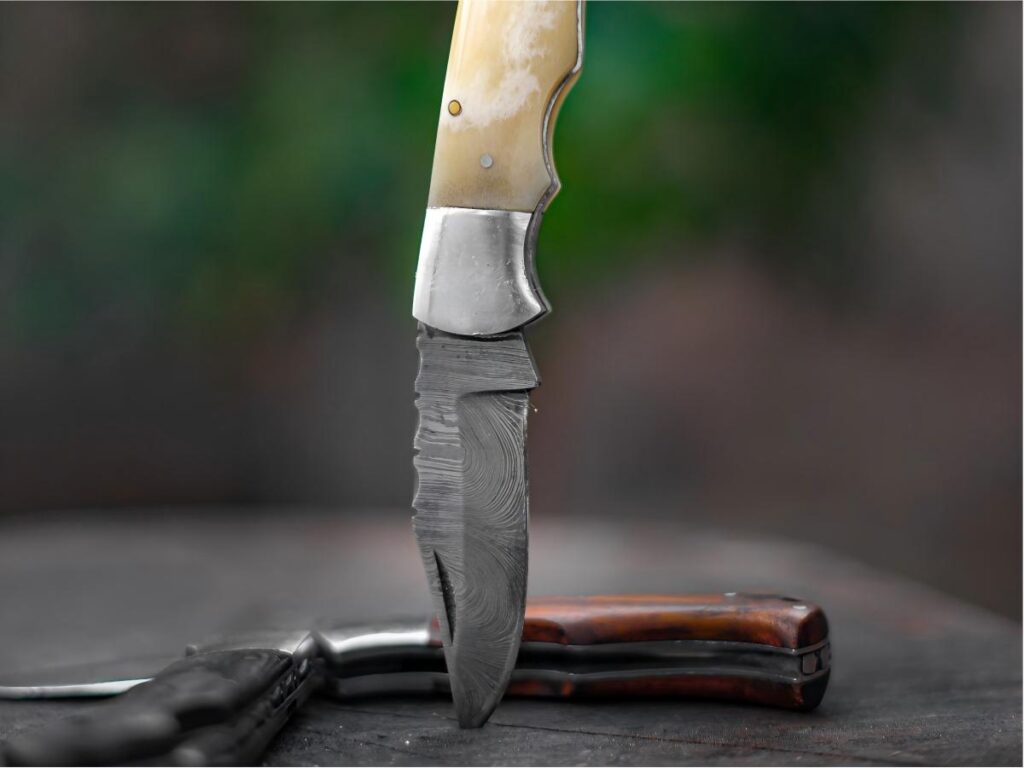
CPM M4 is Crucible Industries’ powder metallurgy version of AISI M4 high-speed tool steel — an alloy originally designed for industrial punches, dies, broaches, and milling cutters, not knives.
Its chemistry (about 1.42% carbon, 4% vanadium, 5.5% tungsten, 5.25% molybdenum) forms a dense field of hard vanadium and tungsten/molybdenum carbides, which is why it wears so slowly at 62-66 HRC. Among knife users, it is known simply as the “edge retention king.”
Benchmade and Spyderco brought M4 into knives in the mid-2000s, and it remains a favorite for hard-use folders and competition cutting blades.
Two practical notes: CPM M4 (powder metallurgy, fine carbides) is the version used in knives — not conventional ingot M4 — and its 4% chromium sits far below the stainless threshold, so it behaves more like D2 steel than like a stainless alloy when moisture is involved.
What Is CPM MagnaCut Steel?
CPM MagnaCut is a powder metallurgy stainless steel designed by metallurgist Dr. Larrin Thomas and produced by Crucible Industries, introduced in 2021.
Its key innovation is eliminating chromium carbides entirely — only fine vanadium and niobium carbides remain — so nearly all of its 10.7% chromium stays in solution and delivers true stainless behavior.
The result is a rare combination: toughness comparable to non-stainless CPM 4V, edge retention in the S35VN class, and corrosion resistance close to LC200N and Vanax.
We cover the full history, design philosophy, and test data in our dedicated MagnaCut steel review, and compare it against other popular steels in MagnaCut vs S30V and 154CM vs MagnaCut.
Chemical Composition: CPM M4 vs MagnaCut
| Element | CPM M4 | CPM MagnaCut | Role |
|---|---|---|---|
| Carbon (C) | 1.42% | 1.15% | Base hardness contributor |
| Chromium (Cr) | 4.00% | 10.70% | Corrosion resistance; carbide formation |
| Vanadium (V) | 4.00% | 4.00% | Hard vanadium carbides for wear resistance |
| Molybdenum (Mo) | 5.25% | 2.00% | Hardenability, tempering resistance, carbides |
| Tungsten (W) | 5.50% | — | Wear resistance and high-temperature hardness |
| Niobium (Nb) | — | 2.00% | Fine niobium carbides; traps carbon before chromium can |
| Nitrogen (N) | — | 0.20% | Supports hardness and corrosion resistance |
| Manganese (Mn) | 0.30% | — | Hardenability and tensile strength |
| Sulfur (S) | 0.06% | — | Machinability in larger bar sizes |
Data sources: Crucible CPM M4 data sheet, Crucible CPM MagnaCut data sheet
Two design philosophies are visible in this table. M4 loads up on carbon, vanadium, tungsten, and molybdenum to maximize carbide volume and wear resistance — a classic high-speed steel recipe.
MagnaCut takes the opposite route: lower carbon, no tungsten, and just enough niobium to lock carbon away from chromium, so its chromium stays free to fight rust.
Both steels contain 4% vanadium, but MagnaCut’s total carbide volume is far lower, which is why it grinds and sharpens so much more easily.
Performance Scorecard: CPM M4 vs MagnaCut
| Performance Indicator | CPM M4 | CPM MagnaCut | Winner & Why |
|---|---|---|---|
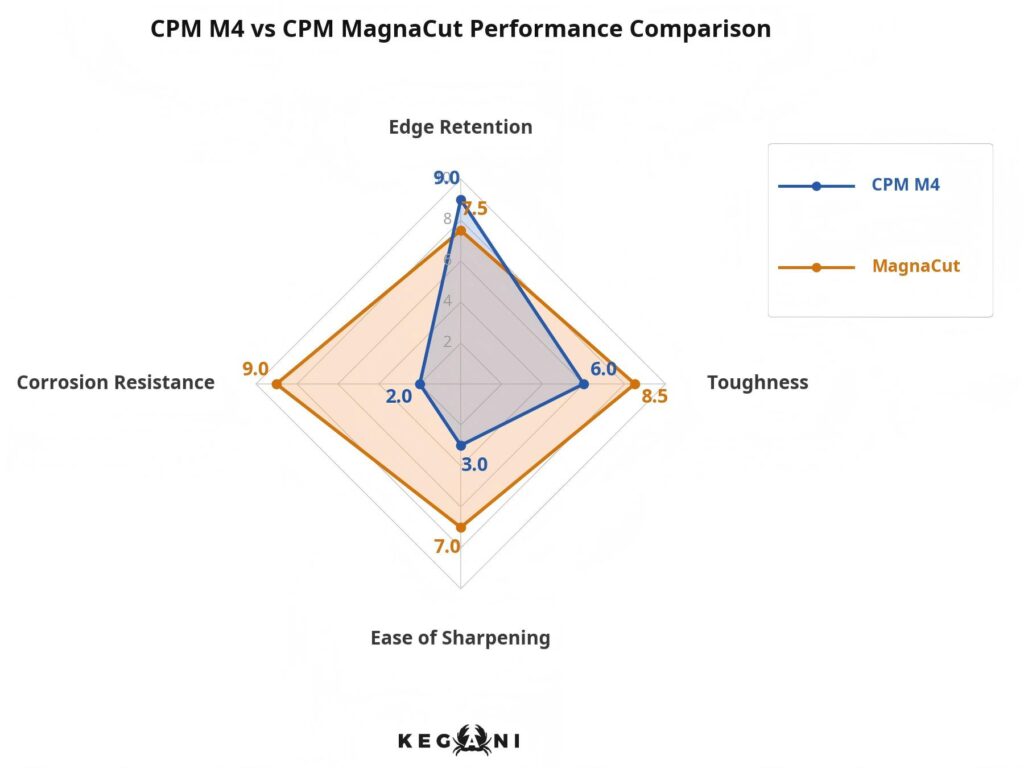
| Edge Retention | 9.0/10 (Excellent) | 7.5/10 (Very Good) | M4 – Higher carbide volume and hardness resist wear |
| Toughness | 6.0/10 (Good) | 8.5/10 (Excellent) | MagnaCut – 38 vs ~28 ft-lbs Charpy at working hardness |
| Corrosion Resistance | 2.0/10 (Poor) | 9.0/10 (Excellent) | MagnaCut – True stainless vs non-stainless tool steel |
| Ease of Sharpening | 3.0/10 (Poor) | 7.0/10 (Good) | MagnaCut – Fine carbides work on ordinary stones |
| Hardness Range | 62-66 HRC (Very High) | 60-64 HRC (High) | M4 – Higher achievable working hardness |
| Availability | Limited runs | Widely stocked | MagnaCut – Broad production vs sprint-run supply |
Scores reflect the industry consensus from published test data (Crucible data sheets, Knife Steel Nerds) and knifemaker feedback. Relative ranking matters more than the absolute number.
The scorecard shows the real shape of this comparison: M4 wins exactly one thing — edge retention — and MagnaCut wins almost everything else.
But that one thing is M4’s entire reason to exist, and for some users and product lines, it outweighs every other row. The sections below break down where each win comes from and when it matters.
Edge Retention
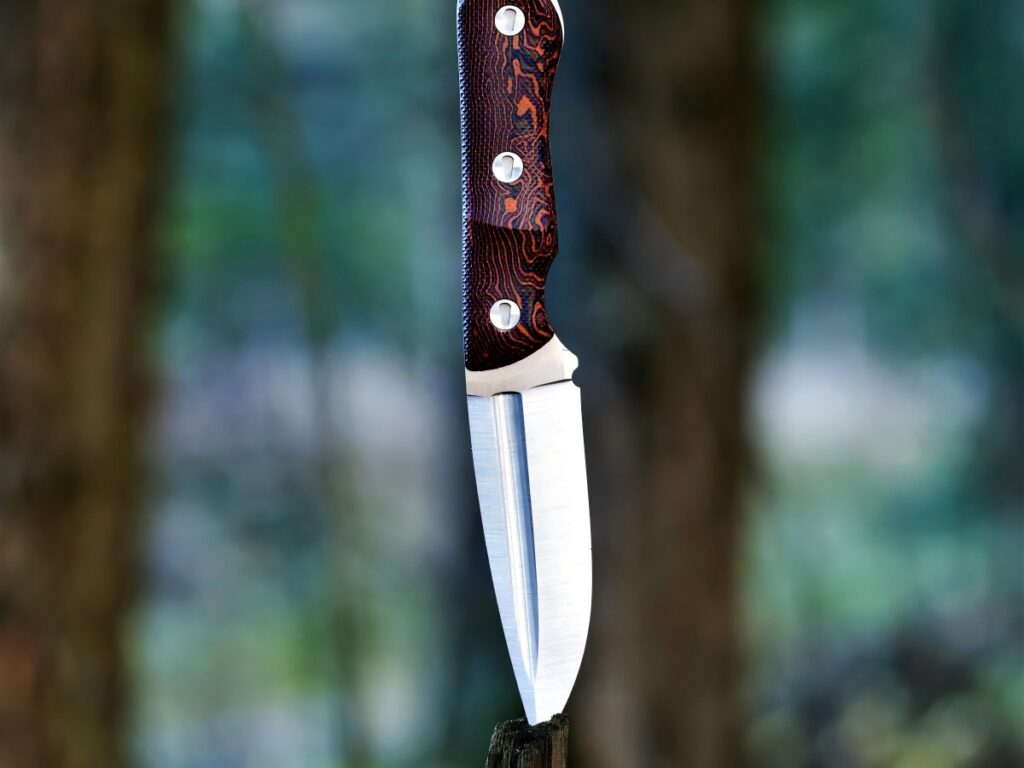
M4 holds an edge longer — the one category where it clearly beats MagnaCut. Its dense vanadium and tungsten/molybdenum carbides resist abrasive wear better than MagnaCut’s niobium-nitrogen system.
Crucible’s official CATRA data rates MagnaCut at 135% of 440C — a strong result, but below M4’s tier. In Knife Steel Nerds’ independent CATRA testing, M4 ranks near the top of all tested steels. The gap widens in abrasive cutting like cardboard and rope.
For a product line marketed on “stays sharp longest,” M4 is the stronger choice.
Toughness
MagnaCut is clearly tougher, and the lab data is not close. Crucible’s figures put MagnaCut at 38 ft-lbs Charpy at 62.5 HRC (30 ft-lbs even at 64 HRC) versus roughly 28 ft-lbs for M4 at 63.5 HRC — MagnaCut was designed to match the toughness of non-stainless CPM 4V, and it lands above M4 while remaining stainless.
In practice, thin MagnaCut edges resist chipping and rolling better during hard use, batoning, and lateral stress.
One caveat: that reputation depends on correct heat treatment. Soft or over-hard production runs lose the advantage — one widely discussed Benchmade example measured just 59.3 HRC against a 60-62 spec — so specify the hardness window and verify it batch by batch.
Corrosion Resistance
MagnaCut wins this category by the widest margin in the comparison. It passes Crucible’s 1% saltwater spray test for 72 hours without visible rust and outperforms 20CV, S35VN, and M390 — sitting close to, though slightly below, LC200N and Vanax.
M4, by contrast, is a non-stainless tool steel: users in humid climates report pitting even with reasonable care, so most production M4 knives ship with a Cerakote, DLC, or PVD coating, and owners still wipe and oil the exposed edge.
The forum consensus says it best: “Wet climate or seaside = MagnaCut. Dry climate = M4.“ For brands selling into coastal or tropical markets, this row alone usually settles the decision.
Ease of Sharpening
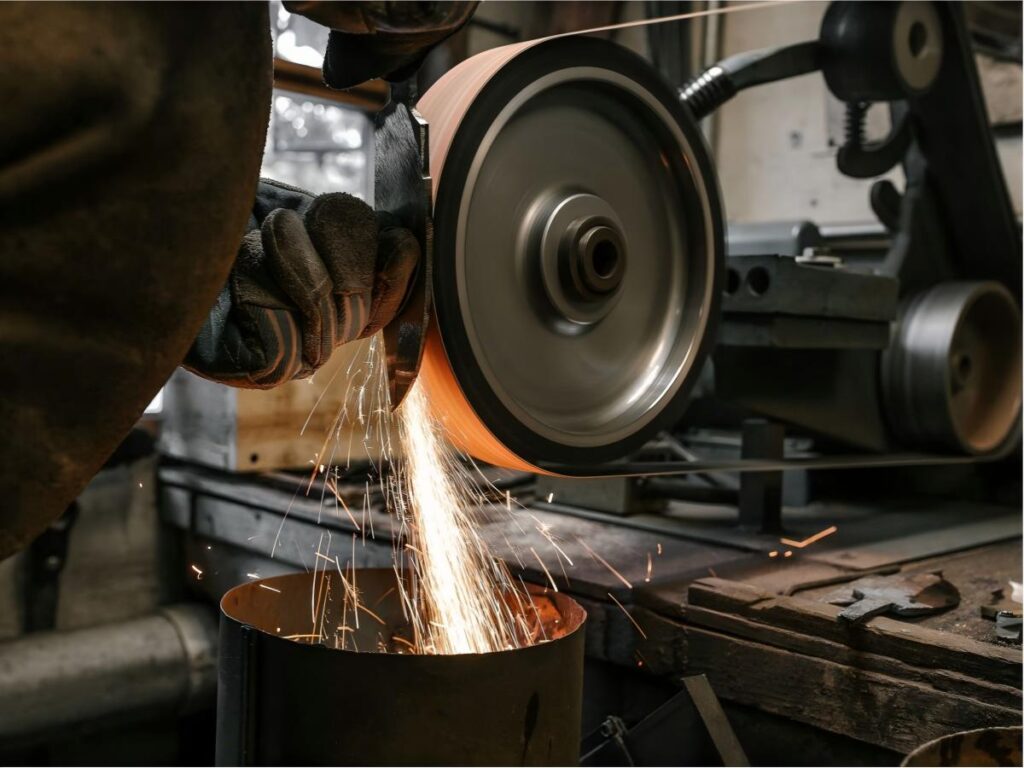
MagnaCut is dramatically easier to sharpen than M4. Its fine, low-volume carbides work on ordinary aluminum-oxide stones — even a Spyderco Sharpmaker — while M4’s hard vanadium and tungsten carbides effectively require diamond or ceramic abrasives, and field touch-ups are slow.
Crucible’s data sheets show the same gap on the factory floor: MagnaCut machines more easily than 20CV and S30V, while M4’s machinability sits around 45% of a simple carbon steel.
For OEM production, that difference shows up as grinding-belt consumption and cycle time — real money across a production run, not just a sharpening inconvenience for end users.
Hardness and Heat Treatment
M4 works harder than almost any knife steel: 62-66 HRC, with most production knives at 62-65. Execution varies by brand, and users notice — Spyderco’s M4 runs around 64-65 HRC and earns praise, while Benchmade’s M4 at 60-62 HRC draws criticism for rolling edges.
MagnaCut targets a lower window: 60-64 HRC, with Crucible recommending 60-63. Inside that window it delivers its famous balance; soft or over-hard batches draw complaints about edge retention or micro-chipping.
For bulk orders, documented heat-treatment records and batch hardness verification matter more for these two steels than for forgiving alloys like 14C28N.
Start Working with a Professional Now
Application Guide
The community consensus is consistent: the wetter the environment and the lower the user’s maintenance tolerance, the stronger the case for MagnaCut; the drier the climate and the more abrasive the cutting, the stronger the case for M4.
CPM M4: Best for Dry-Climate Hard Use and Edge-Retention-Led Lines
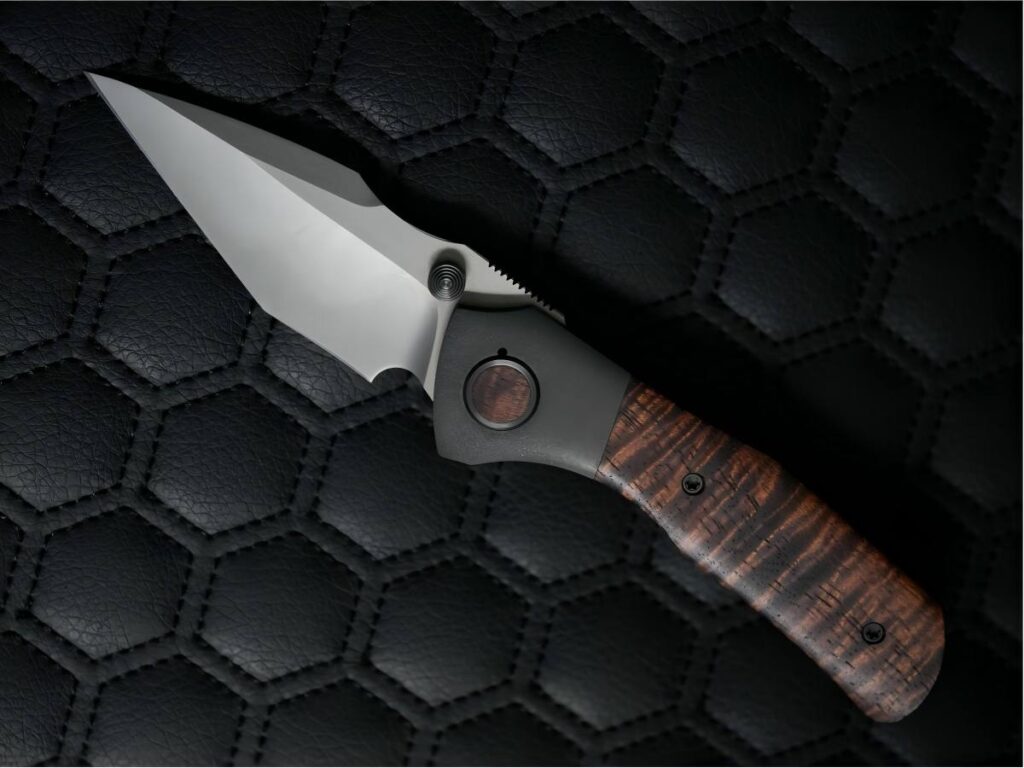
M4 shines where cutting is abrasive, maintenance is accepted, and “longest-lasting edge” is the marketing promise.
Hard-Use and Competition-Style Folders
M4’s carbide density keeps an edge working through cardboard, rope, and webbing long after simpler steels dull — the reason it dominates cutting competitions and hard-use folding knives. Pair it with a coating and clear care instructions, and it supports a genuine “edge retention king” claim at retail.
Dry-Climate Outdoor and Utility Knives
In arid regions, M4’s corrosion weakness largely disappears, leaving a nearly pure wear-resistance advantage. For fixed blade knives sold into dry markets — the American Southwest, Australia, the Middle East — an oiled or coated M4 blade offers premium edge life that customers can feel.
CPM MagnaCut: Best for Humid, Coastal, and Low-Maintenance Premium Lines
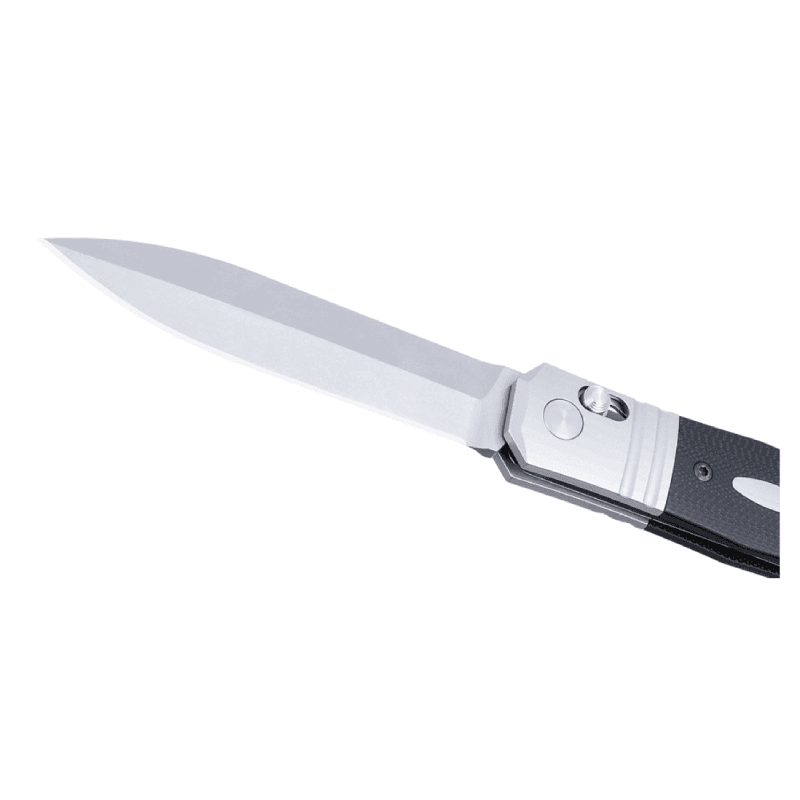
OEM Crossbar Lock Knife G10 Handle (4.06 Inch MagnaCut Blade)
MagnaCut is the safer default wherever moisture, sweat, or casual users are involved.
Humid-Climate and Coastal EDC
Daily pocket carry exposes blades to sweat and humidity — exactly what M4 cannot tolerate uncoated. MagnaCut shrugs it off, strops back easily, and generates fewer rust complaints and warranty claims. It has become the default premium steel for EDC knives for good reason.
Marine, Fishing, and Wet-Environment Knives
Salt spray is MagnaCut’s home turf among high-wear steels — 72-hour salt testing without rust puts it near LC200N territory while holding an edge far longer.
For fishing, boating, and coastal outdoor lines, it removes the coating cost and the maintenance lecture entirely. If your lineup leans toward maximum toughness instead, our MagnaCut vs CPM 3V and MagnaCut vs CruWear comparisons cover those alternatives.
Cost and Market Pricing
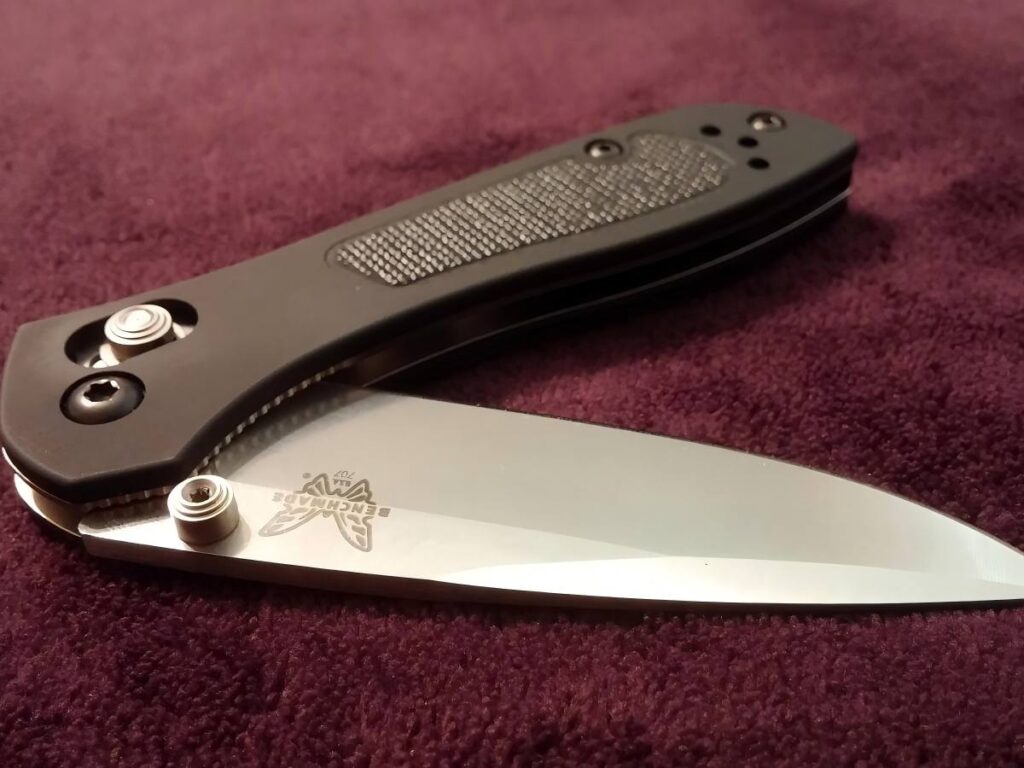
Neither steel is cheap, but they add cost in different places.
M4’s hidden cost is processing and finishing: slow grinding, high abrasive consumption, and the near-mandatory coating step (Cerakote, DLC, or PVD) to keep rust at bay.
MagnaCut’s cost is the alloy itself — a newer premium powder steel — but it machines and grinds more easily than comparable stainless steels and needs no coating.
| Cost Factor | CPM M4 | CPM MagnaCut |
|---|---|---|
| Raw material | High | High |
| Grinding/machining | Slow; high abrasive cost | Easier than 20CV/S30V |
| Coating requirement | Usually yes (Cerakote/DLC/PVD) | No |
| Supply stability | Limited runs; intermittent supply | Widely stocked |
| End-user maintenance | Higher (diamond stones, oiling) | Low (basic stones) |
| Typical retail positioning | Premium hard-use, $200-400+ | Premium all-round, $150-350+ |
At retail, Benchmade’s M4 models typically list between $200 and $400, with limited and custom M4 pieces above $500. MagnaCut now spans a wider band — from Spyderco’s modest +$10 steel upgrade to $300+ Chris Reeve and Hogue models.
One strategic note for line planning: M4 knives are mostly limited runs, while MagnaCut is in continuous production across the industry, so an M4-based line needs tighter material sourcing commitments from your manufacturing partner.
Source CPM M4 or MagnaCut Knives with Kegani
Whether your next line calls for the extreme edge retention of M4 or the stainless all-round performance of MagnaCut, Kegani can build it. From hard-use folding knives to outdoor fixed blades, we manufacture both steels into finished knives that match your market, price point, and brand positioning.
What you get when you work with Kegani:
- Full-range knife manufacturing — EDC folders, outdoor fixed blades, and tactical designs in M4, MagnaCut, and a wide range of proven steels
- Consistent quality control — batch-by-batch hardness verification and documented heat treatment, so every knife performs to spec
- Finish and coating options — stonewash, satin, Cerakote, DLC, and PVD finishes matched to your steel choice and target market
- Flexible supply programs — OEM manufacturing, private label, and wholesale supply for both small batches and large orders
Tell us your target market and price point, and we will recommend the right steel and design for your line — then prove the quality with samples before you commit to production.
Request a free quote or contact the Kegani team to start your M4 or MagnaCut knife project today.
Start Working with a Professional Now
Frequently Asked Questions
Is CPM M4 a good steel?
Yes — for the right job. CPM M4 is one of the best edge-retention steels ever put in a knife, with good toughness for a high-speed steel. Its weaknesses are equally real: it is not stainless, it rusts without care, and it demands diamond abrasives to sharpen.
If you cut abrasive materials in a dry environment and maintain your tools, M4 is excellent. If you want low-maintenance daily carry, it is the wrong steel.
Does CPM M4 steel rust?
Yes. With only 4% chromium, M4 sits far below the ~10.5% stainless threshold and will rust and pit when exposed to moisture, sweat, or humidity. Owners in humid climates report pitting even with regular care.
Prevention is simple but non-negotiable: keep the blade dry, apply a light oil film, and store it outside the sheath. Coatings like Cerakote or DLC protect the flats, but the exposed cutting edge still needs attention.
Is CPM MagnaCut a super steel?
There is no official definition, but by every informal criterion — powder metallurgy production, knife-specific design, and top-tier combined performance — MagnaCut qualifies.
It matches the toughness of non-stainless CPM 4V, holds an edge in the S35VN class, and resists corrosion better than M390. That balance, not any single record, is why the industry treats it as the current benchmark stainless steel.
Is MagnaCut steel worth it?
For most users, yes. You pay a premium over older stainless steels, but you get toughness, edge retention, and corrosion resistance in one package with no coating and no maintenance ritual.
The main exception: if you live in a dry climate, sharpen competently, and prioritize maximum edge life, M4 delivers more wear resistance for similar money. Value also depends on heat treatment — a soft production MagnaCut blade underperforms a well-treated cheaper steel.
Who makes MagnaCut steel now?
Crucible Industries in New York produces CPM MagnaCut, and Niagara Specialty Metals handles hot rolling and distribution. The alloy was designed by metallurgist Dr. Larrin Thomas and released in 2021.
Because it is a single-mill proprietary grade, supply is consistent — one reason manufacturers have adopted it so broadly across production knives.